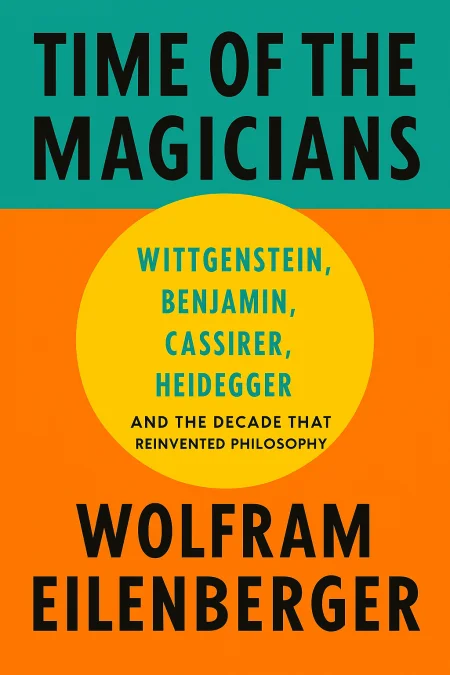
Time of the Magicians
Wittgenstein, Benjamin, Cassirer, Heidegger, and the Decade That Reinvented Philosophy
Book Edition Details
Summary
In the tumultuous aftermath of World War I, four towering intellects stand at the brink of destiny, their lives a delicate ballet of ambition and philosophy. Walter Benjamin wrestles with paternal shadows and uncertain academic footing, a critic on the edge. Ludwig Wittgenstein, heir to vast wealth, renounces material ties in a radical quest for spiritual purity. Martin Heidegger, the meteorologist who dodged the trenches, maneuvers through academia under the guidance of Edmund Husserl, shedding his Catholic skin. Meanwhile, Ernst Cassirer burns the midnight oil, poised to leap from the academic periphery to prominence. In "Time of the Magicians," Wolfram Eilenberger masterfully paints a vivid tableau of the 1920s—a decade where philosophy rewrote itself, challenging conventional thought. As these philosophers' paths converge, they lay the groundwork for ideas that will echo through history, even as the specter of another war looms. Here, amidst a backdrop of economic and artistic revolution, their narratives intertwine with figures like Keynes and Arendt, crafting a profound saga of intellectual fervor.
Introduction
In the aftermath of World War I, as Europe struggled to rebuild not just its cities but its very understanding of human existence, four brilliant minds embarked on parallel journeys that would reshape philosophy forever. Between 1919 and 1929, Ludwig Wittgenstein, Walter Benjamin, Ernst Cassirer, and Martin Heidegger each grappled with fundamental questions that the war had made urgently personal: What does it mean to be human? How should we live? What can we truly know? This extraordinary decade witnessed these thinkers wrestling with language, reality, culture, and existence itself in ways that continue to influence our world today. Wittgenstein abandoned his fortune to become a village schoolteacher while revolutionizing logic. Benjamin wandered between Berlin cafés and Parisian streets, developing theories that would inspire generations of cultural critics. Cassirer built bridges between myth and science in Hamburg's libraries. Heidegger retreated to his Black Forest hut to forge a new understanding of Being. Their ideas would influence everything from artificial intelligence to political theory, from literary criticism to psychoanalysis. These philosophical revolutionaries offer profound insights for anyone seeking to understand how human beings create meaning in times of crisis. Their struggles with authenticity, communication, and purpose speak directly to our contemporary challenges with technology, identity, and social fragmentation. This is essential reading for students, intellectuals, and thoughtful readers who want to understand how the deepest questions of human existence were reimagined in philosophy's most revolutionary decade.
Post-War Awakening: The Crisis of Meaning and New Beginnings (1919-1921)
The years immediately following World War I created an intellectual vacuum that demanded entirely new forms of thinking. Traditional philosophical systems had failed to prevent the catastrophe, leaving a generation of thinkers to rebuild understanding from the ground up. The old certainties about progress, reason, and human nature lay in ruins alongside Europe's devastated cities. Wittgenstein returned from Italian prisoner-of-war camps with his Tractus Logico-Philosophicus complete, convinced he had solved all philosophical problems through pure logic. Yet this apparent triumph left him spiritually empty. In a dramatic gesture that shocked his wealthy Viennese family, he renounced his vast inheritance and became a village schoolteacher, seeking authentic existence through honest labor and direct engagement with simple realities. His retreat from philosophy reflected a deeper conviction that life's most important truths lay beyond language's reach. Meanwhile, Benjamin struggled with his own crisis of purpose in Berlin. His doctoral thesis on Romantic criticism had opened new ways of understanding how art and thought could transform each other, but academic doors remained closed to this brilliant Jewish intellectual. His marriage crumbling and his finances precarious, Benjamin began developing his unique method of reading cultural fragments as windows into historical truth. Heidegger experienced his philosophical awakening in Freiburg, where he broke from Catholic orthodoxy to pursue what he called "the question of Being," challenging students to confront existence's fundamental mystery. These early post-war years established the intellectual frameworks that would define the decade. Each philosopher had identified the core problem—the crisis of meaning in modern life—but their proposed solutions pointed in radically different directions. Their shared recognition that philosophy could no longer remain detached from lived experience would drive them toward increasingly bold experiments in thought and life, setting the stage for the dramatic confrontations to come.
Competing Visions: Language, Reality, and Human Existence (1922-1925)
By the early 1920s, these thinkers had developed radically different approaches to philosophy's central challenge: understanding the relationship between language, thought, and reality. Their competing visions would define intellectual debates for generations to come, each offering a distinct path through the maze of modern uncertainty. Wittgenstein's village teaching years proved both transformative and torturous. His violent outbursts against slow students revealed the tension between his philosophical ideals and psychological demons, yet these years of apparent failure were preparing him for revolutionary insights about language as a form of life. Benjamin's masterful essay on Goethe's Elective Affinities demonstrated his mature critical method, reading the novel as a diagnosis of bourgeois marriage's contradictions. For Benjamin, authentic relationships required leaping beyond conventional choices into transcendent decision, while his translation work revealed language's messianic potential to approach perfect communication. Heidegger's move to Marburg marked his emergence as philosophy's rising star. His analysis of Dasein as "being-thrown-into-the-world" offered a radical alternative to traditional metaphysics. Rather than seeking eternal truths, Heidegger argued that human existence was essentially temporal, finite, and anxiety-ridden. Authentic living required confronting death's inevitability and choosing one's own possibilities. His passionate affair with student Hannah Arendt embodied the intensity he demanded from philosophical thinking. Cassirer's systematic approach provided a counterpoint to these existential philosophies. Working in Hamburg's Warburg Library, he traced how human symbolic forms evolved from myth through art to science. Rather than seeking authentic moments of decision, Cassirer celebrated culture's gradual liberation from primitive fears through increasingly sophisticated symbolic systems. His encounter with the mentally ill Aby Warburg revealed both the fragility and resilience of human meaning-making, reinforcing his faith in culture's progressive power while acknowledging the constant threat of civilizational collapse.
Personal Struggles and Philosophical Breakthroughs (1926-1928)
The middle years of the decade brought intense personal crises that deepened each philosopher's understanding of authentic existence. This period revealed how philosophical insights emerge not from abstract reasoning but from the concrete challenges of living, loving, and finding meaningful work in a disoriented world. Wittgenstein abandoned teaching to design and build a house for his sister in Vienna, finding in architecture a way to express his philosophical ideals in concrete form. The house became a meditation on precision, clarity, and the relationship between logical structure and lived space. Every detail reflected his conviction that philosophical problems arose from misunderstandings about language, and that true wisdom required not more theory but a return to ordinary uses of words in everyday life. Benjamin faced his own crisis of authenticity as his complex love affairs and financial desperation forced him to confront the relationship between personal freedom and social constraints. His relationship with the revolutionary Asja Lacis drew him toward Marxism and a critique of bourgeois culture that would define his mature work. His experiences in Naples and Moscow convinced him that meaning emerged not from cultural achievements but from the revolutionary potential hidden within apparently insignificant details of urban life. Heidegger completed Being and Time, his groundbreaking analysis of human existence that would establish him as one of the century's most influential philosophers. His concept of "authentic existence" offered a path beyond the conformity and superficiality of modern life, though critics questioned whether his radical individualism could address collective problems. The work emerged from his struggle to integrate his passionate relationship with Arendt into his philosophy of individual authenticity, revealing tensions between radical selfhood and genuine human connection. These personal crises proved philosophically productive, forcing each thinker to test their ideas against lived experience. The gap between theory and practice became a central theme, with each philosopher developing different strategies for bridging the divide between thought and life. Their struggles with authenticity would profoundly influence their mature philosophical positions and prepare them for the decade's climactic confrontation.
The Davos Confrontation: Defining the Future of Philosophy (1929)
The decade culminated in the famous debate between Cassirer and Heidegger at Davos in March 1929, a confrontation that crystallized the fundamental tensions running through the period's philosophical developments. This encounter revealed how deeply personal philosophical differences had become, and how much was at stake in choosing between different visions of human possibility. The debate ostensibly concerned Kant's philosophy, but the real issue was the future direction of European thought. Cassirer defended the Enlightenment tradition, arguing that human beings achieve freedom and dignity through participation in cultural forms that transcend individual limitations. His vision emphasized continuity, dialogue, and the gradual expansion of human possibilities through symbolic creativity. Science, art, religion, and philosophy each offered valid perspectives on reality, and cultural progress meant expanding this symbolic diversity while maintaining rational dialogue between different viewpoints. Heidegger challenged this optimistic narrative, arguing that modern technological culture had alienated humans from Being itself. Rather than celebrating symbolic diversity, he called for a return to more primordial ways of thinking that could recover authentic existence. His critique of "das Man" suggested that democratic culture promoted conformity and inauthenticity, and only through confronting anxiety and finitude could individuals achieve genuine selfhood. The student audience overwhelmingly favored Heidegger's radical critique over Cassirer's moderate humanism, reflecting broader cultural currents that would soon sweep away the Weimar Republic. Meanwhile, Benjamin and Wittgenstein pursued their own paths toward philosophical revolution. Benjamin's Arcades Project began mapping capitalism's dream-worlds through fragments of urban experience, seeking revolutionary transformation through critical interpretation of cultural ruins. Wittgenstein slowly developed his later philosophy of language games, preparing insights that would prove crucial for understanding modern culture's complexities. Both thinkers were developing approaches that would transcend the opposition between Cassirer's cultural optimism and Heidegger's existential radicalism, though their full impact wouldn't be felt until after World War II had revealed the catastrophic consequences of rejecting liberal humanism.
Summary
The philosophical revolution of 1919-1929 emerged from a fundamental crisis of meaning that followed World War I's devastation, as four brilliant thinkers developed radically new approaches to understanding human existence, language, and culture. Their competing visions continue to shape contemporary debates about authenticity, communication, technology, and political life, offering crucial insights for navigating our own moment of cultural uncertainty. The central tension running through this decade was between those who sought to preserve and extend Enlightenment values through rational dialogue and cultural pluralism, and those who demanded more radical breaks with modernity through authentic decision and primordial thinking. Cassirer's symbolic forms offered tools for navigating cultural diversity while maintaining human dignity, while Heidegger's existential analytics promised authentic selfhood but risked authoritarian implications. Benjamin's messianic materialism sought revolutionary transformation through critical interpretation, and Wittgenstein's linguistic investigations revealed both language's limits and its creative possibilities. These philosophical experiments offer three essential lessons for our current moment. First, we must recognize that meaning-making is always both individual and collective, requiring personal authenticity within shared symbolic frameworks rather than choosing between them. Second, we should embrace the creative tension between preserving valuable traditions and remaining open to transformative experiences, avoiding both nostalgic retreat and reckless innovation. Finally, we must resist the temptation to seek simple solutions to complex problems, whether through technological fixes or authoritarian promises of certainty. The magicians of 1919-1929 remind us that thinking deeply about fundamental questions remains our best hope for creating more humane ways of living together in an uncertain world.
Related Books
Download PDF & EPUB
To save this Black List summary for later, download the free PDF and EPUB. You can print it out, or read offline at your convenience.
By Wolfram Eilenberger
