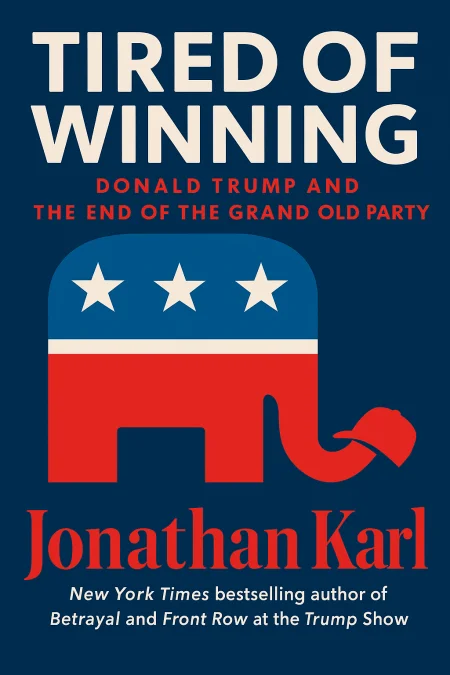
Tired of Winning
Donald Trump and the End of the Grand Old Party
Book Edition Details
Summary
In a turbulent swirl of power plays and political drama, "Tired of Winning" pulls back the curtain on Donald Trump's dramatic reinvention of the Republican Party. From the sun-soaked exile of Mar-a-Lago, Trump emerges more emboldened and unyielding than ever, casting a long shadow over the GOP's future. Jonathan Karl, with decades of firsthand experience, chronicles Trump's audacious comeback and the GOP's precarious crossroads—an existential choice that echoes Reagan's call to action from sixty years ago. Here lies a tale of ambition, vendetta, and the relentless pursuit of influence—a provocative exploration of the man who refuses to fade quietly into history.
Introduction
In the annals of American political history, few periods have tested the resilience of democratic institutions as severely as the years following Donald Trump's 2020 electoral defeat. This extraordinary chronicle reveals how a former president transformed personal grievance into a systematic assault on the very foundations of constitutional governance. Rather than accepting the peaceful transfer of power that has defined American democracy for over two centuries, Trump embarked on an unprecedented campaign to overturn legitimate election results and maintain power through increasingly desperate and destructive means. The story that unfolds offers crucial insights into three interconnected crises that continue to shape contemporary American politics. First, it illuminates how election denial evolved from desperate legal challenges into a comprehensive conspiracy theory that captured millions of Americans and fundamentally altered the Republican Party. Second, it demonstrates how democratic institutions can be weaponized by those sworn to protect them, revealing the fragility of norms that many assumed were unbreakable. Finally, it exposes the dangerous intersection of personal psychology and political power, showing how one individual's inability to accept defeat can threaten an entire democratic system. This account serves as essential reading for anyone seeking to understand how democratic backsliding occurs in established democracies, how political movements can be transformed into personality cults, and what happens when constitutional duty collides with personal loyalty. It offers both a sobering historical record and an urgent warning for citizens, political leaders, and future generations who must grapple with the lasting consequences of this unprecedented assault on American democratic traditions.
From Defeat to Defiance: Election Denial and January 6th (2020-2021)
The transformation of Donald Trump from defeated candidate to democracy-threatening force began in the immediate aftermath of the 2020 election, marking a fundamental departure from American political tradition. As vote counts confirmed his loss, Trump launched an unprecedented campaign to overturn legitimate election results through a cascade of frivolous lawsuits, pressure on state officials, and increasingly desperate schemes that culminated in the January 6th attack on the Capitol. The legal strategy revealed both the scope of Trump's desperation and the resilience of American institutions. His legal team filed dozens of cases challenging election results, losing all but one minor technical victory that changed nothing substantive. When courts failed him, Trump turned to Republican governors and state legislators, demanding they overturn certified results. Even in states where the GOP controlled both executive and legislative branches, officials refused to break the law for him, demonstrating that institutional loyalty ultimately trumped personal allegiance. The psychological dynamics driving this period proved as significant as the political ones. Trump's inner circle became a battleground between reality-based advisors urging acceptance of defeat and a growing faction of enablers who fed his delusions of victory. Figures like Rudy Giuliani and Sidney Powell promoted increasingly bizarre conspiracy theories involving foreign interference and manipulated voting machines, while traditional advisors found themselves marginalized or dismissed entirely. This created a feedback loop that reinforced Trump's detachment from reality while corrupting the broader Republican establishment. The January 6th insurrection represented the violent culmination of months of election denial and revealed the true extent of Trump's authoritarian instincts. His role in inciting the mob, his hours of inaction as democracy hung in the balance, and his eventual message telling rioters "we love you, you're very special" demonstrated a complete abandonment of constitutional duty. This day forever marked the boundary between legitimate political opposition and authoritarian assault on democratic institutions, establishing a dangerous precedent that would define his post-presidential years.
The Mar-a-Lago Years: Conspiracy Theories and Failed Comebacks (2021-2022)
Exiled from Washington but not from political relevance, Trump's Mar-a-Lago period revealed the dangerous persistence of his influence over American conservative politics. Rather than fading into post-presidential obscurity, he established his Florida resort as an alternative power center, complete with the trappings of continued authority and a steady stream of Republican pilgrims seeking his blessing. This phase was characterized by increasingly elaborate conspiracy theories and delusional schemes to return to power without another election. The "reinstatement" fantasy became the defining feature of this period, with Trump apparently believing he could somehow be restored to the presidency through various extra-constitutional mechanisms. These delusions were fed by a cast of characters including Mike Lindell, the MyPillow CEO who promised cyber evidence that never materialized, and other conspiracy theorists who gained unprecedented access to a former president. The Arizona audit conducted by Cyber Ninjas exemplified this descent into fantasy, as Trump obsessively watched livestreams of ballot counting that ultimately confirmed his defeat by an even larger margin. Perhaps most troubling was how Trump's psychological detachment from reality began to reshape the Republican Party itself. Elected officials who privately acknowledged his defeat publicly supported his lies, creating a dangerous feedback loop that reinforced his delusions while corrupting the broader political system. The party's 2022 midterm strategy became hostage to Trump's grievances, with candidate selection based more on loyalty to his false claims than on electability or governing competence, ultimately contributing to disappointing electoral results. This period also witnessed the dangerous normalization of political violence and extremist rhetoric. Trump continued to justify the January 6th rioters while making increasingly explicit threats against perceived enemies, transforming from a former president into what many observers described as the leader of a personality cult. His systematic campaign of revenge against Republicans who had crossed him revealed a man willing to destroy his own party rather than accept diminished influence, setting the stage for an even more destructive return to presidential politics.
Indictments and Insurrection: The 2024 Campaign of a Twice-Impeached President (2022-2023)
The final phase chronicled represents perhaps the most extraordinary period in American political history: a former president running for the nation's highest office while facing multiple criminal indictments. Trump's 2024 campaign launch was marked not by policy proposals or vision for the future, but by explicit promises of retribution against his enemies and the weaponization of government power for personal vengeance. His rally in Waco, Texas, with its deliberate echoes of anti-government extremism, signaled a campaign unlike any in American democratic history. The cascade of criminal charges revealed the full scope of Trump's alleged misconduct while exposing a perverse dynamic in Republican primary politics. From the Manhattan district attorney's case involving hush money payments to federal charges related to classified documents and election interference, each indictment painted a picture of a man who viewed the law as subordinate to his personal interests. Rather than diminishing his support among Republican primary voters, these legal troubles seemed only to strengthen his position, creating a situation where criminality became a badge of honor rather than disqualification. The classified documents case proved particularly damaging to Trump's claims of victimization and demonstrated his fundamental unfitness for office. Special Counsel Jack Smith's indictment revealed not just careless handling of sensitive materials, but alleged obstruction of justice and attempts to destroy evidence. The image of boxes containing America's nuclear secrets stored in a Mar-a-Lago bathroom became a symbol of Trump's cavalier attitude toward national security, yet Republican leaders largely rallied to his defense rather than demanding accountability. Most ominously, this period demonstrated Trump's complete abandonment of democratic norms and constitutional constraints. His dinner with Holocaust denier Nick Fuentes, his call for the "termination" of the Constitution, and his promise of retribution against political opponents revealed a candidate no longer bound by the basic requirements of democratic leadership. The 2024 campaign thus became not merely a contest for political power, but a referendum on whether American democracy could survive another Trump presidency and the authoritarian movement he had created.
Summary
The central thread running through this tumultuous period is the gradual but relentless erosion of democratic norms by a leader who placed personal grievance above constitutional duty. Trump's post-presidential years reveal how quickly democratic institutions can be undermined when political leaders abandon their oath to the Constitution in favor of personal loyalty to an individual. The transformation of the Republican Party from a conservative political organization into what many observers described as a personality cult demonstrates the fragility of democratic systems when faced with sustained authoritarian pressure. The historical parallels offer both instruction and warning for contemporary Americans. Like other democracies that have succumbed to authoritarian capture, the United States witnessed the gradual normalization of previously unthinkable behavior, the weaponization of grievance and victimhood, and the systematic undermining of shared truth and common facts. The pattern suggests that democratic backsliding rarely happens overnight but occurs through incremental steps that each seem manageable in isolation but collectively represent an existential threat to constitutional governance. For current and future generations, this period offers crucial lessons about the vigilance required to maintain democratic institutions. Citizens must demand accountability from their leaders regardless of party affiliation, resist the temptation to normalize abnormal behavior for short-term political gain, and understand that democracy requires active participation rather than passive observation. The institutions that ultimately protected American democracy during this crisis succeeded not because they were perfect, but because individuals within them chose constitutional duty over personal loyalty when it mattered most, providing a template for how democratic resilience can be maintained even under extreme pressure.
Related Books
Download PDF & EPUB
To save this Black List summary for later, download the free PDF and EPUB. You can print it out, or read offline at your convenience.
By Jonathan Karl
