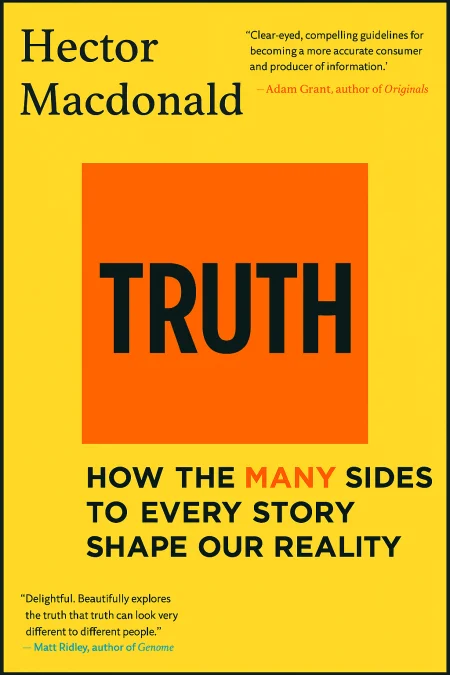
Truth
How the Many Sides to Every Story Shape Our Reality
Book Edition Details
Summary
In the labyrinth of modern life, truth often wears many masks. Hector Macdonald’s "Truth: A User’s Guide" peels back the layers, revealing how two contradictory truths can coexist, each painting a different portrait of reality. Consider the internet: a beacon of knowledge or a breeding ground for misinformation—both depictions are valid. Macdonald deftly navigates this world of “competing truths,” showing us how they shape our perceptions, from the stories spun by politicians to the narratives crafted by everyday conversations. With an engaging blend of storytelling and insightful analysis, he empowers readers to discern the truth behind the truth, arming us with the tools to become more informed citizens of a complex world. An essential read for those eager to understand the subtle power of narratives, this book offers a compelling exploration of truth’s duality in shaping our beliefs and behaviors.
Introduction
Reality appears more malleable than we typically imagine. Every day, we encounter statements that are technically accurate yet lead us toward dramatically different conclusions about the same events, people, or phenomena. These competing truths operate not through deception, but through the strategic selection and presentation of factual information. A corporate quarterly report might truthfully emphasize either growing market share or declining profit margins. A political candidate can accurately cite either rising employment or stagnating wages. A news article may focus on either the environmental benefits of renewable energy or the economic costs of transition. This strategic deployment of selective truth represents one of the most sophisticated forms of influence in modern discourse. Unlike outright falsehoods, which can be fact-checked and debunked, competing truths operate in a realm where verification confirms their accuracy while missing their broader implications. The challenge lies not in distinguishing truth from fiction, but in recognizing how different truths create different versions of reality in our minds. Each selected truth shapes our understanding, our emotional responses, and ultimately our decisions and actions. The phenomenon extends far beyond politics and journalism into every domain of human communication. Marketing professionals craft product narratives by emphasizing certain features while downplaying others. Organizational leaders inspire or discourage their teams through carefully chosen historical precedents and future projections. Even personal relationships involve the constant negotiation of which truths to highlight and which to minimize. Understanding this process becomes essential for anyone seeking to navigate modern information environments with greater awareness and discernment.
The Nature and Mechanics of Competing Truths
Most subjects possess inherent complexity that defies simple characterization. A multinational corporation like Amazon simultaneously serves as a bookstore destroyer, small business enabler, technological innovator, and employment generator. Each description remains factually accurate while producing entirely different impressions of the company's role in society. This multiplicity exists because reality itself contains numerous valid perspectives that can be emphasized or obscured depending on the communicator's objectives. The selection process operates through several distinct mechanisms. Omission represents the simplest technique, where communicators simply avoid mentioning inconvenient facts while highlighting favorable ones. Obfuscation involves burying problematic truths beneath layers of more appealing information, making it difficult for audiences to focus on potential negatives. Association tactics link unrelated but emotionally resonant information to create implied connections that may not reflect genuine causation or relevance. Context manipulation proves particularly powerful in shaping interpretation. The same statistical trend can appear alarming or reassuring depending on the timeframe selected for comparison. Historical events take on different meanings when framed as isolated incidents versus part of broader patterns. Even individual achievements or failures gain different significance when presented against various benchmarks or expectations. These techniques operate most effectively when audiences lack the time or expertise to independently evaluate the full scope of available information. Modern communication environments, characterized by information overload and shortened attention spans, create ideal conditions for competing truths to flourish. The result is that technically accurate statements can systematically mislead audiences while maintaining plausible deniability for their creators.
How Advocates and Misleaders Deploy Selective Truths
The strategic use of selective truth serves diverse purposes across different domains of human activity. Advocates employ these techniques constructively to advance beneficial causes, simplify complex issues for broader understanding, or motivate positive action. Environmental campaigners might emphasize the immediate health benefits of reduced air pollution rather than dwelling on long-term economic transition costs. Medical researchers present their findings in ways that encourage beneficial behavioral changes without overwhelming patients with technical complexities. Misleaders, by contrast, deploy similar techniques to create false impressions that serve narrow interests at the expense of broader understanding. Pharmaceutical companies may highlight positive clinical trial results while minimizing discussion of side effects or limited sample sizes. Political operatives construct narratives that technically avoid falsehood while systematically distorting public understanding of policy implications or opponent positions. The distinction between advocacy and misleading often depends on the alignment between communicator intent and audience welfare. Advocates generally seek outcomes that would benefit their audiences if those audiences possessed complete information. Misleaders pursue objectives that would likely be rejected by audiences with full knowledge of relevant facts and implications. Historical examples demonstrate how the same information can be weaponized for opposing purposes. The development of nuclear weapons can be truthfully characterized as either a technological triumph that ended World War II or a catastrophic escalation that brought humanity to the brink of extinction. The framing chosen influences public attitudes toward nuclear policy, military spending, and international relations for generations.
The Psychological and Social Impact of Truth Selection
Human psychology creates systematic vulnerabilities to competing truths that skilled communicators readily exploit. Confirmation bias leads people to accept information that reinforces existing beliefs while scrutinizing contradictory evidence more skeptically. This creates opportunities for misleaders to present selective truths that feel intuitively correct to their target audiences, even when broader evidence suggests different conclusions. Social dynamics amplify these individual psychological tendencies through group reinforcement mechanisms. When communities encounter competing truths that align with their collective identity or interests, they often embrace and propagate these messages without rigorous evaluation. Religious, political, and cultural groups can become echo chambers where particular interpretations of truth become unquestioned orthodoxy, resistant to alternative perspectives even when supported by substantial evidence. The emotional resonance of competing truths often matters more than their logical consistency or empirical support. Messages that evoke strong feelings of fear, hope, anger, or pride tend to spread more rapidly and embed more deeply in individual and collective consciousness. This creates incentives for communicators to frame their selective truths in emotionally compelling ways, even when more measured presentations might serve audiences better. Long-term consequences include the erosion of shared factual foundations necessary for democratic discourse and collaborative problem-solving. When different groups operate from incompatible sets of competing truths, they struggle to engage in productive dialogue or reach mutually acceptable compromises. This fragmentation contributes to political polarization, social conflict, and institutional dysfunction across many societies.
Defending Against Deception While Using Truth Effectively
Developing resistance to misleading competing truths requires cultivating habits of critical evaluation and information gathering. Effective defense begins with recognizing that most important issues admit multiple valid perspectives and that any single presentation likely omits relevant information. Seeking diverse sources, asking probing questions about methodological assumptions, and examining potential conflicts of interest help reveal the broader landscape of available truth. Practical verification techniques include investigating what information has been omitted, examining whether statistical presentations fairly represent underlying data, and considering whether emotional appeals substitute for logical argumentation. Understanding common manipulation techniques enables more sophisticated evaluation of persuasive communications across political, commercial, and social contexts. Simultaneously, ethical communicators can harness competing truths constructively by ensuring their selective presentations create accurate rather than distorted impressions of reality. This involves choosing truthful elements that genuinely represent broader patterns rather than cherry-picking isolated exceptions. Responsible advocacy acknowledges limitations and uncertainties while still making compelling cases for preferred courses of action. Institutional solutions require developing new forms of accountability for technically truthful but systematically misleading communication. Traditional fact-checking approaches prove inadequate when dealing with competing truths rather than outright falsehoods. Educational initiatives must teach critical thinking skills that help citizens navigate environments where truth selection rather than truth creation determines public understanding.
Summary
The manipulation of reality through selective truth represents a fundamental challenge to informed decision-making in complex societies. While the phenomenon itself is ancient, modern communication technologies and information environments have dramatically amplified both its potential impact and its sophistication. Success in navigating these conditions requires understanding that truth itself can be a weapon when divorced from context, completeness, and genuine concern for audience welfare. Rather than seeking simple rules for identifying deception, we must develop more nuanced capabilities for evaluating how partial truths combine to create comprehensive understanding or systematic distortion. This awareness becomes essential not only for protecting ourselves from manipulation but also for communicating responsibly when we possess the power to shape others' perceptions of reality.
Related Books
Download PDF & EPUB
To save this Black List summary for later, download the free PDF and EPUB. You can print it out, or read offline at your convenience.
By Hector Macdonald
