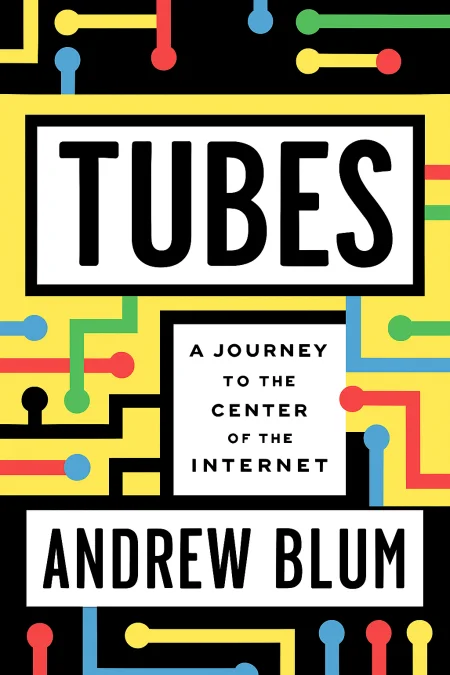
Tubes
A Journey to the Center of the Internet
Book Edition Details
Summary
Picture a world where the veins of our digital existence pulse beneath our feet, unseen and unexplored. Andrew Blum invites readers to step into the tangible heart of the Internet—a hidden labyrinth of cables and data centers that shape our daily lives. "Tubes" peels back the layers of this vast network, illuminating the mysterious pathways and hubs that connect continents. Blum's journey unveils a tactile dimension of the Internet, where dusty old telegraph buildings are reborn as vital communication centers and sleek, glass fibers shimmer with the light of information. As he travels from the storied corridors of Los Angeles to the rugged shores of Portugal, Blum reveals an Internet that is startlingly real and surprisingly human. Prepare to see your virtual world in a new light, grounded in the very earth beneath us.
Introduction
In the winter of a few years ago, when a squirrel's teeth severed an internet cable in a Brooklyn backyard, something remarkable was revealed. What seemed like a virtual, ethereal network suddenly showed its physical reality - cables, boxes, and vulnerable connections to the natural world. This moment of disruption opened a door to understanding one of the most transformative yet invisible infrastructures of our time. The internet appears to exist everywhere and nowhere simultaneously. We speak of "the cloud" as if our digital lives float in some weightless realm, yet every click, every search, every shared photo travels through very real places with specific addresses, concrete floors, and humming machines. From the first experimental connections between university computers in 1969 to today's massive data centers consuming the electricity of small cities, the internet has always been built somewhere by someone. This exploration reveals how our connected world emerged not as pure technology, but as a fundamentally human story of builders, dreamers, and pragmatists who created physical pathways for digital dreams. Perfect for anyone curious about the hidden geography that makes modern life possible, this journey uncovers the cables under streets, the buildings full of servers, and the people who keep the lights blinking in humanity's newest and most essential infrastructure.
From ARPANET to the World Wide Web (1969-1995)
The internet began not with grand vision but with practical necessity. On a quiet Saturday in September 1969, graduate students gathered in a UCLA courtyard to witness the arrival of a refrigerator-sized machine called an Interface Message Processor. This first node of ARPANET represented something unprecedented: a network designed to connect different types of computers across vast distances, funded by military research dollars but driven by academic curiosity. Leonard Kleinrock, the young professor overseeing this moment, had already theorized how data could travel efficiently in small packets rather than continuous streams. But theory became reality only through the dedication of engineers who understood that connecting networks required more than clever protocols. It demanded trust, cooperation, and a willingness to share resources across institutional boundaries. The early ARPANET directory of 1980 reads like a small town phonebook, listing five thousand people who formed the first digital community. The network's expansion followed patterns of academic collaboration and military funding, creating scattered outposts connected by expensive long-distance telephone lines. Unlike telephone networks designed for centralized control, ARPANET pioneered distributed communication where each node announced its presence to others, creating a system based on openness rather than hierarchy. This architectural choice, born from practical constraints, would become the internet's defining characteristic. By the early 1990s, the academic experiment had evolved into something approaching a public utility. The National Science Foundation lifted restrictions on commercial use, while advances in fiber optic technology made high-capacity long-distance networks economically viable. When the World Wide Web emerged from European research labs, it provided the user-friendly interface that transformed a researcher's tool into a medium for everyone. The stage was set for explosive growth that would strain every assumption about network capacity and geography.
The Dot-Com Boom and Global Network Expansion (1995-2005)
The internet's transformation from academic curiosity to commercial phenomenon created unprecedented infrastructure challenges. As millions of new users came online, the scattered nodes of early networks proved inadequate for the torrent of traffic flowing between websites, email systems, and emerging online services. The solution emerged in unexpected places: suburban office parks where competing telecommunications companies built exchange points where networks could interconnect directly. MAE-East, housed in a converted parking garage in Tysons Corner, Virginia, became the unlikely center of the internet world. Half of global internet traffic flowed through this concrete bunker, where engineers worked around the clock to prevent the network from choking on its own success. The scene exemplified the internet's paradoxical nature: a technology promising to eliminate distance was utterly dependent on specific physical locations where cables met and routers connected. The dot-com boom unleashed billions in investment capital that transformed this makeshift infrastructure into purpose-built facilities. Companies like Equinix pioneered "carrier neutral" buildings designed specifically for network interconnection, complete with backup generators, multiple fiber pathways, and the kind of redundancy that could keep the internet running even when individual components failed. These facilities spread across continents, following patterns of global commerce but creating their own geographic logic. The bubble's eventual collapse left behind a crucial legacy: a global fiber optic backbone with capacity far exceeding immediate needs. What seemed like wasteful overbuilding during the boom years provided the foundation for the internet's next phase of growth. The cheap bandwidth that resulted from this oversupply would soon enable streaming video, social networks, and cloud computing services that required massive data flows between continents. The infrastructure was ready; the applications were about to arrive.
The Rise of Data Centers and Cloud Computing (2005-2012)
As the internet evolved from a communications medium into a computing platform, the challenge shifted from connecting networks to housing the servers and storage systems that would run our digital lives. Data centers, once afterthoughts tucked into basement closets, began consuming entire warehouses and then custom-built facilities the size of aircraft hangars. Companies like Google and Facebook discovered that applications serving millions of users required infrastructure at previously unimaginable scales. The siting of these massive facilities revealed new economic and environmental pressures. Unlike network equipment that needed to be near users, servers could theoretically run anywhere with power and cooling. Entrepreneurs scoured maps for locations offering cheap electricity, favorable tax policies, and climates that minimized air conditioning costs. The Columbia River valley in Oregon became an unlikely technology hub, its hydroelectric dams and cool mountain air attracting billions in data center investment to farming communities that had never seen such industry. This geographic dispersal reflected a fundamental shift in how we interact with technology. Where early internet users dialed into local service providers who connected them to distant resources, cloud computing reversed the equation. Our devices became windows into vast computing resources that might be housed thousands of miles away. The "cloud" metaphor obscured this physical reality, encouraging users to imagine their data floating weightlessly rather than spinning on hard drives in specific buildings owned by specific companies. The economic logic driving this transformation created new forms of digital colonialism. Technology companies sought communities desperate enough for economic development to offer substantial tax incentives, then built facilities employing relatively few local workers while consuming enormous amounts of local resources. Yet these arrangements also brought previously isolated communities into the heart of global information infrastructure, creating new forms of economic interdependence that spanned from rural Oregon to urban India.
Physical Reality vs Virtual Mythology in the Digital Age
The internet's success at making distance irrelevant has paradoxically made its physical infrastructure more important than ever. Every improvement in network capacity, every expansion of cloud services, requires additional investment in cables, buildings, and cooling systems. The total electricity consumption of data centers now rivals that of entire countries, while the submarine cables carrying international traffic represent some of the largest engineering projects in human history. Understanding this physical reality challenges comfortable myths about digital dematerialization. When environmental activists track the carbon footprint of streaming video or cryptocurrency mining, they're acknowledging that virtual activities have material consequences. When governments worry about foreign control of telecommunications infrastructure, they're recognizing that information flows through specific cables owned by specific entities. The internet may feel ethereal, but it's built from copper, silicon, and concrete. This recognition carries both opportunities and responsibilities. Communities that understand how internet infrastructure works can make informed decisions about hosting data centers or demanding better broadband access. Citizens who grasp the physical nature of digital networks can engage more thoughtfully with questions about privacy, sustainability, and technological sovereignty. The internet isn't magic; it's engineering, and like all engineering, it reflects the values and priorities of those who build and control it.
Summary
The internet's evolution from experimental academic network to essential global infrastructure reveals a fundamental tension between virtual possibility and physical necessity. Every expansion of digital capability has required corresponding investment in cables, buildings, and power systems, creating a hidden geography that shapes our connected world more than most users realize. This physical foundation offers three crucial insights for navigating our digital future. First, the internet's apparent universality masks profound inequalities in access and control, as communities without adequate infrastructure remain excluded from opportunities that others take for granted. Second, the environmental costs of digital life are not abstract but concentrated in specific places where data centers and network facilities consume enormous resources. Third, the internet's dependence on physical infrastructure makes it both more vulnerable and more governable than its mythology suggests, creating opportunities for democratic oversight and community engagement. The most profound lesson may be that technology's power to transcend geography ultimately depends on our willingness to engage with geography. The internet works because people in specific places maintain the cables, power the servers, and make the daily decisions that keep information flowing. Understanding and supporting this human infrastructure may be as important as the fiber optic cables and server farms that make our connected world possible.
Related Books
Download PDF & EPUB
To save this Black List summary for later, download the free PDF and EPUB. You can print it out, or read offline at your convenience.
By Andrew Blum
