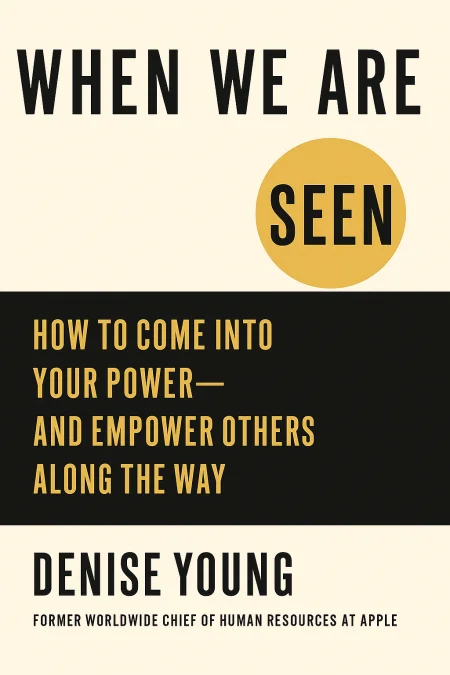
When We Are Seen
How to Come Into Your Power – and Empower Others Along the Way
Book Edition Details
Summary
In the bustling, male-dominated corridors of Silicon Valley, Denise Young emerges as a beacon of resilience and vision. Her memoir, *When We Are Seen*, is a raw, inspiring tapestry weaving her journey as a Black woman who defied the odds to become Apple's trailblazing chief of HR and architect of the Apple Store's cultural ethos. This narrative is more than just a personal history; it's a manifesto for embracing one's full identity in spaces that weren't designed to accommodate it. Young's insights are a clarion call for transformation—showing how authenticity and empathy can break cycles of exclusion and foster genuine inclusion. For anyone who has ever felt marginalized or invisible, Denise offers both solace and a strategic guide to not only survive but thrive, encouraging us all to bring our true selves into the light.
Introduction
In the gleaming halls of Apple's headquarters, Denise Young Smith stood as a quiet revolutionary, the first Black woman to reach C-suite level at one of the world's most influential technology companies. Her journey from the foothills of Colorado to the epicenter of Silicon Valley represents more than personal triumph—it embodies the profound power of being truly seen and, in turn, seeing others with clarity and compassion. Throughout her groundbreaking career, Young Smith helped shape not only Apple's legendary retail experience but also redefined what inclusive leadership could look like in corporate America. Her story unfolds against the backdrop of America's ongoing struggle with diversity and belonging, particularly in the tech industry where representation has remained stubbornly limited. As she navigated boardrooms where she was often the only person who looked like her, Young Smith developed an extraordinary ability to bridge worlds, translate experiences, and create spaces where people could thrive authentically. Through her eyes, we witness the complex dynamics of being a "first" and an "only," while discovering the transformative impact one person can have when they refuse to let others remain invisible. Her narrative reveals how the simple yet radical act of seeing people—truly seeing them—can unlock human potential, drive innovation, and ultimately change the trajectory of lives and organizations.
Finding Voice: From Colorado Springs to Corporate Halls
Growing up in Colorado Springs during the 1960s and 70s, Young Smith discovered early that being seen required more than just showing up. As often the only Black child in dance classes or academic programs, she learned to navigate spaces where her presence was both notable and questioned. Her parents, Leon and Margaret Young, deliberately exposed her to experiences that would prepare her for a world that might not readily embrace her, from classical ballet training to extensive cultural education that spanned music, art, and literature. The defining moment came when her ballet instructors, Keith and Marjorie, cast her as the Autumn Fairy in a production of Prokofiev's Cinderella. This wasn't just a role assignment—it was recognition that talent transcended conventional expectations. For a young Black girl in 1970s Colorado, dancing a principal part challenged both her own assumptions and those of her predominantly white peers. The experience taught her that being seen often requires others to look beyond surface differences and recognize authentic ability. Her education at Grambling State University, a historically Black college in Louisiana, provided a crucial counterbalance to her earlier experiences. Here, she wasn't an exception but part of a vibrant community where "everybody is somebody." The environment allowed her to develop her voice without the constant need to prove her worthiness, while professors like Miss Lee Grant challenged her to reach higher standards precisely because they saw her potential. These formative experiences created a foundation of resilience and self-awareness that would prove invaluable in her later corporate journey. Young Smith learned to code-switch naturally, moving between different cultural contexts while maintaining her authentic core. More importantly, she discovered that being seen—and seeing others—was not a luxury but a necessity for human flourishing.
Breaking Barriers: The Apple Store Revolution and Beyond
When Young Smith joined Apple in 1996, the company was struggling to find its identity in a rapidly changing technology landscape. Her initial role in talent acquisition at Apple's Colorado facility seemed modest, but it placed her at the intersection of human potential and technological innovation. Her ability to see beyond conventional hiring practices and connect with diverse talent pools caught the attention of leadership, eventually leading to her involvement in one of retail's most ambitious projects. The creation of the Apple Store represented a fundamental reimagining of how people interact with technology. As head of people and culture for the global retail operation, Young Smith helped architect an experience that prioritized human connection over mere transactions. She understood that customers needed to feel seen and valued, not intimidated by technology. This philosophy extended to employees, who were empowered to build genuine relationships with customers rather than simply process sales. Her approach challenged traditional retail models that treated staff as interchangeable parts. Instead, she championed hiring based on curiosity, empathy, and communication skills—qualities that couldn't be easily measured but made all the difference in customer experience. The Apple Store's distinctive culture of learning, growth, and mutual respect became a model studied by retailers worldwide. The success of this human-centered approach validated Young Smith's core belief that seeing people authentically drives better business outcomes. When employees feel valued and understood, they naturally extend that same care to customers. When customers feel seen rather than sold to, they develop lasting relationships with brands. This virtuous cycle became central to Apple's retail success and demonstrated how inclusive leadership could create both human fulfillment and commercial achievement.
The Burden of Being First: Navigating Isolation and Impact
Rising through Apple's ranks as a "first" and often "only" brought unique challenges that extended far beyond typical corporate pressures. Young Smith carried the weight of representation, knowing that her successes and failures would be viewed as reflective of her entire community's capabilities. This burden manifested in countless small moments—being the sole voice in rooms where decisions affecting millions were made, fielding questions about diversity that were rarely asked of her white male peers, and constantly translating between different cultural perspectives. The isolation of leadership was compounded by the isolation of difference. While her colleagues could find mentors and role models who shared their backgrounds, Young Smith had to chart largely unnavigated territory. She learned to draw strength from historical examples and community connections outside of work, maintaining ties to HBCU networks and cultural organizations that provided grounding and perspective. Perhaps most challenging was the expectation to be both exceptional and invisible—to succeed without making others uncomfortable about what her success might mean for traditional power structures. She discovered that excellence could sometimes generate resentment rather than respect, particularly when it challenged assumptions about who belonged in positions of influence. The careful balance required to push boundaries while remaining politically viable demanded enormous emotional intelligence and personal resilience. Yet Young Smith also recognized the profound impact of her visibility. Black employees throughout Apple and the broader tech industry found inspiration in her presence, even when they never interacted directly. Her ascension created permission for others to dream bigger and provided concrete evidence that advancement was possible. The responsibility was heavy, but the potential to open doors for those who would follow made the burden meaningful.
Reclaiming Power: The Art of Seeing and Being Seen
In her most senior roles at Apple, including her tenure as the company's first VP of Inclusion and Diversity, Young Smith confronted the complex dynamics of organizational change. She discovered that creating inclusive cultures required more than policy changes or training programs—it demanded a fundamental shift in how people saw each other and themselves. Her work focused on helping leaders understand that diversity wasn't about quotas or charity but about unlocking the full potential of human talent. The challenge proved more formidable than anticipated. Despite good intentions, many leaders struggled to move beyond surface-level commitments to diversity toward the deeper work of examining their own biases and blind spots. Young Smith found herself in the familiar position of having to educate while avoiding threatening those whose support she needed. The irony wasn't lost on her that she was expected to solve problems she hadn't created while working within systems that had historically excluded people like her. Her departure from Apple after more than two decades marked not an ending but a transformation. She recognized that her voice had been somewhat muted by corporate constraints and that she could potentially have greater impact by reclaiming her narrative and speaking more directly about the experiences of being a "first" and "only." Her subsequent work as an executive in residence at Cornell Tech, board leadership at SFJAZZ, and continued advocacy for inclusive leadership represented a new chapter in using her platform. The lessons she carried forward were profound in their simplicity. True power lies not in forcing others to see you but in developing the courage to see yourself clearly and authentically. When we know our own worth and story, we become less dependent on external validation and more capable of creating change from a position of inner strength. Most importantly, the act of truly seeing others—understanding their experiences, challenges, and potential—becomes both a moral imperative and a practical strategy for building the kind of world where everyone can thrive.
Summary
Denise Young Smith's journey from Colorado Springs to Silicon Valley's highest echelons illuminates a fundamental truth about human potential: we all flourish most fully when we are truly seen and valued for who we are. Her story demonstrates that breaking barriers isn't just about individual achievement but about creating pathways for others to follow, transforming organizational cultures one authentic interaction at a time. Through her experiences as a pioneering executive in one of the world's most influential companies, she reveals how the simple yet radical act of seeing people—really seeing them—can unlock innovation, drive business success, and create more equitable workplaces. For anyone who has ever felt invisible, overlooked, or undervalued in their professional or personal life, Young Smith's narrative offers both validation and hope. Her insights remind us that we all have the power to see others more clearly and, in doing so, contribute to a world where talent can emerge from anywhere and thrive everywhere. Her legacy extends an invitation to examine our own capacity for seeing and being seen, challenging us to move beyond surface-level diversity initiatives toward the deeper work of creating genuine belonging and inclusive excellence.
Related Books
Download PDF & EPUB
To save this Black List summary for later, download the free PDF and EPUB. You can print it out, or read offline at your convenience.
By Denise Young
