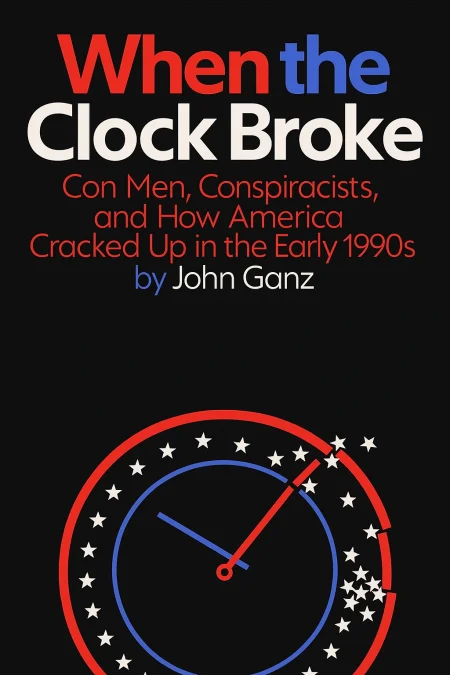
When the Clock Broke
Con Men, Conspiracists, and How America Cracked Up in the Early 1990s
Book Edition Details
Summary
In the twilight of the Reagan era, America stood at a crossroads—a nation poised on the brink of profound transformation and turmoil. "When the Clock Broke" by John Ganz is a riveting chronicle of a nation grappling with its own identity in the shadow of a Cold War victory. Amidst promises of a gentler society, the early '90s instead witnessed a surge of divisive energy: from racial tensions in urban centers to the rise of populist firebrands like Pat Buchanan and Ross Perot. As Rush Limbaugh's broadcasts echoed through the airwaves and survivalists bunkered down in the heartland, a new political landscape emerged. Ganz deftly captures the fierce ideological clashes that foretold today's polarized climate, illuminating how the seeds of contemporary discontent were sown. With a dynamic narrative pulse, this book unveils the turbulent birth of modern America, a land caught between its past triumphs and the stormy path ahead.
Introduction
In the winter of 1991, as America celebrated its Cold War victory, a different kind of revolution was brewing in the heartland. From Louisiana's bayous to New Hampshire's factory towns, millions of citizens who felt abandoned by their own government were turning against the very institutions that had guided the nation through decades of prosperity. This period reveals how quickly democratic societies can fracture when economic security evaporates and cultural certainties crumble. The early 1990s witnessed the emergence of political forces that would reshape American conservatism for generations. David Duke's shocking electoral success, Pat Buchanan's insurgent presidential campaign, the rise of talk radio demagogues, and Ross Perot's billionaire populism all signaled the birth of a new politics based on grievance, nostalgia, and the promise to reclaim a country that seemed to be slipping away. These years saw the collapse of the post-war consensus and the rise of anti-establishment movements that would define American political discourse for decades to come. For anyone seeking to understand how American politics became so polarized and angry, this era provides essential lessons. The seeds of today's political upheavals were planted when old certainties collapsed and new forms of populist rebellion took root, forever changing the relationship between citizens and their government.
Economic Collapse and the Rise of Outsider Politics (1989-1991)
The recession that officially began in July 1990 was more than a statistical downturn; it represented the end of an era when middle-class Americans could expect their children to live better lives. As the Berlin Wall fell and the Soviet Union collapsed, Americans expected a peace dividend that never materialized. Instead, they found themselves trapped in an economic crisis that mocked the triumphant rhetoric of the Reagan years. The savings and loan crisis had wiped out billions in wealth, while corporate downsizing eliminated jobs that had once seemed secure. Into this vacuum stepped unlikely figures who would reshape American politics. In Louisiana, David Duke's election to the state legislature in 1989 sent shockwaves through the political establishment. The former Klansman's success came not despite his racist past, but because of it. Voters devastated by the oil bust found in Duke a champion who promised to restore their sense of superiority and belonging. His ability to sanitize extremism for mainstream consumption, replacing white robes with business suits while dog-whistling to deeper racial anxieties, made him particularly dangerous. Pat Buchanan emerged as another voice of discontent, launching a primary challenge against President Bush that tapped into working-class resentment over trade deals and cultural changes. His "America First" message resonated with voters who felt abandoned by globalization. When Buchanan declared that "the peasants are coming with pitchforks," he captured something profound about the electorate's mood. His surprising showing in New Hampshire, capturing 37 percent of the vote against a sitting president, proved that significant portions of the Republican base were ready for a more radical message. The rise of talk radio provided the perfect medium for this growing discontent. Rush Limbaugh's show became a daily gathering place for Americans who felt abandoned by both political parties, creating what scholars would later recognize as "negative solidarity" - communities bound together not by shared values but by shared enemies. These economic and cultural anxieties would only intensify, setting the stage for even more dramatic political upheavals.
Cultural Wars and Institutional Breakdown (1991-1992)
The year 1992 transformed simmering cultural tensions into open warfare that would define American politics for generations. The acquittal of four Los Angeles police officers in the beating of Rodney King sparked devastating urban riots, revealing the depth of racial divisions that many Americans had preferred to ignore. The flames that consumed South Central Los Angeles became a symbol of a nation coming apart at the seams, exposing the inadequacy of traditional law enforcement responses to deep-seated social problems. These racial tensions intersected with broader cultural conflicts over the changing nature of American society. The Murphy Brown controversy, triggered by Vice President Dan Quayle's criticism of the television character's single motherhood, crystallized debates about family values that went far beyond entertainment. Conservative voices argued that the breakdown of traditional families was destroying American civilization, while liberals saw such arguments as thinly veiled attacks on women's autonomy and minority communities. The culture wars extended into every aspect of American life, from university campuses where battles raged over political correctness to art galleries where taxpayer-funded exhibitions sparked outrage among religious conservatives. Pat Buchanan's declaration of a "religious war" for "the soul of America" captured the apocalyptic tone that increasingly characterized political discourse. These weren't merely policy disagreements but existential struggles over what kind of nation America would become. Perhaps most significantly, these cultural battles began to reshape how Americans understood race and politics. Bill Clinton's calculated confrontation with rapper Sister Souljah demonstrated how even liberal politicians felt compelled to distance themselves from Black radicalism to appeal to white voters. The emergence of identity politics created new forms of solidarity and division that cut across traditional party lines, establishing patterns of polarization that would dominate American political discourse for decades to come.
Violence, Media, and the New Political Order (1992)
The breakdown of social order in 1992 reached its most dramatic expression in the Los Angeles riots, which lasted six days and resulted in 63 deaths. The uprising was both a spontaneous explosion of rage and a media spectacle that transformed how Americans understood urban crisis and racial conflict. The videotaped beating of Rodney King had seemed to provide incontrovertible evidence of police brutality, yet the Simi Valley jury's acquittal demonstrated the persistence of racial bias in the justice system. The violence extended beyond Los Angeles to places like Ruby Ridge, Idaho, where federal agents' siege of the Weaver family compound resulted in multiple deaths and galvanized anti-government sentiment. These confrontations between government forces and armed citizens reflected growing distrust of federal authority and the emergence of anti-government extremism. The incident provided a template for future confrontations and became a rallying cry for militia movements and conspiracy theorists who saw their own government as the primary threat to American freedom. The intersection of media coverage, political rhetoric, and actual violence created a feedback loop that amplified social tensions and made peaceful resolution increasingly difficult. Chief Daryl Gates of the Los Angeles Police Department became a symbol of the militarized approach to urban policing that saw communities as battlegrounds rather than neighborhoods to be served. His philosophy of the "thin blue line" between civilization and chaos reflected a worldview that would influence law enforcement for decades. These events demonstrated how quickly democratic institutions could be overwhelmed when economic anxiety merged with cultural upheaval and political dysfunction. The seeds of militia movements, conspiracy theories, and anti-government extremism that would plague American politics for decades can be traced back to the angry rhetoric and apocalyptic visions that emerged from this crisis year. The breakdown of shared narratives and common institutions made democratic governance increasingly difficult as citizens lost faith in the very idea of a common good.
The Birth of Anti-Establishment America
By the end of 1992, the American political system had been fundamentally transformed by the forces unleashed during this tumultuous period. Ross Perot's independent candidacy represented the ultimate expression of anti-establishment anger, as the Texas billionaire built a national movement almost overnight using new media technologies. His folksy charts and graphs promised simple solutions to complex problems, while his focus on the federal deficit resonated with Americans who understood that something was fundamentally wrong with the nation's finances. Perot's genius lay in understanding how media fragmentation had created new possibilities for political insurgency. His appearances on talk shows allowed him to bypass traditional gatekeepers and speak directly to frustrated voters. When he challenged Americans to put him on the ballot in all fifty states, volunteers across the country organized petition drives with religious fervor, convinced they were participating in a historic mission to save their country. By summer 1992, he was leading both Bush and Clinton in polls, an unprecedented achievement for a third-party candidate. The Republican Party was forced to confront the populist insurgency that Buchanan had unleashed. The Houston convention's embrace of culture war themes, particularly Buchanan's inflammatory speech about "taking back our culture," revealed internal tensions between the establishment wing and an increasingly militant base. These divisions would continue to shape Republican politics for decades, as the party struggled to contain forces it had helped unleash through years of racial dog-whistling and anti-government rhetoric. The infrastructure and energy created by these movements would persist long after the 1992 election ended, contributing to ongoing challenges to traditional party structures and political norms. The template established by figures like Duke, Buchanan, and Perot would inspire imitators for decades to come, culminating in movements that would make their rebellion look tame by comparison. The birth of anti-establishment America in this period marked the beginning of a new era in which outsiders could mobilize mass movements against the very foundations of democratic governance.
Summary
The crisis of 1989-1992 revealed the fundamental tension between America's democratic ideals and the reality of a society increasingly divided by race, class, and culture. What should have been the nation's moment of triumph after winning the Cold War instead became a period of profound questioning about America's direction and identity. The central contradiction of this era was that victory abroad coincided with crisis at home, as economic stagnation and cultural anxiety created space for political entrepreneurs who promised radical solutions to complex problems. These years established patterns that would define American politics for generations: the rise of media-savvy demagogues who could bypass traditional gatekeepers, the transformation of conservatism from a philosophy of order into a vehicle for populist rage, and the emergence of politics based on grievance rather than governance. The figures who emerged during this period pioneered techniques of political mobilization that would be perfected by later movements, while the breakdown of shared institutions and common narratives made democratic consensus increasingly elusive. Understanding this era's legacy suggests that Americans must rebuild economic institutions that provide genuine opportunity for working families, find ways to acknowledge cultural differences while maintaining shared civic values, and restore faith in democratic institutions by making them more responsive to ordinary citizens. The alternative, as this period demonstrated, is a politics of permanent crisis where demagogues thrive and democratic norms erode, threatening the very foundations of American self-governance.
Related Books
Download PDF & EPUB
To save this Black List summary for later, download the free PDF and EPUB. You can print it out, or read offline at your convenience.
By John Ganz
