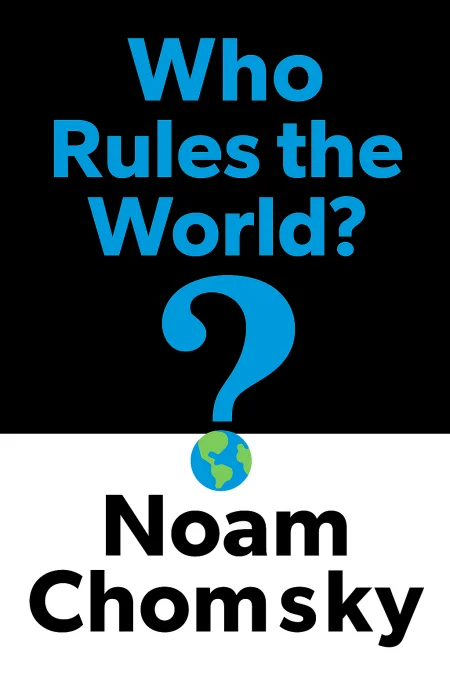
Who Rules the World?
Explore the Hidden Powers That Govern Our World Today
Book Edition Details
Summary
The stage is set for an intense geopolitical ballet as Noam Chomsky dismantles the facade of America's global hegemony in "Who Rules the World." Through a tapestry of historical and contemporary narratives—from Cuba's shadows to Iran's sanctioned strife—Chomsky exposes the chasm between the U.S.'s proclaimed ideals and its practiced politics. With razor-sharp insight, he navigates the tangled web of Middle Eastern conflicts and scrutinizes the power dynamics that shape our volatile world. The specter of Donald Trump's election looms large, casting new light on the intricacies of American society. This piercing critique reveals how entrenched elites engineer the global stage to serve their interests, challenging readers to question the forces steering humanity's course.
Introduction
The question of who truly governs global affairs reveals a complex web of power structures that extend far beyond traditional notions of democratic representation. While public discourse often focuses on electoral politics and diplomatic ceremonies, the actual mechanisms of control operate through less visible channels involving corporate interests, military establishments, and elite networks that span both public and private sectors. These power brokers shape international relations, economic policies, and social outcomes in ways that frequently contradict stated democratic principles and popular preferences. The analysis presented here employs a systematic examination of declassified documents, policy outcomes, and historical patterns to expose the gap between official rhetoric and actual practice in global governance. Rather than accepting conventional explanations about national security, humanitarian intervention, or free market dynamics, this investigation traces the consistent threads of elite interest that run through seemingly disparate events and policies. The approach challenges readers to look beyond surface-level political theater and examine the structural forces that determine how resources are allocated, conflicts are managed, and societies are organized on a planetary scale.
The Architecture of American Hegemony: Military, Economic and Ideological Control
American global dominance operates through a sophisticated system of economic, military, and ideological control that extends far beyond traditional concepts of territorial empire. The foundation of this hegemony was established during World War II when U.S. planners recognized that the country would emerge with unprecedented global power. They developed the concept of a "Grand Area" encompassing the Western Hemisphere, the Far East, and the former British Empire, with the United States maintaining "unquestioned power" and ensuring the "limitation of any exercise of sovereignty" by states that might interfere with American designs. This system functions through multiple interconnected mechanisms. Military bases and intervention forces project power globally, while economic institutions like the International Monetary Fund and World Trade Organization enforce policies favorable to American corporate interests. The doctrine of "humanitarian intervention" provides ideological cover for actions that serve strategic purposes, while massive propaganda operations shape public opinion both domestically and internationally. When direct control proves impossible, the system relies on client regimes and proxy forces to maintain favorable conditions for American interests. The persistence of this hegemonic structure becomes evident when examining policy continuity across different administrations and changing global circumstances. Even after the collapse of the Soviet Union eliminated the primary stated justification for American military dominance, the essential framework remained intact with new pretexts substituted for old ones. The "war on terror" replaced the Cold War as the organizing principle, but the underlying commitment to global dominance continued unchanged. What distinguishes this form of hegemony from historical empires is its ability to present itself as a force for freedom and democracy while systematically undermining both whenever they conflict with elite interests. This contradiction is managed through sophisticated information control and the cultivation of intellectual classes who provide legitimizing narratives for policies that serve narrow interests at the expense of broader human welfare.
Manufacturing Consent: How Media and Propaganda Enable Imperial Policies
Public support for imperial policies requires sophisticated propaganda systems that shape popular understanding of international events. The manufacturing of consent operates through selective reporting, framing techniques, and the systematic exclusion of perspectives that might challenge official narratives. Media institutions, while maintaining an appearance of independence, consistently promote interpretations that align with state and corporate interests. The concept of terrorism provides a particularly clear example of how language and selective focus serve imperial objectives. Acts of violence by official enemies receive extensive coverage and moral condemnation, while comparable or greater violence by the United States and its allies is either ignored, justified as necessary, or reframed as defensive measures. This double standard creates a moral framework that legitimizes American violence while delegitimizing resistance to American policies. Democratic discourse becomes constrained within narrow parameters that exclude fundamental questions about the legitimacy of imperial policies. Elections offer choices between candidates who share basic assumptions about American global leadership, while genuine alternatives that might challenge corporate power or imperial ambitions remain marginalized. Public opinion polls consistently show popular opposition to many military interventions and corporate-friendly policies, yet these preferences have minimal impact on actual policy decisions. The educational system reinforces these patterns by presenting American history and foreign policy through frameworks that emphasize benevolent intentions while minimizing or ignoring the systematic pursuit of economic and strategic advantages. Historical events are interpreted through narratives of American exceptionalism that make current policies appear as natural extensions of democratic values rather than expressions of imperial ambition.
From Cold War to Terror War: Patterns of Global Intervention
American military interventions since World War II reveal consistent patterns that contradict official justifications based on democracy promotion, human rights, or security threats. Analysis of specific cases demonstrates that interventions typically serve economic and strategic objectives while causing enormous human suffering that receives minimal attention in American discourse. The Cold War provided convenient justification for interventions that had little to do with Soviet threats and everything to do with preventing independent development that might challenge American economic interests. Countries that attempted to control their own resources, implement land reforms, or pursue economic policies that prioritized domestic needs over foreign investment faced American hostility regardless of their political systems or human rights records. The pattern persisted after the Soviet collapse, revealing that anti-communism was merely a pretext for maintaining global dominance. The War on Terror represents a continuation of these patterns under new rhetorical frameworks. Military actions justified as responses to terrorism consistently target regions of strategic importance while ignoring comparable or greater terrorism by American allies. The expansion of military operations across multiple continents has created more terrorism than it has eliminated, suggesting that the stated objectives are secondary to the maintenance of military presence and the projection of power. Humanitarian intervention provides another rhetorical framework for military actions that serve strategic objectives. The selective application of humanitarian concerns—intervening in some cases while ignoring comparable or worse situations elsewhere—reveals the subordination of genuine humanitarian goals to geopolitical calculations. These interventions typically worsen humanitarian conditions while advancing American strategic interests in resource-rich or strategically located regions.
Existential Threats and Elite Priorities: Climate Crisis and Nuclear Risks
The gravest threats to human survival receive inadequate attention from political systems dominated by short-term economic interests and imperial competition. Climate change and nuclear weapons pose existential risks that require international cooperation and fundamental changes in economic priorities, yet current power structures prevent the necessary responses. Corporate influence over climate policy ensures that short-term profits take precedence over long-term human survival. Energy companies spend enormous resources promoting climate denial and blocking renewable energy development, while political systems respond primarily to corporate lobbying rather than scientific evidence or public concern. The result is a trajectory toward climate catastrophe that could make large portions of the planet uninhabitable within decades. Nuclear weapons policies reveal similar patterns of elite decision-making that ignores public welfare. The United States maintains and modernizes nuclear arsenals while pursuing strategic doctrines that increase the risk of accidental or intentional nuclear war. Military planners develop scenarios for nuclear weapon use that treat mass destruction as acceptable costs for maintaining strategic advantages, while the public remains largely unaware of the risks being taken on their behalf. International cooperation on both climate and nuclear issues faces obstacles created by imperial competition and the subordination of human welfare to corporate profits. Solutions exist for both problems, but implementing them would require fundamental changes in power structures that currently prevent rational responses to existential threats. The choice facing humanity is between continuing current patterns that lead toward civilizational collapse or creating democratic systems that can prioritize survival over elite interests.
Summary
The evidence reveals that contemporary global governance serves concentrated private interests rather than democratic values or human welfare, operating through institutional mechanisms that maintain the appearance of democracy while systematically excluding popular participation in crucial decisions. This analysis demonstrates how imperial ambitions manifest through economic, military, and ideological instruments that create global hierarchies serving elite interests at enormous human cost. Understanding these patterns provides essential tools for citizens who wish to create genuine democratic alternatives to systems that currently threaten human survival through climate destruction and nuclear warfare. The framework presented here offers a foundation for critical thinking about power structures that shape our world, particularly valuable for those seeking to understand the gap between democratic rhetoric and imperial reality.
Related Books
Download PDF & EPUB
To save this Black List summary for later, download the free PDF and EPUB. You can print it out, or read offline at your convenience.
By Noam Chomsky
