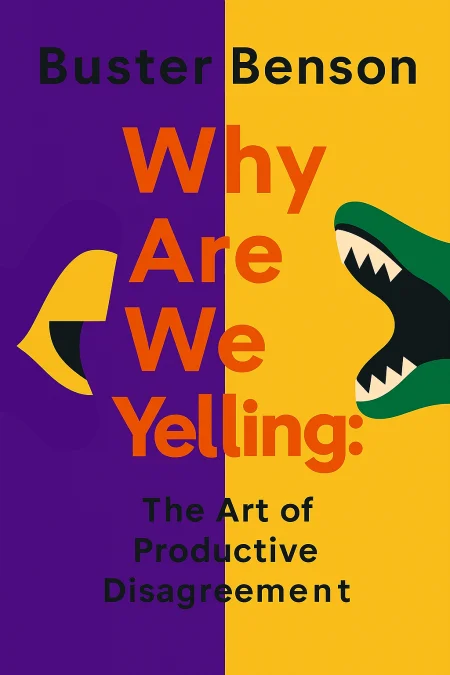
Why Are We Yelling?
The Art of Productive Disagreement
Book Edition Details
Summary
Tired of sidestepping conflict like it's an emotional minefield? Buster Benson has cracked the code on turning clashes into connections. Drawing from his high-stakes experiences with Amazon, Twitter, and Slack, Benson unveils a transformative blueprint for mastering the art of disagreement. This isn't just about talking your way out of tense moments; it's about harnessing the power of conflict to fuel creativity and strengthen bonds. With his insights, you'll learn to navigate the stormy seas of office tensions and family feuds, emerging with deeper understanding and innovative solutions. Say goodbye to the dread of discord and hello to a world where arguments become opportunities for growth and collaboration. Let Benson guide you through the mechanics of meaningful discourse and unlock the potential hidden in every heated exchange.
Introduction
Modern discourse has devolved into a battlefield where winning matters more than understanding, where conversations end in frustration rather than insight. This troubling reality reflects our fundamental misunderstanding of what disagreement actually represents and how it might serve us. Rather than viewing disagreements as problems to be eliminated or battles to be won, we might consider them as opportunities for growth, connection, and deeper understanding. The exploration that follows challenges three pervasive misconceptions that plague contemporary dialogue: that arguments are inherently destructive, that their primary purpose is to change minds, and that they can be definitively resolved. These assumptions have created a culture of avoidance and anxiety around disagreement, leaving us poorly equipped to navigate the complex challenges facing society. Through systematic analysis of cognitive biases, internal voices, and the environments where disagreements unfold, a different approach emerges—one that transforms conflict into collaboration and frustration into curiosity. This examination reveals how productive disagreement requires not just new techniques, but a fundamental shift in perspective about what these conversations can accomplish and why they matter for human flourishing.
Reframing Disagreement: From Threat to Opportunity
The conventional wisdom treats disagreement as a malfunction in human communication—something to be avoided, minimized, or quickly resolved. This perspective fundamentally misunderstands the role that disagreement plays in healthy relationships and functioning communities. Research demonstrates that relationships without conflict are relationships without genuine communication, destined to fail under the weight of unexpressed tensions and unaddressed differences. Disagreements serve as early warning systems, flagging when something important to us feels threatened or challenged. They arise naturally whenever multiple perspectives encounter each other, whether in intimate relationships, professional settings, or broader social contexts. The anxiety we feel when confronted with opposing viewpoints signals not danger, but the presence of an opportunity to learn something new about ourselves, others, or the world around us. The shift from viewing disagreements as threats to seeing them as opportunities requires recognizing their potential to yield multiple forms of value. Beyond the immediate security that comes from resolving conflicts, productive disagreements can generate growth through new insights, connection through deeper understanding, and even enjoyment through the intellectual stimulation of wrestling with complex ideas alongside others. When disagreements are approached with curiosity rather than defensiveness, they become laboratories for testing assumptions, refining beliefs, and building stronger relationships. The goal transforms from winning or being right to discovering what might be possible when different perspectives collaborate rather than compete.
Understanding Our Internal Voices and Biases in Conflict
Every person carries within them a collection of automatic responses to disagreement, inherited from family, culture, and personal experience. These internal voices spring into action whenever cognitive dissonance arises, each offering its own strategy for managing the discomfort of conflicting perspectives. Understanding these voices allows us to hear their recommendations as suggestions rather than commands. The voice of power responds to disagreement with force, seeking to dominate or shut down opposing views through authority, volume, or intimidation. While effective in the short term, this approach creates resentment and often strengthens the very positions it seeks to eliminate. The voice of reason attempts to resolve conflicts through logic and evidence, appealing to shared authorities and established facts. Though more sophisticated than raw power, this voice struggles when disagreements involve values, emotions, or experiences that cannot be easily quantified. The voice of avoidance sidesteps conflict entirely, hoping that problems will resolve themselves if ignored long enough. This strategy feels safe but allows underlying tensions to fester and grow stronger over time. A fourth voice emerges when we learn to listen more carefully—the voice of possibility, which approaches disagreement with genuine curiosity about what might be learned or discovered. Cognitive biases compound these automatic responses, creating systematic blind spots in how we process information and interpret others' intentions. Rather than viewing these biases as flaws to be eliminated, productive disagreement requires developing honest acknowledgment of our limitations. We cannot think our way out of bias, but we can learn to work with it more skillfully, seeking diverse perspectives to compensate for our inevitable blind spots and remaining open to evidence that challenges our existing beliefs.
Building Arguments Together Through Neutral Dialogue
Traditional approaches to disagreement assume that the strongest argument will emerge from adversarial competition between opposing sides. This framework encourages each party to present only their strongest points while concealing weaknesses, resulting in incomplete pictures and missed opportunities for genuine insight. Productive disagreement invites a collaborative approach where participants work together to build the strongest possible versions of all relevant positions. The shift from adversarial to collaborative argument-building requires creating neutral spaces where different ideas can be examined without judgment. These spaces must welcome diverse perspectives, allow participants to join and leave freely, and evolve organically based on the relationships and conversations that unfold within them. Physical environment matters—sharing food, sitting in circles, meeting in neutral territory—as do cultural norms that prioritize curiosity over certainty. Successful collaborative dialogue distinguishes between three distinct types of disagreement: conflicts about what is true, what is meaningful, and what is useful. Each type requires different evidence and resolution strategies. Conflicts about truth can potentially be settled with reliable information. Conflicts about meaning involve personal values and preferences that cannot be proven right or wrong. Conflicts about usefulness concern practical strategies and their likely outcomes over time. When participants work together to strengthen arguments rather than tear them apart, they become invested in the quality of reasoning rather than the victory of their initial position. This collaborative dynamic transforms disagreements from zero-sum battles into positive-sum explorations where everyone benefits from the improved understanding that emerges. The goal becomes building the most complete and accurate picture possible rather than defending territory.
Accepting Reality and Participating in Dangerous Conversations
The ultimate test of productive disagreement lies in our willingness to engage with ideas that genuinely challenge our deepest assumptions and values. These "dangerous ideas" cannot be indefinitely avoided or censored without cost. History demonstrates repeatedly that suppressing uncomfortable perspectives often strengthens them by creating martyrs and driving conversations underground where they become more extreme and less accountable. Engaging productively with dangerous ideas requires distinguishing between accepting them into conversation and endorsing them. This distinction allows us to examine perspectives we find troubling or offensive without compromising our own values or judgment. The goal is not to become neutral about everything, but to understand what we are really disagreeing with rather than shadow-boxing with our own projections and stereotypes. Such engagement demands exceptional care in creating truly neutral spaces where participants feel safe to represent their authentic views rather than performative versions designed for public consumption. These conversations work best when they include the strongest and most thoughtful advocates for each position rather than the most extreme or easily dismissed representatives. The willingness to participate in dangerous conversations reflects a fundamental acceptance of reality as it is rather than as we wish it were. We cannot change what we refuse to acknowledge, nor can we solve problems we are afraid to discuss. This acceptance paradoxically creates more security, not less, by allowing us to work with actual challenges rather than imagined ones. When we stop expending energy avoiding difficult conversations, that energy becomes available for more constructive purposes.
Summary
Productive disagreement represents a fundamental shift from treating conflict as a problem to be solved to viewing it as a resource to be cultivated. When we stop trying to eliminate disagreement and start learning to work with it skillfully, we discover that our most challenging conversations can become our most valuable ones. This approach requires developing new capacities: the ability to recognize our own biases without being paralyzed by them, the skill to create spaces where genuine dialogue can unfold, and the courage to engage with perspectives that genuinely challenge us. The transformation of disagreement from obstacle to opportunity opens pathways to understanding that remain invisible when we approach differences with defensiveness or avoidance. For readers seeking to move beyond the polarization and frustration that characterize so much contemporary discourse, this framework offers both practical tools and a deeper vision of what becomes possible when we learn to disagree well.
Related Books
Download PDF & EPUB
To save this Black List summary for later, download the free PDF and EPUB. You can print it out, or read offline at your convenience.
By Buster Benson
