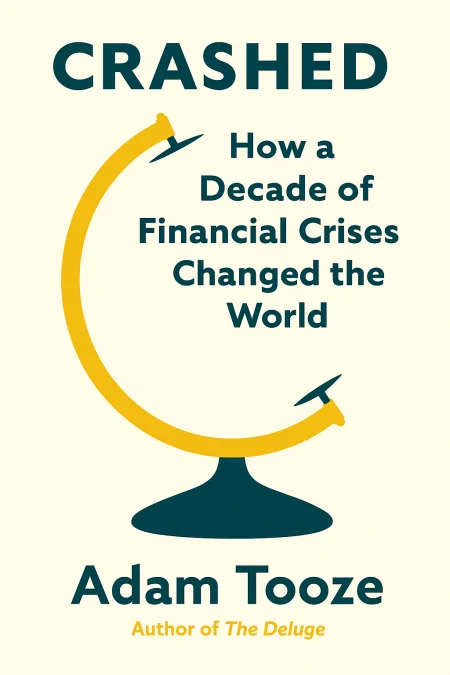
Crashed
How a Decade of Financial Crises Changed the World
Book Edition Details
Summary
In the churning maelstrom of global finance, 2008 marked a cataclysmic rupture, sending ripples that reshaped the very fabric of world order. Adam Tooze's "Crashed" doesn't just recount the events; it dissects the intricate web of financial interdependencies that bind nations in a dance of profit, power, and peril. As the collapse unfurled from Wall Street's epicenter, its tremors reverberated through Europe's corridors of power, Asia's bustling industries, and beyond, igniting geopolitical and economic upheavals that echo into our present. Tooze's narrative deftly intertwines the rise of social media, the shifting tides of Middle America, and the ascent of China, posing a provocative question: in the aftermath of chaos, can we envisage a future where stability reigns, or are we forever poised on the brink of another financial tempest?
Introduction
On a crisp September morning in 2008, as Lehman Brothers collapsed into bankruptcy, few could have imagined that this single event would trigger a cascade of political upheavals that would reshape democracy itself. What began as a crisis in American mortgage markets quickly evolved into something far more profound—a fundamental challenge to the post-Cold War consensus that had seemed unshakeable just years before. This extraordinary period illuminates three crucial historical transformations that continue to define our world today. First, it reveals how deeply interconnected global finance had become by the early 21st century, creating a system where local failures could instantly become worldwide catastrophes that no single nation could control. Second, it demonstrates the hidden mechanics of how economic trauma translates into political revolution, showing us why the confident globalization of the early 2000s gave way to the populist insurgencies that produced Brexit, Trump, and the rise of nationalist movements across the Western world. Third, it exposes the fundamental tension between global capitalism and democratic governance, forcing us to confront uncomfortable truths about who really holds power when crisis strikes. For anyone seeking to understand why our political landscape looks so dramatically different today—why established parties crumble, why international cooperation seems so fragile, why economic anxiety drives electoral outcomes—this story provides essential historical context. The events between 2007 and 2017 weren't just about banks and bailouts; they marked the moment when the optimistic assumptions of the globalized era collided with harsh economic and political reality, setting in motion forces that continue to reshape our democratic institutions and international relationships.
The Global Contagion: Banking Collapse and Emergency Response (2007-2009)
The crisis began quietly in 2007 with failures among American subprime mortgage lenders, but what seemed like a localized problem quickly revealed the dangerous interconnectedness of global finance. American banks had packaged risky mortgages into complex securities that were sold worldwide, creating a web of financial relationships that spanned continents. When housing prices began falling and mortgage defaults soared, the contagion spread with shocking speed across the Atlantic, exposing how European banks had become deeply embedded in American mortgage markets through their purchases of toxic securities. The pivotal moment came in September 2008 with the collapse of Lehman Brothers. This wasn't just the failure of one investment bank—it was the moment when policymakers realized they were facing a systemic crisis that threatened the entire global financial system. Credit markets froze, banks stopped lending to each other, and European institutions found themselves desperately short of the dollars they needed to fund their operations. The Federal Reserve, recognizing that American financial stability depended on global stability, began providing emergency dollar funding to foreign central banks through swap lines, effectively becoming the world's lender of last resort. The response required unprecedented international cooperation and massive government intervention. The Federal Reserve's various lending programs pumped over ten trillion dollars into the global financial system, with European banks receiving the majority of the support. Meanwhile, governments across the world nationalized banks and launched massive stimulus programs, fundamentally altering the relationship between state and market. The ideological foundations of free-market capitalism crumbled as even conservative leaders embraced unprecedented levels of government intervention to prevent complete economic collapse. This period exposed a fundamental truth about modern capitalism that few wanted to acknowledge. Despite decades of rhetoric about free markets and limited government, the financial system could survive only through the most massive state intervention in peacetime history. The crisis had revealed that financial globalization created new forms of systemic risk that required coordinated international response, setting the stage for a decade of political upheaval as democratic societies struggled to come to terms with this new reality.
European Sovereign Crisis: Austerity Politics and Democratic Deficit (2010-2012)
Just as the world seemed to be recovering from the initial financial shock, Europe faced a second wave of crisis that would prove even more politically destructive. Greece's revelation that it had been understating its budget deficits triggered a sovereign debt crisis that spread across the eurozone's periphery, exposing fundamental flaws in the European monetary union's design. Unlike the United States, which could rely on a single central bank and federal fiscal system, Europe lacked the institutional mechanisms to respond quickly and decisively to the crisis. The European response, dominated by Germany's insistence on fiscal discipline, imposed harsh austerity measures on crisis-hit countries in exchange for bailout funds. This approach, championed by Chancellor Angela Merkel, reflected deep-seated German beliefs about the moral hazards of debt and the importance of fiscal responsibility. However, the austerity programs proved economically counterproductive and politically explosive, as countries like Greece, Spain, and Portugal saw their economies shrink and unemployment soar to levels not seen since the Great Depression. The crisis revealed the eurozone's democratic deficit in stark terms. Elected governments found their policy choices constrained by conditions imposed by the "troika" of the European Commission, European Central Bank, and International Monetary Fund. Technocratic governments replaced elected ones in Italy and Greece, while leaders across southern Europe implemented policies that directly contradicted their campaign promises. This erosion of democratic sovereignty demonstrated how financial crises could override democratic processes, creating a profound legitimacy crisis for European integration itself. The human cost was devastating, but the political consequences proved even more lasting. New political movements emerged across Europe to challenge the established order, from Syriza in Greece to Podemos in Spain to the Alternative for Germany. These parties successfully channeled popular anger at the political establishment's handling of the crisis, marking the beginning of a populist challenge that would reshape European politics for years to come and fundamentally alter the relationship between European integration and democratic accountability.
Political Backlash: From Financial Crisis to Populist Revolution (2013-2017)
The final phase of the crisis's immediate aftermath saw its economic disruptions translate into lasting political transformation. The "recovery" that began in 2013 proved hollow for many ordinary citizens, as wage growth remained stagnant, inequality widened, and traditional career paths disappeared. This created fertile ground for populist movements that promised to restore national sovereignty and challenge the globalized economic order that had produced such instability and seemed to benefit only financial elites. The 2016 Brexit referendum and Donald Trump's presidential victory represented the crisis's ultimate political legacy. Both campaigns successfully channeled economic anxiety and cultural displacement into votes against the established order. Brexit supporters argued that European Union membership had subjected Britain to the same kind of external economic control that had devastated Greece, while Trump promised to tear up trade agreements and restore American manufacturing jobs. These weren't merely protest votes—they represented a fundamental rejection of the globalized, finance-driven economic model that had dominated the pre-crisis era. The crisis had also shifted global economic power in ways that traditional political establishments struggled to acknowledge. China's massive stimulus program had helped stabilize the world economy, but it also accelerated the country's rise as an economic superpower capable of challenging American hegemony. Meanwhile, the experience of financial sanctions convinced countries like Russia that economic interdependence was a source of vulnerability rather than strength, leading to efforts to create alternative financial systems outside Western control. Perhaps most importantly, the crisis shattered the technocratic consensus that had dominated policymaking since the 1990s. The idea that complex economic problems could be solved by experts applying market-friendly solutions lost credibility when those same experts failed to predict or prevent the crisis. This opened space for political entrepreneurs who promised simple solutions to complex problems, even when those solutions contradicted economic orthodoxy. The result was a new era of economic nationalism and political polarization that continues to reshape democratic politics across the Western world, challenging the fundamental assumptions about expertise, international cooperation, and the relationship between capitalism and democracy.
Summary
The decade of financial crisis from 2007 to 2017 reveals a fundamental truth about modern history: economic and political systems are far more fragile and interconnected than their architects typically recognize. What began as a technical problem in American mortgage markets cascaded through global financial networks to produce political earthquakes that continue reverberating today. The crisis exposed how globalization had created new vulnerabilities while concentrating power in ways that democratic institutions struggled to control or even comprehend, ultimately delegitimizing not just specific policies but entire ways of thinking about economics and governance. The historical pattern that emerges is clear: when established economic arrangements fail to deliver broadly shared prosperity, political upheaval inevitably follows. The emergency measures that saved the financial system—bank bailouts, quantitative easing, and austerity programs—may have prevented economic collapse, but they also created new forms of inequality and democratic deficit that fueled populist backlash. This created opportunities for political movements that promised to restore national control over economic destiny, even at the cost of international cooperation and institutional stability. Looking forward, this history offers three essential lessons for navigating our current moment of political uncertainty. First, economic systems require constant vigilance and reform to prevent the accumulation of dangerous imbalances that can overwhelm democratic institutions when crisis strikes. Second, international cooperation, while essential for managing global challenges, must be structured in ways that preserve democratic legitimacy and ensure that the benefits of integration are broadly shared rather than concentrated among financial elites. Finally, the relationship between global capitalism and democratic governance remains fundamentally unstable, requiring ongoing efforts to ensure that economic policy serves democratic purposes rather than undermining the very foundations of representative government.
Related Books
Download PDF & EPUB
To save this Black List summary for later, download the free PDF and EPUB. You can print it out, or read offline at your convenience.
By Adam Tooze
