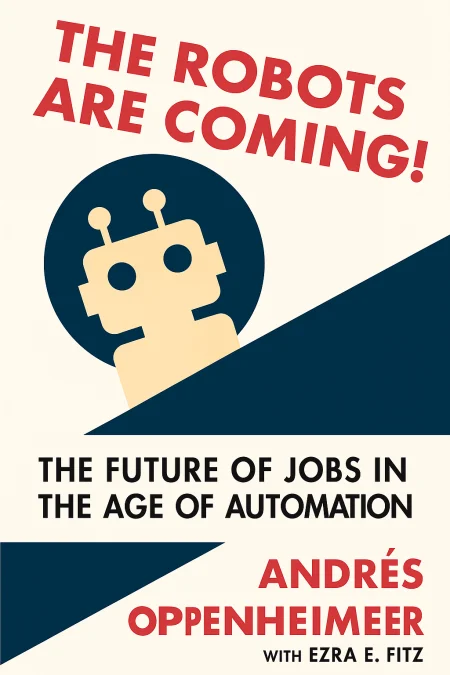
The Robots Are Coming!
The Future of Jobs in the Age of Automation
byAndrés Oppenheimer, Ezra E. Fitz
Book Edition Details
Summary
In a world where the lines between human labor and robotic efficiency blur, Andrés Oppenheimer unveils the delicate dance of survival in an automated age. "The Robots Are Coming!" paints a vivid tableau of industries on the brink of transformation—where chefs, lawyers, bankers, and doctors face the relentless march of technology. Oppenheimer, with his signature investigative prowess, dives into the heart of these seismic shifts, capturing the tension between innovation's promise and its pitfalls. Through conversations with leading thinkers and a mosaic of expert insights, he navigates the spectrum from optimism to skepticism, ultimately carving out a space for cautious hope. This isn't just a book; it's a glimpse into the future—a compelling call to reimagine what work, and life, might soon become.
Introduction
In the quiet hum of a modern factory floor, where robotic arms dance in perfect synchronization, we witness the latest chapter of humanity's oldest story: the relentless march of technology transforming how we work and live. This transformation isn't merely about machines replacing humans—it's about understanding the profound economic, social, and cultural shifts that occur when artificial intelligence and automation reshape entire industries overnight. This exploration reveals three critical questions that will define our immediate future: How rapidly are intelligent machines displacing human workers across different sectors? What new forms of employment and economic structures emerge when algorithms can perform tasks once thought uniquely human? And perhaps most importantly, how can individuals, communities, and nations prepare for a world where the relationship between technology and labor has fundamentally changed? The insights gathered here will prove invaluable for workers seeking to future-proof their careers, business leaders navigating technological disruption, policymakers crafting responses to technological unemployment, and anyone curious about the economic forces reshaping our world. Through examining real-world examples from Silicon Valley to Tokyo, from newsrooms to operating theaters, we uncover both the promises and perils of our automated future.
Early Digital Disruption: The First Wave (2000s-2010s)
The early decades of the twenty-first century marked a pivotal moment when digital technologies began their systematic infiltration of traditional workplaces. Unlike previous industrial revolutions that unfolded over generations, this transformation accelerated at an unprecedented pace, catching many industries unprepared for the magnitude of change ahead. The period witnessed the emergence of what economists would later recognize as a fundamental shift in the nature of technological displacement. Where steam engines and assembly lines had primarily replaced physical labor, the new wave of digital automation began targeting cognitive tasks previously considered the exclusive domain of educated professionals. Search engines eliminated library researchers, electronic pagination replaced newspaper layout artists, and spell-check programs rendered many copy editors obsolete. Perhaps most significantly, this era established a troubling pattern that would define the decades to follow: new technology companies employed far fewer people than the traditional industries they disrupted. When Instagram, with its thirteen employees, contributed to the bankruptcy of Kodak's 140,000-person workforce, it signaled a new economic reality where massive value creation no longer guaranteed proportional job creation. The seeds of social and political upheaval were planted during these years, though few recognized them at the time. The growing anxiety among workers in traditional industries would later manifest in the populist movements and anti-globalization sentiment that swept across developed nations, as communities struggled to understand why their economic foundations were crumbling despite apparent technological progress.
AI Revolution Across Industries: The Great Acceleration (2010s-2020s)
The second phase of the automation revolution brought artificial intelligence from research laboratories into everyday workplaces, fundamentally altering professions once thought immune to technological disruption. This period saw the emergence of Watson defeating human champions at Jeopardy, autonomous vehicles navigating city streets, and algorithms making medical diagnoses with greater accuracy than experienced physicians. The transformation proved particularly dramatic in white-collar professions. Legal research, once the domain of junior associates, became the province of AI systems that could analyze millions of case files in seconds. Financial analysts found themselves competing with algorithms capable of processing vast datasets and identifying market patterns invisible to human perception. Even creative fields felt the impact as AI began generating news articles, composing music, and creating visual art. What distinguished this phase was the speed and breadth of simultaneous disruption across multiple industries. Unlike previous technological revolutions that typically affected one sector at a time, allowing displaced workers to migrate to emerging industries, AI's versatility meant that virtually every profession faced some degree of automation pressure simultaneously. The Oxford study predicting that forty-seven percent of jobs faced automation risk became a rallying cry for both technological optimists and pessimists. The period also revealed the emergence of new economic models, from peer-to-peer lending platforms bypassing traditional banks to virtual reality applications transforming retail experiences. These innovations demonstrated that the disruption extended beyond simple job displacement to fundamental restructuring of entire economic sectors, creating new forms of value while destroying established business models.
Human Adaptation and New Employment: Survival Strategies Emerge
As automation swept through traditional job categories, a fascinating pattern of human adaptation began to emerge. Rather than simply displacing workers, the technological revolution started creating entirely new categories of employment that hadn't existed before. Data scientists became the new gold miners, extracting valuable insights from the massive streams of information generated by digital systems. Cybersecurity specialists evolved into digital bodyguards, protecting companies and individuals from increasingly sophisticated online threats. The healthcare sector exemplified this adaptive transformation most clearly. While diagnostic AI threatened radiologists and pathologists, the aging global population created unprecedented demand for human caregivers, physical therapists, and mental health counselors. Robots could perform surgery with mechanical precision, but they couldn't provide the emotional support that patients desperately needed during recovery. This led to the emergence of hybrid roles—robotic surgery technicians who combined technical expertise with human empathy. Education underwent a similar metamorphosis as traditional teaching methods collided with digital learning platforms. Rather than replacing teachers, technology began freeing educators from routine information transmission, allowing them to focus on developing students' critical thinking, creativity, and emotional intelligence. The most successful schools started employing learning experience designers who crafted personalized educational journeys, and digital wellness coaches who helped students navigate the psychological challenges of screen-dominated learning environments. Perhaps most surprisingly, the automation wave sparked a renaissance in distinctly human services. As people spent more time interacting with machines, they began craving authentic human connection more intensely. This created opportunities for personal trainers, artisanal craftspeople, spiritual counselors, and even professional companions for the elderly. The key insight was that humans weren't just competing with machines—they were learning to complement them, focusing on uniquely human capabilities like creativity, empathy, and complex problem-solving that remained beyond artificial intelligence's reach.
Future Crossroads: Toward a Post-Work Society
As we stand at the threshold of the 2020s and beyond, the automation revolution has reached a critical inflection point where society must make fundamental choices about its future direction. The technological capability to automate vast swaths of human labor now exists, but the social and political frameworks to manage this transition remain largely undeveloped. Countries like Finland and Kenya are experimenting with universal basic income programs, while others debate whether robots should pay taxes to fund displaced workers' retraining. The emerging post-work society presents both utopian possibilities and dystopian risks. On one hand, automation could free humanity from dangerous, repetitive, and unfulfilling labor, creating unprecedented leisure time for creative pursuits, family relationships, and personal development. The cost of goods and services could plummet as robotic production eliminates human labor costs, potentially providing abundance for all. Some futurists envision a world where people pursue their passions rather than working for survival, supported by the wealth generated by tireless artificial workers. Yet this optimistic vision faces significant obstacles. The transition period threatens to create massive unemployment and social unrest as workers struggle to adapt faster than new opportunities emerge. Wealth could concentrate among those who own the robots and algorithms, creating unprecedented inequality between the technologically empowered and the displaced masses. Early signs of this division are already visible in the growing protests by taxi drivers against ride-sharing platforms, hotel workers against service robots, and entire communities against the closure of automated factories. The path forward requires unprecedented cooperation between governments, businesses, and educational institutions to manage this transformation humanely. Successful adaptation will likely involve radical changes to education systems, social safety nets, and even our fundamental concepts of work and value. The societies that thrive in the post-work era will be those that can harness automation's productive power while preserving human dignity and purpose. The choices we make in the next decade will determine whether the robot revolution becomes humanity's greatest liberation or its most devastating disruption.
Summary
The automation revolution represents the most rapid and comprehensive transformation of human work since agriculture gave way to industry. Unlike previous technological shifts that unfolded over centuries, artificial intelligence and robotics are reshaping entire sectors within decades, creating a compression of historical change that challenges our ability to adapt. The central tension of our era lies between technology's promise of abundance and its threat of displacement—between a future of human liberation and one of social fragmentation. This transformation demands a fundamental reimagining of education, economics, and social organization. The most successful individuals and societies will be those that embrace lifelong learning, develop uniquely human skills that complement rather than compete with machines, and create new forms of meaning and purpose beyond traditional employment. We must move from asking how to stop the robots to ensuring the benefits of automation serve all humanity. The window for proactive adaptation is narrowing, but the potential rewards—a world where technology amplifies human potential rather than replacing it—justify the effort required to navigate this historic transition thoughtfully and inclusively.
Related Books
Download PDF & EPUB
To save this Black List summary for later, download the free PDF and EPUB. You can print it out, or read offline at your convenience.
By Andrés Oppenheimer
