
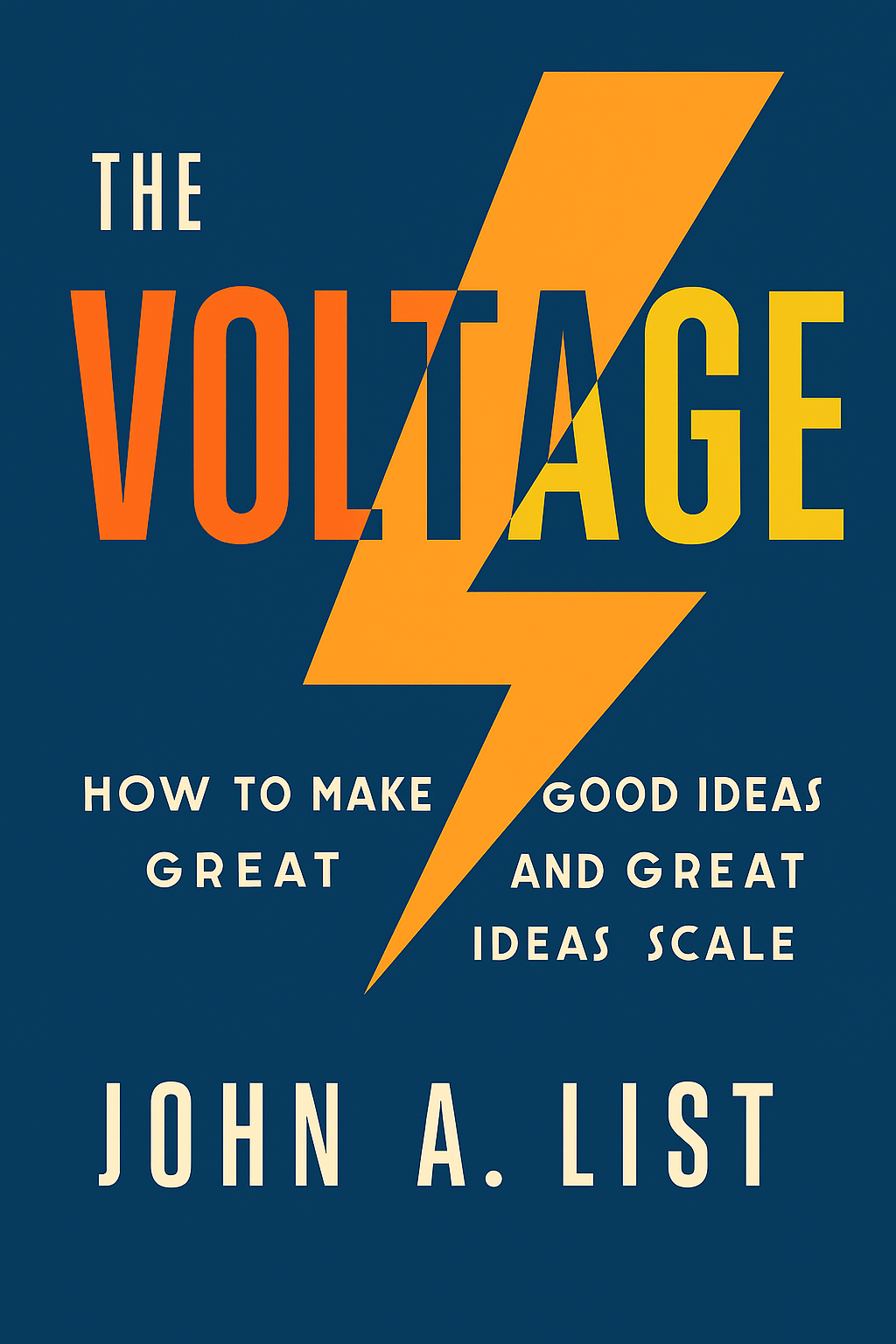
The Voltage Effect
How to Make Good Ideas Great and Great Ideas Scale
Book Edition Details
Summary
In a world where ideas ignite like lightning, only a few strike with lasting brilliance. Economist John A. List, celebrated for his groundbreaking research, unveils the secret to why some ideas soar while others fizzle. "The Voltage Effect" is a masterclass in the art of scalability, revealing the elusive qualities that enable concepts to leap from small circles to global impact. Whether you're a startup dreamer or a policy pioneer, List’s insights are your compass. Through vivid case studies—from Jamie Oliver's culinary empire to transformative education initiatives—he maps the DNA of successful scaling. With five vital signs of scalability as your guide, navigate the electrifying potential of your ideas, ensuring they don't just flicker but blaze across industries and communities. Here lies the blueprint for change-makers yearning to light up the world with their vision, all powered by the voltage of possibility.
Introduction
Why do promising ideas that succeed brilliantly on a small scale often collapse when expanded to larger audiences? This fundamental puzzle confronts entrepreneurs, policymakers, and innovators across every sector of society. The stark reality is that most well-intentioned programs, innovative products, and breakthrough solutions experience what behavioral economist John List terms "voltage drops" when they attempt to scale beyond their initial success. This book introduces a comprehensive framework for understanding scalability through the lens of economic science and behavioral insights. Drawing from decades of field experiments and real-world observations, the analysis reveals that scaling is not merely about expanding size or reach, but about maintaining the essential conditions that created initial success while navigating the complex dynamics that emerge at larger scales. The theoretical foundation rests on five critical diagnostic measures that determine whether an idea possesses genuine scalability, combined with four proven strategies for engineering what the author calls "voltage gains." This systematic approach challenges conventional wisdom about growth and expansion, offering instead a rigorous methodology for distinguishing between ideas that merely appear successful and those with authentic potential for widespread impact. The framework addresses fundamental questions about representation and generalizability, examining how initial populations and situations may not reflect broader realities. It explores the hidden costs and unintended consequences that often emerge at scale, while providing actionable strategies for building sustainable incentive structures, optimizing resource allocation, and fostering organizational cultures that thrive during expansion rather than deteriorate under the pressures of growth.
The Five Vital Signs: Avoiding Voltage Drops at Scale
The first critical insight in scaling science involves recognizing that not all early successes represent genuine effectiveness. The phenomenon of false positives creates perhaps the most dangerous obstacle to successful scaling, as it leads organizations to invest massive resources in expanding ideas that never truly worked in the first place. These statistical mirages emerge from various sources, including random sampling errors, confirmation bias, and in worst cases, deliberate deception. False positives manifest when initial data appears to demonstrate success but later proves unreliable under more rigorous examination. The classic example involves programs that show promising results in small pilot studies but fail to replicate when tested with different populations or under independent oversight. This occurs because early samples may not be representative of broader populations, or because researchers unconsciously select conditions that favor their hypothesis. The second vital sign concerns audience representation, examining whether initial participants accurately reflect the larger population an idea hopes to serve. Many scaling failures occur because early adopters or test subjects possess characteristics that make them particularly receptive to an intervention, while the general population lacks these same traits. This creates a dangerous illusion of universal appeal when the idea actually works only for specific demographic or psychographic segments. Understanding spillover effects represents the third vital sign, acknowledging that scaling inevitably creates unintended consequences that can undermine the original objectives. These effects operate through multiple mechanisms, including general equilibrium changes that alter market dynamics, social influences that modify behavior patterns, and network effects that can either amplify or diminish impact as systems grow larger. The final two vital signs address sustainability and cost structures. Ideas must maintain fidelity to their core success factors while scaling, which requires distinguishing between negotiable and non-negotiable elements. Additionally, the economic realities of expansion often reveal cost structures that become prohibitive at scale, even when the underlying idea remains sound. Successful scaling requires identifying these potential failure points before they become insurmountable obstacles.
High-Voltage Scaling: Incentives, Margins, and Strategic Quitting
Behavioral economics reveals that human motivation operates according to predictable patterns that can be leveraged to create powerful scaling advantages. The most counterintuitive insight involves loss aversion, which demonstrates that people respond more strongly to the prospect of losing something they already possess than to gaining something of equivalent value. This psychological asymmetry creates opportunities to design incentive structures that maintain effectiveness even as organizations grow larger and more complex. Traditional incentive design focuses on rewarding desired behaviors after they occur, but this approach often loses power at scale due to delayed gratification effects and diminishing marginal returns. More effective approaches involve what researchers call "clawback" mechanisms, where individuals receive benefits upfront but must maintain certain behaviors to retain them. This reverses the psychological framing from potential gains to potential losses, creating stronger and more consistent motivation across diverse populations. Marginal thinking represents a fundamental shift from average-based decision making to optimization at the edges of performance. Most organizations make resource allocation decisions based on average returns across their entire operation, missing critical insights about where additional investments will generate the highest impact. The marginal revolution in scaling involves continuously identifying where the next dollar spent or hour invested will create the greatest value, then systematically redirecting resources toward these high-impact margins. This approach extends beyond simple financial calculations to encompass opportunity costs and comparative advantages. Every choice to continue pursuing one direction represents a choice to forego other potential paths. Strategic quitting becomes not a sign of failure but a sophisticated tool for maximizing long-term impact. Organizations that master this principle develop the ability to abandon good ideas in favor of great ones, and to recognize when their initial advantages no longer justify continued investment. The key insight involves distinguishing between temporary setbacks that require persistence and fundamental misalignments that require redirection. This distinction cannot be made through wishful thinking or emotional attachment to past investments, but only through honest assessment of comparative advantages and remaining opportunity costs.
Building Scalable Culture: Trust, Cooperation, and Organizational DNA
Organizational culture functions as the invisible infrastructure that either amplifies or undermines scaling efforts. Research in behavioral economics demonstrates that workplace norms shape not only how people perform their jobs but how they interact with each other, make decisions under pressure, and respond to the inevitable challenges that arise during rapid growth. The most critical insight involves recognizing that culture scales differently than business processes or technological systems. Trust emerges as the fundamental currency of scalable organizations. Unlike hierarchical control mechanisms that become increasingly unwieldy as organizations grow, trust-based systems create self-reinforcing cycles that actually improve with scale. When team members believe their contributions will be fairly evaluated and their colleagues will act in good faith, they invest more energy in collaborative problem-solving rather than defensive positioning. The distinction between authentic meritocracy and its superficial imitations proves crucial for sustainable scaling. True meritocracy requires creating environments where the best ideas can emerge regardless of their source, which demands careful attention to psychological safety, diverse perspectives, and systematic protection against various forms of bias. Organizations that confuse competitive internal dynamics with genuine merit-based evaluation often create cultures that reward political skill over substantive contribution. Recruitment and retention strategies must align with cultural objectives rather than treating culture as a secondary consideration. This means designing job postings, interview processes, and onboarding experiences that both attract individuals likely to thrive in collaborative environments and screen out those whose success depends on zero-sum competition. The goal involves creating what researchers call "positive selection effects" where organizational growth naturally improves rather than dilutes cultural quality. The most sophisticated insight involves understanding how organizational culture influences broader social norms and outcomes. Companies and institutions that successfully scale positive cultural attributes contribute to what economists call "social capital," creating ripple effects that extend far beyond their immediate operations. This recognition transforms culture from an internal concern into a form of social responsibility, acknowledging that how organizations treat their own people ultimately influences how society functions as a whole.
Summary
The voltage effect reveals that scalability is not about having any single perfect characteristic, but about systematically avoiding the multiple ways that promising ideas can fail when expanded beyond their initial context. True scaling success requires passing through all five diagnostic checkpoints while implementing behavioral insights about human motivation, resource optimization, strategic decision-making, and cultural architecture. This comprehensive approach transforms scaling from an art of intuition into a science of systematic analysis and evidence-based strategy, offering organizations and leaders a reliable framework for turning good ideas into transformative impact at the largest possible scale.
Related Books
Download PDF & EPUB
To save this Black List summary for later, download the free PDF and EPUB. You can print it out, or read offline at your convenience.
By John A. List
