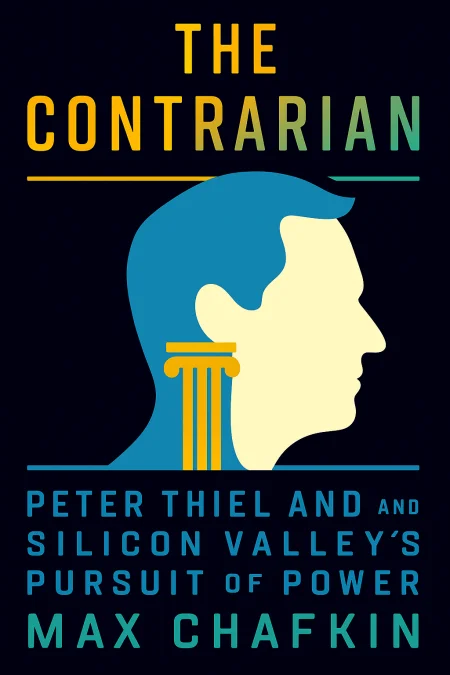
The Contrarian
Peter Thiel and Silicon Valley's Pursuit of Power
Book Edition Details
Summary
In the clandestine corridors where innovation and ideology collide, Peter Thiel stands as a paradoxical force. Max Chafkin's "The Contrarian" peels back the layers of this formidable architect of Silicon Valley, offering a rare glimpse into the mind of a man whose influence stretches beyond the tech world into the political realm. From his audacious ventures like PayPal and Palantir to his pivotal role in shaping Facebook and SpaceX, Thiel's journey is a testament to ambition unbound by convention. Yet, it's his fervent drive to inject his radical ideologies into the veins of American power that truly sets him apart. Here lies a tale of ambition, controversy, and a relentless quest to redefine the landscape of influence.
Introduction
In the gleaming towers of Silicon Valley, where disruption is gospel and innovation the highest virtue, few figures have wielded influence as quietly yet decisively as Peter Thiel. The German-born entrepreneur who co-founded PayPal and became Facebook's first outside investor represents a paradox at the heart of modern technology: a libertarian who builds surveillance tools for governments, a contrarian who shapes consensus, a man who preaches freedom while accumulating unprecedented power. Thiel's journey from a lonely chess prodigy in suburban California to one of the most influential power brokers in American business and politics reveals the hidden currents that have shaped our digital age. His story illuminates how a single individual's worldview can ripple across industries, elections, and the very fabric of democratic society. Through his ventures, investments, and ideological crusades, Thiel has demonstrated that in the information age, the ability to see around corners and act on contrarian insights can translate into extraordinary influence over the future itself. From this remarkable figure, we discover the art of strategic thinking that turns unpopular positions into profitable ones, the methods by which technological innovation becomes political power, and the complex moral calculations that define leadership in an era where the line between progress and control grows ever thinner.
From Stanford Provocateur to PayPal Pioneer
Peter Thiel's transformation from awkward undergraduate to Silicon Valley kingmaker began in the unlikely crucible of campus politics at Stanford University. Arriving in 1985 as a brilliant but socially isolated freshman, Thiel found himself surrounded by what he perceived as suffocating liberal orthodoxy. Rather than conform, he chose confrontation, founding the Stanford Review as a conservative counterweight to campus progressivism. The young Thiel displayed an early genius for turning perceived persecution into power. His newspaper didn't merely critique liberal policies; it deliberately provoked outrage, understanding that controversy generates attention and attention creates influence. When campus activists protested apartheid, Thiel defended the South African system as economically sound. When students demanded curriculum changes to include diverse voices, he framed it as an assault on Western civilization itself. This pattern of contrarian thinking would define Thiel's approach to everything that followed. At Stanford Law School, he refined his ability to identify what everyone else believed and systematically argue the opposite. His 1995 book crystallized these views into a broader critique of multiculturalism, establishing him as a young intellectual provocateur willing to say what others wouldn't dare. The transition from campus gadfly to tech entrepreneur came through his recognition that the internet represented the ultimate contrarian bet. While others saw the web as a tool for communication and entertainment, Thiel envisioned it as a weapon against traditional institutions. PayPal wasn't just a payment system; it was, in his words, a path toward the erosion of established financial power. This grandiose vision, combined with ruthless execution and a willingness to break rules that competitors respected, transformed a simple money transfer service into the foundation of modern digital commerce.
Building Silicon Valley's Shadow Empire
The dot-com crash that devastated Silicon Valley in 2000 became Thiel's opportunity to build something more enduring than a single company: an entire ecosystem of power and influence. His investment in Facebook represented more than financial acumen; it demonstrated his ability to recognize and nurture the kind of founder who would reshape society itself. Mark Zuckerberg's social network wasn't just connecting college students; it was creating a new form of human organization that Thiel understood could be leveraged for unprecedented influence. Simultaneously, Thiel was constructing Palantir, a data analysis company that would become his most controversial creation. Named after the all-seeing stones from Tolkien's Middle-earth, Palantir promised to help governments and corporations make sense of vast amounts of information. What began as an attempt to adapt PayPal's fraud detection algorithms for counterterrorism evolved into something far more ambitious: a tool for surveillance and control that would make its founder indispensable to the national security establishment. The genius of Thiel's approach lay in his understanding that in the information age, the ability to process and analyze data would become the ultimate source of power. While other tech entrepreneurs focused on consumer applications, Thiel positioned himself at the intersection of technology and governance. Palantir's contracts with intelligence agencies, law enforcement, and military organizations created a web of dependencies that made Thiel not just wealthy, but strategically important to the functioning of the American state. Through his venture capital firm Founders Fund, Thiel extended this influence by backing entrepreneurs who shared his vision of technology as a force for fundamental change. His portfolio companies weren't just businesses; they were instruments for reshaping society according to his contrarian worldview. From SpaceX's challenge to government space monopolies to various biotechnology ventures promising to defeat aging itself, Thiel's investments reflected his belief that technological progress could transcend traditional limitations of politics, geography, and even mortality.
The Political Transformation: From Libertarian to Trump Kingmaker
Thiel's most audacious gambit came through his systematic cultivation of young minds through the Thiel Fellowship, a program that paid promising students to drop out of college and start companies instead. Ostensibly about entrepreneurship, the fellowship was actually a sophisticated recruitment tool for Thiel's broader ideological project. By identifying brilliant young people and offering them an alternative to traditional educational paths, he was building a network of future leaders who owed their careers to his vision. The fellowship's real purpose became clear in Thiel's broader critique of higher education as a bubble that trapped young people in debt while failing to prepare them for the modern economy. This wasn't merely economic analysis; it was cultural warfare against the institutions that had rejected his worldview. By positioning himself as the champion of practical innovation against academic orthodoxy, Thiel was laying groundwork for a broader assault on elite consensus. This strategy reached its culmination in Thiel's support for Donald Trump's 2016 presidential campaign. While Silicon Valley overwhelmingly opposed Trump, Thiel recognized in the candidate a vehicle for his own contrarian agenda. His speech at the Republican National Convention and subsequent donation weren't just political contributions; they were investments in a future where his vision of technological disruption could be implemented through state power. The Trump presidency validated Thiel's long-term strategy of building influence across multiple domains simultaneously. His companies received government contracts, his protégés gained positions in the administration, and his ideas about technology, immigration, and governance moved from the margins to the center of American political discourse. Through patient cultivation of relationships and systematic investment in contrarian positions, Thiel had transformed himself from campus provocateur to kingmaker, proving that in a democratic society, the ability to think differently and act strategically can ultimately reshape the entire system.
Legacy of Innovation and Authoritarian Influence
Thiel's pursuit of influence and control has revealed the fundamental contradictions that define his legacy and the broader transformation of Silicon Valley from countercultural movement to corporate powerhouse. His decade-long campaign to destroy Gawker Media, which he secretly funded through a series of lawsuits, demonstrated both his capacity for patient, methodical revenge and his willingness to undermine press freedom to protect his privacy. While he portrayed the campaign as a principled stand against irresponsible journalism, it also revealed an authoritarian streak that troubled even some of his allies. The Trump presidency exposed both the extent and the limits of Thiel's influence on American politics. While he successfully positioned himself as a key advisor during the transition, his recommendations for radical deregulation and unconventional appointments were largely rejected by a White House that proved more chaotic than revolutionary. His association with Trump also damaged his relationships within Silicon Valley and led to his effective exile from many industry forums, forcing him to relocate his operations to Miami and establish alternative power centers. Perhaps most significantly, Thiel's relentless focus on avoiding competition and achieving monopolistic control has created a kind of intellectual isolation that may ultimately undermine his effectiveness. Surrounded by employees, protégés, and business partners who depend on his favor, he has constructed an echo chamber that reinforces his beliefs while shielding him from genuine criticism. His vast wealth and multiple citizenships have given him options that most people lack, but they have also disconnected him from the ordinary experiences and concerns that drive democratic politics. The companies Thiel founded or funded continue to shape global commerce, communication, and governance in ways that reflect his particular vision of technological progress. From PayPal's transformation of digital payments to Palantir's role in government surveillance, his innovations have created new forms of power and control that operate largely beyond democratic oversight. As he approaches his sixth decade, Thiel remains one of the most powerful individuals in American technology and politics, but his influence increasingly resembles that of a foreign actor operating within American institutions rather than a citizen working to improve his country.
Summary
Peter Thiel's extraordinary journey reveals that true power in the modern world comes not from following conventional wisdom, but from the courage to systematically oppose it and the patience to build alternatives over decades. His life demonstrates that contrarian thinking, when combined with strategic execution and long-term vision, can transform individual insight into systemic influence across multiple domains of society. From Thiel's example, we learn the importance of identifying assumptions that everyone else takes for granted and the value of building networks of like-minded individuals who can amplify unconventional ideas into mainstream movements. His story also serves as a cautionary tale about the concentration of power in the hands of those who understand technology's political implications better than those who govern it, and the ease with which democratic norms can be eroded by those who view themselves as architects of the future. For anyone seeking to understand how innovation intersects with power in the twenty-first century, Thiel's career offers both inspiration and warning about the responsibilities that come with the ability to see the future before others do.
Related Books
Download PDF & EPUB
To save this Black List summary for later, download the free PDF and EPUB. You can print it out, or read offline at your convenience.
By Max Chafkin
