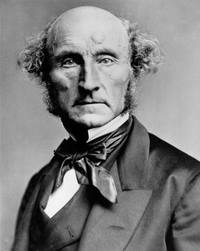
John Stuart Mill
John Stuart Mill, a luminary of 19th-century English thought, seamlessly intertwined the roles of philosopher, political economist, and civil servant with that of a legislator. Born into a milieu that valued intellectual rigor, Mill was profoundly influenced by his father, James Mill, and his early tutelage under the utilitarian philosopher Jeremy Bentham. His life and work were emblematic of a fervent commitment to liberal ideals, and he emerged as a pivotal figure in the discourse on individual freedom and social justice, leaving an indelible mark on the intellectual landscape of his time. Among his seminal contributions to philosophical literature are the acclaimed works "Utilitarianism," "On Liberty," and "The Subjection of Women." In "Utilitarianism," Mill refines Bentham's ethical theory, advocating for the greatest happiness principle while acknowledging the qualitative differences in pleasures. "On Liberty" stands as a timeless defense of individual freedom against societal oppression, championing the importance of personal autonomy and the protection of minority opinions. Meanwhile, "The Subjection of Women" is a pioneering treatise advocating for gender equality, arguing passionately for the emancipation and empowerment of women in a patriarchal society. Mill's prose is distinguished by its clarity and cogency, seamlessly blending analytical precision with an impassioned plea for human dignity and progress. His writings consistently explore themes of liberty, justice, and equality, underpinned by a deep-seated belief in the potential of human reason and the moral imperative to foster societal well-being. As a leading voice in liberal philosophy, Mill's enduring contributions continue to resonate, shaping contemporary debates on civil rights, ethics, and governance.
New From John Stuart Mill
More Books by John Stuart Mill


by Paul J. Zak
by Rory Vaden
by Robert C. Solomon, Fernando Flores
by Brett Gardner
by Dennis S. Reina
by Julian Baggini
by Larry Downes, Omar Abbosh, Paul Nunes
by Jacqueline Woodson
by Kevin Oakes
by Lindsey Pollak, Kimberly B. Cummings, Kimberly Brown
