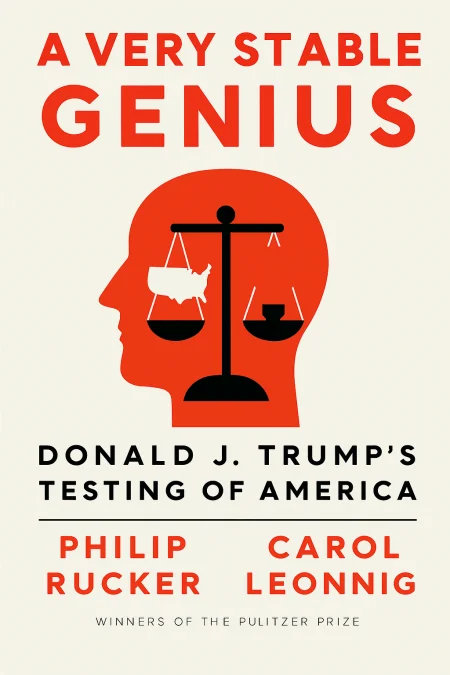
A Very Stable Genius
Donald J. Trump's Testing of America
byPhilip Rucker, Carol Leonnig
Book Edition Details
Summary
In the halls of power where whispers shape history, Carol Leonnig and Philip Rucker invite you into a labyrinth of intrigue with "A Very Stable Genius." This isn't just a chronicle of chaos; it's an exposé of orchestrated turbulence during Donald Trump's presidency. Drawing from a treasure trove of exclusive interviews and meticulous reporting, the authors dismantle the facade of disorder to reveal a method to the madness. Venture into the heart of the West Wing, where crisis management is the norm, and follow Trump's audacious confrontations with impeachment and foreign diplomacy. This is not merely a tale of survival but a compelling narrative that captures the relentless pulse of American politics and the audacious reinvention of its presidency.
Introduction
The story of American democracy in the early 21st century reveals a system under unprecedented strain, where traditional norms collided with an entirely new approach to presidential power. This remarkable period in our nation's history offers a unique window into how democratic institutions respond when their foundational assumptions are systematically challenged. Through careful examination of key moments and decisions, we witness the delicate balance between executive authority and constitutional constraints being tested in ways the founders never anticipated. Three critical questions emerge from this turbulent era that will define how future generations understand democratic governance. First, what happens when the informal norms that have guided presidential behavior for centuries are abandoned in favor of a more personalized, transactional approach to power? Second, how do career civil servants and institutional leaders navigate the tension between loyalty to an individual president and their oath to defend the Constitution? Finally, can democratic institutions designed in the 18th century withstand the pressures of modern political warfare and information manipulation? This examination provides essential insights for anyone seeking to understand how power operates in Washington, how constitutional crises develop in real time, and why the preservation of democratic norms requires constant vigilance from both leaders and citizens. For students of political science, engaged citizens, and future public servants, this account offers invaluable lessons about the fragility and resilience of American democracy when confronted with unprecedented challenges to its core principles.
Chaotic Foundations: The Unprepared Transition and Early Institutional Conflicts (2016-2017)
The seeds of institutional chaos were planted long before inauguration day, rooted in a transition process that reflected a fundamental misunderstanding of how democratic governance actually functions. Having never truly expected to win the presidency, the incoming administration approached the monumental task of staffing the federal government like a reality television casting call, prioritizing personal loyalty and media appeal over competence and institutional knowledge. This approach would establish patterns of dysfunction that would echo throughout the entire term. The selection of key personnel during this period revealed a dangerous conflation of government service with personal enterprise. Family members were installed in senior advisory roles despite having no relevant experience, while crucial positions remained unfilled for months as the administration struggled to find candidates who met both loyalty tests and basic qualifications. The appointment of Michael Flynn as national security adviser, despite explicit warnings from the outgoing president about his questionable judgment and foreign entanglements, exemplified this haphazard approach to critical decision-making. Within the administration, two distinct factions emerged that would define its internal dynamics. True believers saw their mission as revolutionary, convinced they were saving America from a corrupt establishment. Meanwhile, experienced professionals, dubbed the "adults in the room," found themselves constantly managing crises created by their boss's impulses and ignorance of basic governmental functions. This fundamental tension created a government at war with itself, where policy implementation became secondary to damage control. The transition's dysfunction foreshadowed deeper problems with the new president's conception of democratic leadership. His treatment of cabinet positions as rewards for supporters, his insistence on personal loyalty oaths from career officials, and his expectation that government agencies should serve his personal interests rather than the public good all reflected a profound misunderstanding of democratic governance that would define the administration's chaotic character and test institutional resilience from the very beginning.
Constitutional Crisis: The Comey Firing and Mueller Investigation Response (2017-2018)
The dismissal of FBI Director James Comey on May 9, 2017, marked the moment when administrative chaos transformed into constitutional crisis. This pivotal decision revealed the president's fundamental misunderstanding of law enforcement independence and his expectation that the justice system should function as an extension of his personal will. The firing shocked even the president's own advisers and legal counsel, many of whom recognized it as a potentially catastrophic miscalculation that would only intensify scrutiny rather than end it. The events leading to Comey's dismissal demonstrated an escalating pattern of inappropriate pressure on law enforcement officials. Private entreaties to intelligence leaders, demands for personal loyalty from FBI officials, and requests to abandon ongoing investigations all reflected a president who viewed the rule of law as subordinate to his personal interests. When these efforts failed to produce the desired results, frustration boiled over into the impulsive decision that would define the remainder of his presidency. The appointment of Robert Mueller as special counsel eight days later represented the moment the president's legal problems became truly existential. Mueller's sterling reputation for methodical investigation and his independence from political pressure struck fear into an administration accustomed to bending reality through media manipulation and political pressure. The president's immediate recognition that this appointment meant "the end of my presidency" proved remarkably prescient, as the investigation would cast a shadow over every subsequent decision. This period established a destructive cycle that would repeat throughout the administration: impulsive actions driven by personal grievance that created far greater problems than they solved. Each attempt to control or limit the investigation only provided additional evidence of potentially obstructive behavior, creating a vicious spiral where efforts to escape legal scrutiny only deepened legal jeopardy. The constitutional crisis had begun in earnest, testing whether American institutions could investigate potential wrongdoing at the highest levels while maintaining public confidence in democratic governance.
Guardrails Removed: The Breakdown of Executive Branch Constraints (2018-2019)
By 2018, the systematic departure of experienced officials had eliminated many of the institutional constraints that had previously moderated presidential behavior. The exodus of figures like James Mattis, Rex Tillerson, and John Kelly marked the end of what observers called the "adults in the room" era, leaving the president increasingly surrounded by loyalists chosen for their willingness to enable rather than constrain his impulses. This transformation fundamentally altered the character of executive decision-making and removed crucial safeguards that had operated behind the scenes. The family separation policy at the southern border exemplified how the erosion of institutional processes could lead to humanitarian disasters. Career officials found themselves implementing policies that violated established protocols and professional standards, while the chaotic implementation revealed the consequences of governing without adequate institutional input. The policy's eventual reversal under intense public pressure demonstrated that external accountability mechanisms could still function, even when internal guardrails had failed. Presidential interactions with foreign leaders during this period revealed the dangers of unrestrained diplomatic freelancing. Private meetings with authoritarian leaders conducted without adequate record-keeping or staff presence violated decades of established practice designed to protect American interests. Impulsive policy announcements, such as sudden troop withdrawals, caught even senior military officials off guard and undermined carefully constructed strategic relationships built over years of patient diplomacy. The transformation of the Justice Department from an independent law enforcement agency into a political battlefield accelerated dramatically during this phase. Public attacks on the Attorney General, demands for investigations of political opponents, and interference in ongoing prosecutions represented unprecedented presidential intrusion into law enforcement operations. The resignation of Jeff Sessions and his replacement with loyalist Matthew Whitaker signaled the complete politicization of institutions that had maintained at least nominal independence under previous administrations of both parties.
Democracy Under Siege: Unchecked Power and Constitutional Breakdown (2019-2021)
The final phase witnessed the complete abandonment of institutional constraints and the emergence of what historians may recognize as an imperial presidency operating without meaningful checks or balances. With loyalists installed throughout the executive branch and congressional oversight mechanisms effectively neutralized, the president operated with unprecedented freedom from traditional constraints. The Ukraine affair, which led to impeachment proceedings, demonstrated how this unconstrained power could be weaponized to pressure foreign governments for personal political benefit. The release of the Mueller Report, despite documenting extensive evidence of potentially criminal behavior, failed to trigger meaningful accountability mechanisms. Skilled political messaging successfully overcame detailed legal findings, revealing how institutional actors' unwillingness to draw explicit conclusions could be exploited by determined political operatives. The report's complex legal language and prosecutorial caution allowed the administration to declare "total exoneration" despite damaging revelations about obstruction of justice and abuse of power. The administration's response to the COVID-19 pandemic illustrated the deadly consequences of governing without institutional input or scientific expertise. The dismissal of public health professionals, promotion of unproven treatments, and politicization of basic safety measures transformed a public health crisis into a political battleground. The pandemic response revealed how the erosion of institutional capacity could have life-and-death consequences for ordinary Americans, as political considerations consistently trumped scientific evidence. The 2020 election and its aftermath represented the ultimate test of American democratic resilience. The president's refusal to accept electoral defeat, his pressure campaign on state officials to overturn results, and his role in inciting the January 6th Capitol attack demonstrated how far presidential power could be stretched in service of personal political survival. These actions revealed that the American system's ultimate safeguard was not institutional design but the courage of individual officials willing to uphold democratic norms even at tremendous personal cost.
Summary
The central thread running through this extraordinary period in American history was the fundamental collision between a president who viewed institutional constraints as personal obstacles and a democratic system designed to function through voluntary compliance with established norms. This tension exposed that American democracy's true strength lay not in its formal legal structures but in the informal agreements and shared understandings that had governed political behavior for over two centuries. When those norms were systematically abandoned, the vulnerabilities of the entire system became starkly apparent. The historical record reveals three critical lessons for preserving democratic governance in the future. First, institutional independence cannot be maintained through legal frameworks alone when political actors are determined to undermine them from within. The preservation of democratic institutions requires constant vigilance and the courage of individuals willing to put constitutional principles above personal loyalty or career advancement. Second, the concentration of executive power, even when legally authorized, poses inherent risks to democratic accountability that must be actively counterbalanced through robust congressional oversight and engaged public participation. Third, the informal norms that constrain political behavior are far more fragile than most Americans realized, and their preservation depends ultimately on leaders who choose institutional responsibility over personal advantage. These revelations demand immediate action to strengthen democratic resilience for future challenges. Citizens must support constitutional reforms that reduce reliance on voluntary compliance with democratic norms, enhance congressional oversight capabilities, and create meaningful accountability mechanisms for executive overreach. The experience serves as both a warning about democracy's fragility and a roadmap for those committed to preserving constitutional governance. Most importantly, it reminds us that democracy is not self-sustaining but requires the active participation of informed citizens willing to hold their leaders accountable to the highest standards of public service.
Related Books
Download PDF & EPUB
To save this Black List summary for later, download the free PDF and EPUB. You can print it out, or read offline at your convenience.
By Philip Rucker
