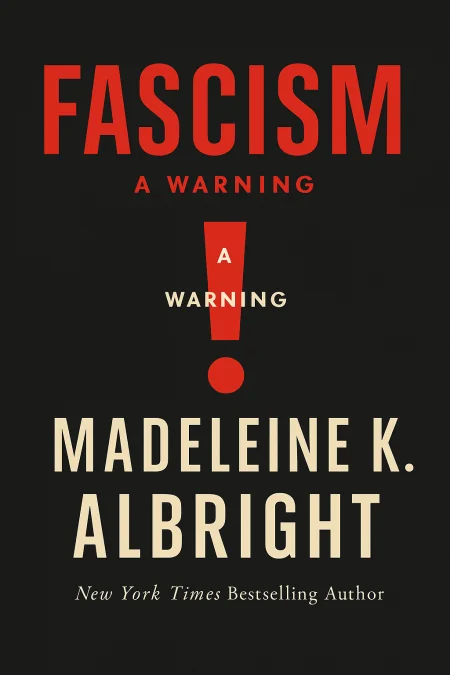
Fascism
A Warning
Book Edition Details
Summary
In a world shadowed by past horrors, Madeleine Albright, the trailblazing former U.S. Secretary of State, issues a clarion call in "Fascism: A Warning." With the insight of one who has both witnessed and shaped history, Albright dissects the chilling resurgence of fascist ideologies. Her narrative threads the past's haunting legacy with today’s political landscape, where democratic principles are increasingly threatened. As leaders mimic the autocratic tactics of the 20th century, Albright's book becomes a crucial manifesto for vigilance. She poignantly challenges us to recognize the signs of rising extremism and to fortify the fragile bastions of democracy before they crumble. This is more than a history lesson; it's an urgent plea to safeguard our future.
Introduction
In the shadow of Prague Castle on March 15, 1939, storm troopers escorted Adolf Hitler into the heart of Czechoslovakia, forever altering the trajectory of a young girl's life and the course of world history. That girl would grow up to become America's first female Secretary of State, but first she would witness the devastating power of fascism to destroy lives, nations, and the very fabric of civilization itself. This remarkable journey through the rise and fall of fascist movements reveals how democratic societies can slip toward authoritarianism through a series of seemingly small steps. From Mussolini's march on Rome to Putin's Russia, from the economic desperation that birthed the Nazi party to the contemporary erosion of democratic norms, we discover that fascism rarely announces itself with jackboots and rallies. Instead, it creeps forward through the exploitation of fear, the manipulation of grievances, and the gradual weakening of institutions that protect individual rights. The lessons contained within these pages speak directly to anyone who has ever wondered how civilized nations can descend into barbarism, how democratic institutions can be hollowed out from within, and why the price of freedom truly is eternal vigilance. For students of history, concerned citizens, and leaders at every level, this exploration offers both a sobering warning and an essential roadmap for recognizing and resisting the dark forces that continue to threaten human dignity and democratic governance around the world.
The Rise of Fascism: From Mussolini to Hitler (1920s-1940s)
The fascist movement emerged from the ashes of World War I, born in the meeting rooms of Milan where angry men pledged to "kill or die" in defense of Italy. Benito Mussolini, a former socialist turned nationalist demagogue, understood that democracy's greatest vulnerability lay not in its external enemies but in its own citizens' willingness to trade freedom for the promise of order and greatness. Mussolini's genius lay in recognizing that fascism need not be imposed from above but could grow from below, feeding on genuine grievances and legitimate frustrations. Italy in the 1920s faced economic chaos, political paralysis, and national humiliation. Into this void stepped a man who promised to make the trains run on time and restore the glory of ancient Rome. His methods were theatrical yet effective, combining mass spectacle with targeted violence, transforming politics from governance into entertainment. The pattern established in Italy would prove tragically exportable. In Germany, Adolf Hitler observed Mussolini's techniques and refined them for a nation nursing even deeper wounds. The Treaty of Versailles had left Germany economically devastated and psychologically shattered, creating fertile ground for a movement that promised to restore national pride through the identification and elimination of internal enemies. Hitler's particular innovation was the systematic deployment of lies so enormous that people assumed they must contain some truth. Both movements succeeded because they offered simple explanations for complex problems and channeled popular anger toward convenient scapegoats. They exploited the gap between democratic ideals and democratic performance, positioning themselves as the authentic voice of the people against corrupt elites. Most critically, they gained power not through revolution but through the ballot box, demonstrating that fascism could emerge from democracy itself when citizens lost faith in the system's ability to address their fundamental concerns.
Cold War Aftermath and Democratic Reversals (1990s-2000s)
The collapse of the Berlin Wall in 1989 seemed to herald the definitive triumph of democratic values over authoritarianism. From Prague's Wenceslas Square to the shipyards of Gdansk, millions celebrated the end of Communist rule and the promise of freedom. Yet within a decade, many of these same societies would discover that the transition from dictatorship to democracy was far more complicated than anyone had imagined. In Russia, the chaos of the 1990s created conditions eerily reminiscent of Weimar Germany. Economic collapse, political instability, and national humiliation provided the perfect breeding ground for a strongman who promised to restore order and dignity. Vladimir Putin's rise demonstrated how quickly democratic institutions could be captured and hollowed out by those who understood the system's vulnerabilities better than its defenders. The Yugoslav wars of the 1990s revealed how quickly ethnic nationalism could tear apart multinational societies that had lived in relative peace for decades. Slobodan Milošević's manipulation of historical grievances and his systematic use of media propaganda showed how modern technology could amplify ancient hatreds with devastating efficiency. The concentration camps that dotted Bosnia were a stark reminder that the horrors of the 20th century could return with shocking speed. Perhaps most troubling was the realization that democratic transitions were not irreversible. In country after country, the institutions of democracy proved fragile when confronted by leaders who viewed constitutional constraints as obstacles to be overcome rather than principles to be respected. The international community's focus on holding elections often ignored the deeper work of building democratic culture, leaving societies vulnerable to demagogues who could win votes while systematically dismantling the foundations of free government.
Contemporary Strongmen and Authoritarian Resurgence (2010s-Present)
The second decade of the 21st century witnessed the emergence of a new generation of strongmen who understood how to exploit democracy's vulnerabilities while maintaining the facade of popular legitimacy. Unlike their 20th-century predecessors, these leaders operated in an interconnected world where they could learn from each other's successes and failures. In Turkey, Recep Tayyip Erdoğan transformed himself from a democratic reformer into an increasingly authoritarian leader, using a failed coup attempt as justification for purging tens of thousands of civil servants, judges, and military officers. His methods became a template for aspiring autocrats worldwide: consolidate control of the media, pack the courts with loyalists, and brand all opposition as treason. Viktor Orbán's Hungary demonstrated how European Union membership provided no immunity against democratic backsliding. By employing the rhetoric of "illiberal democracy," Orbán showed how populist language could mask authoritarian intentions, while his systematic attacks on civil society organizations and independent media revealed the playbook for dismantling democracy from within. In Venezuela, Hugo Chávez's initially popular revolution gradually morphed into the economic and political catastrophe overseen by his successor, Nicolás Maduro. The Venezuelan experience illustrated how charismatic leadership and oil wealth could temporarily mask the fundamental incompatibility between authoritarian governance and sustainable prosperity. These contemporary strongmen shared several key characteristics: they claimed to speak for "the real people" against corrupt elites, they systematically weakened independent institutions, and they used democratic procedures to gain power while gradually eliminating democratic competition. Most importantly, they recognized that in the modern era, successful authoritarianism required not the elimination of elections but their careful management to ensure predetermined outcomes.
Democracy Under Siege: Lessons and Warnings for Today
The historical patterns revealed in these pages point to a troubling conclusion: democracy's greatest enemy is not external conquest but internal decay. Fascist movements succeed not by overthrowing democratic institutions but by capturing and corrupting them, turning the tools of self-governance into instruments of oppression. The warning signs remain remarkably consistent across time and geography. Democratic erosion begins with the demonization of opposition, the systematic undermining of independent media, and the cultivation of contempt for constitutional constraints. It accelerates when political leaders prioritize loyalty over competence, when courts become partisan weapons, and when the rule of law gives way to the rule of power. The digital age has amplified these dangers exponentially. Social media platforms that were supposed to democratize information have instead enabled the spread of disinformation on an unprecedented scale. Foreign adversaries can now interfere in domestic politics with surgical precision, while domestic demagogues can bypass traditional gatekeepers to speak directly to their followers' fears and prejudices. Yet history also provides reasons for hope. Democracy has proven remarkably resilient when its defenders remain vigilant and engaged. The key lies in recognizing that democratic institutions are not self-sustaining machines but living systems that require constant tending. They depend not merely on laws and procedures but on the civic virtues and democratic habits of ordinary citizens who must choose, day after day, to uphold the values of tolerance, compromise, and mutual respect that make free government possible.
Summary
The central lesson that emerges from this historical survey is that fascism is not a relic of the past but a persistent threat that adapts to each era's particular circumstances. Whether cloaked in the black shirts of Mussolini's Italy or the digital manipulation of contemporary authoritarians, the fascist impulse remains fundamentally the same: the exploitation of fear and grievance to concentrate power in the hands of those who promise simple solutions to complex problems. The historical pattern reveals that democratic societies are most vulnerable during periods of economic uncertainty, cultural change, and institutional failure. When citizens lose faith in their government's ability to address their concerns, they become susceptible to leaders who promise to cut through democratic complexity with authoritarian efficiency. The tragedy is that these promises inevitably prove hollow, leading not to effective governance but to the destruction of the very foundations upon which prosperity and security depend. Today's challenges demand both historical awareness and contemporary vigilance. Citizens must learn to recognize the early warning signs of democratic erosion, support independent institutions, and resist the temptation to trade freedom for the illusion of security. Leaders at every level must recommit themselves to the patient work of democratic governance, addressing legitimate grievances while defending the norms and institutions that protect minority rights and individual dignity. Most importantly, we must remember that democracy's survival depends not on the actions of heroes but on the daily choices of ordinary people who refuse to remain silent when freedom comes under attack.
Related Books
Download PDF & EPUB
To save this Black List summary for later, download the free PDF and EPUB. You can print it out, or read offline at your convenience.
By Madeleine K. Albright
