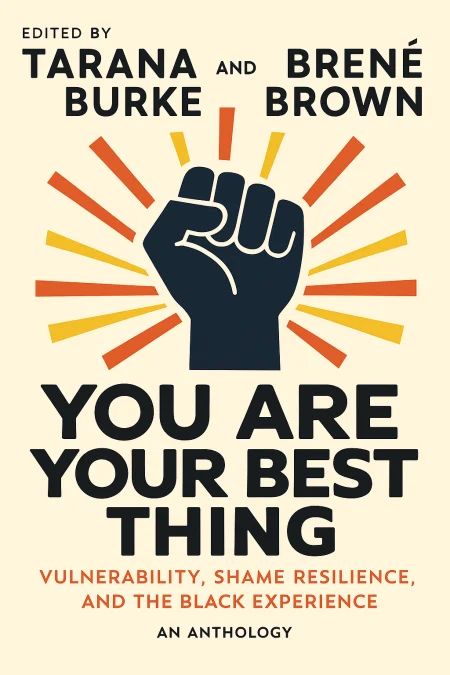
You Are Your Best Thing
Vulnerability, Shame Resilience, and the Black Experience
Book Edition Details
Summary
Tarana Burke and Dr. Brené Brown have crafted a transformative tapestry of voices in "You Are Your Best Thing," weaving together the raw truths of Black experience with threads of vulnerability and resilience. This powerful anthology gathers an array of gifted Black thinkers and creators—including Kiese Laymon, Imani Perry, and Laverne Cox—to confront the complex dance between personal healing and systemic oppression. Through candid essays, these contributors navigate the dual landscapes of emotional depth and societal injustice, offering a space for recognition and reclamation. Born from an unexpected conversation between Burke and Brown, this collection transcends academic discourse, speaking directly to the heart with authenticity and urgency. Readers are invited to witness the courageous peeling away of armor, revealing stories that resonate with the universal quest for love and liberation amidst the shadows of white supremacy.
Introduction
In a quiet moment after her mother's death, a daughter sits in her therapist's office, finally ready to speak the truth she's carried for decades. The weight of generational silence, of being told to stay strong no matter what, has become unbearable. For the first time, she allows herself to be seen not as the resilient Black woman everyone expects, but as someone who hurts, who fears, who needs healing. This moment of radical vulnerability becomes the beginning of her true liberation. This collection brings together powerful voices exploring the complex relationship between Blackness, vulnerability, and healing. In a world that demands armor from Black bodies, these stories reveal the courage it takes to remove that protection and embrace our full humanity. Through personal narratives that span childhood trauma, professional challenges, and intimate relationships, each contributor illuminates how shame operates differently in Black communities and how vulnerability can become a pathway to freedom. Here you'll discover not just the pain of carrying ancestral wounds, but the profound healing that comes when we dare to be authentically ourselves, creating space for others to do the same.
The Weight of Being: Stories of Shame and Identity
Jason Reynolds recalls being thirteen when his grandfather's leg was amputated, and thirteen when he died. Years later, at twenty-two, Reynolds faced his own moral amputation when his mother needed emergency surgery on the same day he was meant to sign his first book deal. Despite the twelve-hour surgery that could have taken her life, he chose his career over being present for her potential final moments. The shame of that choice haunted him for over a decade, creating an infection of self-loathing that spread through every aspect of his identity. Keah Brown remembers the moment shame first took hold at age twelve, when a classmate mocked her limp in the school cafeteria. Born with cerebral palsy, she had loved her Black skin since childhood, finding power in her shared identity with strong Black women. But discovering that her disability could be weaponized against her shattered that confidence, leaving her feeling "undesirable and invisible" for years to come. For Tracey Michae'l Lewis-Giggetts, shame arrived wrapped in the protective arms of church mothers who meant well but wielded silence as scripture. After childhood sexual abuse, the Black church that should have offered sanctuary instead demanded respectability, teaching her that her trauma was something to hide rather than heal. The very institution meant to provide spiritual refuge became another space where her full humanity couldn't be acknowledged. These stories reveal how shame operates as both personal wound and systemic weapon, targeting Black bodies and spirits with precision. When society teaches you that your very existence is shameful, the simple act of being yourself becomes an act of radical defiance.
Breaking the Armor: From Survival to Authenticity
Tanya Denise Fields woke up one morning with scratches around her neck, a bruised throat, and eyes swollen from crying all night. Her partner had nearly killed her in front of her six children. Sitting in the 41st Precinct, facing a dismissive white officer, she reached a point of spiritual bankruptcy. The shame that had protected her for so long by making her accept less than she deserved had finally led her to the edge of death. In that moment of complete exhaustion, she decided to reject the narrative that she had to earn love and safety through performance. Marc Lamont Hill learned early that his sensitivity was dangerous for a Black boy in North Philadelphia. The tears came too easily, the books mattered more than basketball, and his natural tenderness was constantly corrected by adults who feared for his survival. By the time he reached college, he had successfully armored himself in traditional masculinity, believing that his humanity was tied to his ability to suppress vulnerability. It took a Black feminist psychology course to help him understand that the very traits he'd been taught to hide were sources of strength. Laverne Cox carries the weight of her great-grandfather's story, a freedman who took a dead cow to feed his family and was sold back into slavery as punishment. That generational trauma lives in her body today as she navigates the world as a Black trans woman, knowing that the same systems that brutalized her ancestors continue to threaten her existence. The hypervigilance required for survival makes vulnerability feel like luxury she cannot afford. These stories illuminate the exhausting performance required to survive in a hostile world, and the revolutionary act of choosing authenticity over safety. Breaking the armor doesn't mean becoming defenseless; it means choosing when and how to be vulnerable on your own terms.
Healing in Community: Love as Resistance
Shawn Ginwright discovered the power of collective healing while working with young people in Oakland. When seventeen-year-old Greg lost his friend to gun violence, his automatic response was "I'm cool, I'm good, I'm a'ight." But in the safety of healing circles, surrounded by others who shared his reality, Greg found permission to feel what he'd been taught to numb. The blues, Ginwright learned from his Uncle Kenny, is about opening up and pouring out whatever is inside without shame or polish. True healing happens not in isolation, but in the sacred bonds created when people risk being vulnerable together. Austin Channing Brown felt her own version of "foreboding joy" as she watched her toddler son pull his hood up in the bathroom, looking exactly like Trayvon Martin. The racist reality that can steal Black joy at any moment creates a unique form of vulnerability where happiness itself feels dangerous. Yet she refuses to let white supremacy steal both her life and her capacity for love, choosing to "love harder" and "lean into joy" as acts of resistance. Yolo Akili Robinson writes to their future self with radical honesty about the sickness that comes from trying to contain generational shame. After struggling with panic attacks disguised as strength for decades, they recognize that healing requires community witnesses who can hold the truth when it becomes too heavy for one person to carry alone. The work isn't just individual therapy but collective liberation from the stories that keep Black people isolated in their pain. These narratives demonstrate that healing happens in relationship, in the courage to share our stories and the commitment to hold space for others' pain without judgment. When we create containers strong enough to hold the truth of Black experience, we begin to transform not just ourselves but the very systems that created our wounds. Love becomes the antidote to shame, and vulnerability becomes a pathway to freedom that benefits not just individuals but entire communities yearning to breathe.
Summary
Through intimate stories of trauma and triumph, this collection reveals that vulnerability is not a luxury Black people cannot afford but a necessity for true liberation. Each narrator's journey from shame to healing illuminates a universal truth: we cannot armor our way to wholeness. Whether facing childhood abuse, professional discrimination, or the daily violence of white supremacy, these voices demonstrate that authentic healing requires the courage to be seen in our full humanity. The path forward lies not in individual resilience alone but in creating communities brave enough to hold each other's truth, transforming shame into strength and isolation into connection. When we dare to remove the armor that survival has required, we discover that our greatest vulnerability becomes our most powerful gift, not just to ourselves but to future generations who will inherit our courage instead of our wounds.
Related Books
Download PDF & EPUB
To save this Black List summary for later, download the free PDF and EPUB. You can print it out, or read offline at your convenience.
By Brené Brown
