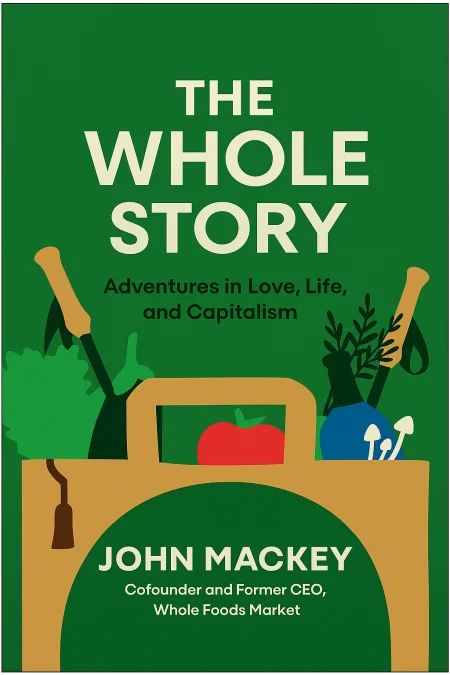
The Whole Story
Adventures in Love, Life, and Capitalism
Book Edition Details
Summary
John Mackey, the visionary behind Whole Foods Market, unveils the riveting saga of a small natural foods store blossoming into a global phenomenon. In "The Whole Story," Mackey offers a candid peek behind the curtain, sharing untold anecdotes of the vibrant characters and seismic decisions that fueled the company’s ascent. This is more than a tale of entrepreneurial triumph; it’s an exploration of cultural transformation, personal evolution, and ideological awakening. From wild entrepreneurial gambits to philosophical introspection, Mackey’s journey is a tapestry of idealism and ambition woven together with a commitment to ethical capitalism. For anyone who has ever shopped at Whole Foods or been curious about the impact of conscious business, this is a narrative of passion, innovation, and the relentless pursuit of a mission that reshaped how the world eats and thinks.
Introduction
In 1978, a twenty-five-year-old college dropout with shoulder-length hair stood in a cramped Victorian house in Austin, Texas, surrounded by bins of organic produce and dreams of revolutionizing how Americans thought about food. John Mackey had no business plan, no MBA, and barely enough money to keep the lights on in his tiny natural foods store called SaferWay. Yet within four decades, this unlikely entrepreneur would transform his countercultural idealism into Whole Foods Market, a multi-billion-dollar empire that fundamentally changed the grocery industry and pioneered the concept of conscious capitalism. Mackey's extraordinary journey unfolds against the backdrop of America's cultural evolution, from the hippie movement of the 1970s through the corporate responsibility awakening of the 21st century. His story challenges every conventional assumption about business leadership, proving that companies can be both wildly profitable and deeply purposeful. Through devastating floods, boardroom coups, and the pressures of public ownership, he maintained an unwavering commitment to serving all stakeholders—customers, employees, suppliers, communities, and shareholders—rather than prioritizing profits alone. From Mackey's remarkable transformation, readers will discover how authentic leadership emerges when personal values align with business strategy, creating enterprises that generate both financial returns and social impact. His experience reveals the art of scaling a mission-driven organization without losing its soul, the power of viewing business as a force for good, and the profound satisfaction that comes from building something meaningful that outlasts its founder. Most importantly, his story demonstrates that the most successful businesses are often those that dare to serve a purpose greater than themselves.
Countercultural Awakening: From College Dropout to Natural Foods Pioneer
John Mackey's entrepreneurial awakening began not in a boardroom or business school, but in the communal kitchens and food cooperatives of 1970s Austin, where he discovered that his deepest values could become the foundation for meaningful work. After dropping out of the University of Texas, he found himself drawn to the emerging natural foods movement, living in vegetarian cooperatives and questioning the materialistic assumptions of mainstream American culture. Unlike many of his peers who rejected capitalism entirely, Mackey began to envision business as a potential vehicle for positive change, a way to align his countercultural ideals with practical action in the world. The decision to open SaferWay Natural Foods with his girlfriend Renee Lawson represented a leap of faith that would define the rest of his life. With just $45,000 borrowed from family and friends, they transformed a rundown house into Austin's first large-scale natural foods store, sleeping upstairs and working eighteen-hour days to keep the dream alive. The early months were marked by constant financial pressure, learning every aspect of retail through trial and error, and the gradual realization that passion alone wasn't sufficient to sustain a business—they needed to develop real expertise in operations, marketing, and customer service. The merger with Clarksville Natural Grocery in 1980 marked Mackey's evolution from idealistic shopkeeper to visionary business leader, creating the original Whole Foods Market in a spacious 10,500-square-foot location that offered something unprecedented: a full-service grocery store dedicated entirely to natural and organic foods. This wasn't just about selling healthier products; it was about creating an entirely new retail experience that educated customers about nutrition, organic farming, and environmental sustainability. Mackey understood intuitively that he wasn't competing with other health food stores—he was pioneering a new category that would eventually transform the entire grocery industry. The devastating flood that destroyed the store just nine months after opening became a defining moment in Mackey's development as a leader, teaching him profound lessons about resilience, community, and the power of stakeholder loyalty. Standing in eight feet of muddy water, watching his life's work literally float away, he could have given up. Instead, the outpouring of support from customers, suppliers, and employees who volunteered their time and resources to help rebuild convinced him that they had created something more valuable than a business—they had built a community united around shared values and mutual care.
Building an Empire: Scaling Values While Growing Whole Foods Market
As Whole Foods expanded beyond Austin, Mackey faced the fundamental challenge that confronts every values-driven entrepreneur: how to maintain the company's soul while building the systems and processes necessary for large-scale success. His approach to this dilemma revealed a sophisticated understanding that culture, not strategy, would ultimately determine whether Whole Foods could fulfill its mission of transforming American eating habits. Rather than imposing rigid corporate policies from headquarters, he created a decentralized structure that empowered local teams to adapt the company's values to their specific communities while maintaining consistent standards for quality and service. The company's expansion strategy throughout the 1980s and 1990s demonstrated Mackey's unique blend of idealistic vision and pragmatic execution, as he carefully selected markets where natural foods could find receptive audiences while gradually building the infrastructure needed for national growth. Each new store was designed as a community gathering place that went far beyond traditional grocery shopping, featuring extensive prepared food sections, educational displays about organic farming, and knowledgeable team members who could guide customers toward healthier choices. This wasn't just retail innovation; it was cultural evangelism, spreading the natural foods message one community at a time. The decision to take Whole Foods public in 1992 marked a crucial test of Mackey's commitment to conscious capitalism, as he had to prove that a values-driven company could satisfy Wall Street's demands for growth and profitability without compromising its core mission. Many observers expected the company's culture to deteriorate under shareholder pressure, but Mackey used the public platform to advocate for what he called "stakeholder capitalism," demonstrating that businesses could create value for customers, employees, suppliers, and communities while delivering exceptional returns to investors. His willingness to cap executive compensation, share profits widely through stock options, and maintain high standards for product quality and environmental responsibility showed that going public didn't have to mean selling out. The acquisition strategy that fueled Whole Foods' rapid growth revealed Mackey's mature understanding of how to expand while preserving the entrepreneurial spirit that made the company special. Rather than simply buying competitors and imposing corporate uniformity, he sought to learn from each acquired company, incorporating their best practices while gradually introducing Whole Foods' values and standards. This patient, respectful approach to integration allowed the company to grow from a regional chain to a national powerhouse while maintaining the local flavor and community connections that customers valued, proving that conscious capitalism could scale without losing its authenticity.
Conscious Leadership: Navigating Crises and Corporate Evolution
The true measure of Mackey's leadership philosophy emerged during the inevitable crises that test every growing enterprise, from natural disasters and competitive threats to internal power struggles and activist investor campaigns. His response to these challenges consistently reflected his commitment to what he called "conscious leadership"—making decisions based on the long-term interests of all stakeholders rather than short-term pressures from any single group. This approach required tremendous courage and conviction, especially when Wall Street analysts questioned his priorities or when internal critics challenged his fitness to lead the company he had founded. One of the most significant tests came in the form of a boardroom coup attempt that nearly cost Mackey his position as CEO, forcing him to confront uncomfortable truths about his own leadership style and the need for continuous personal growth. Rather than responding defensively or seeking revenge against his critics, he used the crisis as an opportunity for deep self-reflection, embarking on a transformative journey that included hiking the Appalachian Trail and studying with spiritual teachers who helped him develop greater emotional intelligence and collaborative skills. This willingness to examine his own role in problems, rather than simply blaming external forces, demonstrated the kind of mature leadership that conscious capitalism requires. The company's response to external crises, such as Hurricane Katrina and the 2008 financial crisis, showcased Mackey's understanding that how a business behaves during difficult times reveals its true character and builds lasting stakeholder loyalty. When natural disasters struck communities where Whole Foods operated, the company didn't just reopen its stores—it became a community resource, providing food and supplies to relief workers and displaced residents. During economic downturns, while many companies cut benefits and laid off workers, Whole Foods maintained its commitment to team members and continued investing in long-term growth, recognizing that conscious businesses have responsibilities that extend beyond quarterly earnings reports. Mackey's evolution as a conscious leader was perhaps most evident in his response to criticism from animal rights activists, who challenged Whole Foods' practices regarding the treatment of animals in its supply chain. Initially defensive about these attacks, he eventually embraced them as an opportunity to become more informed and ethically consistent, ultimately becoming vegan himself and leading the development of comprehensive animal welfare standards that transformed industry practices. This willingness to admit mistakes, learn from critics, and change course based on new information exemplified the kind of principled leadership that earned him respect even from former adversaries and established Whole Foods as a genuine force for positive change in the food system.
Legacy and Transformation: The Amazon Sale and Beyond
The decision to sell Whole Foods to Amazon in 2017 represented perhaps the most emotionally complex choice of Mackey's career, as he had to balance his desire to maintain the company's independence with his responsibility to protect its mission and values from activist investors who threatened to break it apart. His selection of Amazon wasn't simply about financial considerations—it reflected his belief that Jeff Bezos's customer obsession and long-term thinking aligned with Whole Foods' stakeholder capitalism principles, creating the best opportunity for the company to continue serving its higher purpose while accessing the resources needed for continued growth and innovation. The integration with Amazon brought both unprecedented opportunities and significant cultural challenges that tested Mackey's adaptability as a leader in his fifth decade with the company. On the positive side, Amazon's vast resources allowed Whole Foods to lower prices dramatically, invest in cutting-edge technology, and expand more rapidly than would have been possible as an independent company. However, the cultural merger proved more complex than anticipated, as Amazon's data-driven, hierarchical approach sometimes clashed with Whole Foods' more intuitive, collaborative culture, requiring careful navigation to preserve what made the company special while embracing beneficial changes. Mackey's decision to retire from Whole Foods in 2022, after 44 years of leadership, marked not an ending but a transformation, as he launched Love.Life, a new venture that combines his passions for natural foods, wellness, personal growth, and community building into what he envisions as the next evolution of conscious capitalism. This new enterprise represents the culmination of his life's learning about how business can serve human flourishing, creating spaces where people can nourish their bodies, minds, and spirits while building meaningful connections with others who share their values and aspirations. The transition from building Whole Foods to creating Love.Life illustrates Mackey's understanding of business as what he calls an "infinite game"—not something you play to win and finish, but something you engage in to keep playing at higher and higher levels of contribution and impact. His new venture combines a wellness center, healthy food offerings, educational programs, and community spaces, demonstrating that retirement for a true entrepreneur isn't about stepping back from meaningful work but finding new ways to serve others and create value in the world.
Summary
John Mackey's extraordinary journey from Austin hippie to Fortune 500 CEO demonstrates that business success and social consciousness are not competing forces but complementary aspects of sustainable enterprise, proving that companies can generate exceptional profits while serving all stakeholders and contributing to human flourishing. His greatest legacy lies not just in building a successful company, but in pioneering the conscious capitalism movement that has inspired thousands of entrepreneurs to view business as a force for good, showing that the most enduring enterprises are those that align profit with purpose and create value for everyone they touch. The essential lessons from Mackey's experience offer profound guidance for anyone seeking to build meaningful work and create positive impact in the world. First, that authentic success emerges when personal values align with professional activities, providing the energy and resilience needed to overcome inevitable challenges while maintaining integrity under pressure. Second, that conscious leadership requires continuous personal growth and the humility to learn from critics, admit mistakes, and evolve one's thinking based on new information and changing circumstances. His story will particularly resonate with entrepreneurs, business leaders, and anyone interested in the intersection of commerce and consciousness, showing that it's possible to build thriving enterprises while treating people well, protecting the environment, and serving the greater good.
Related Books
Download PDF & EPUB
To save this Black List summary for later, download the free PDF and EPUB. You can print it out, or read offline at your convenience.
By John Mackey
