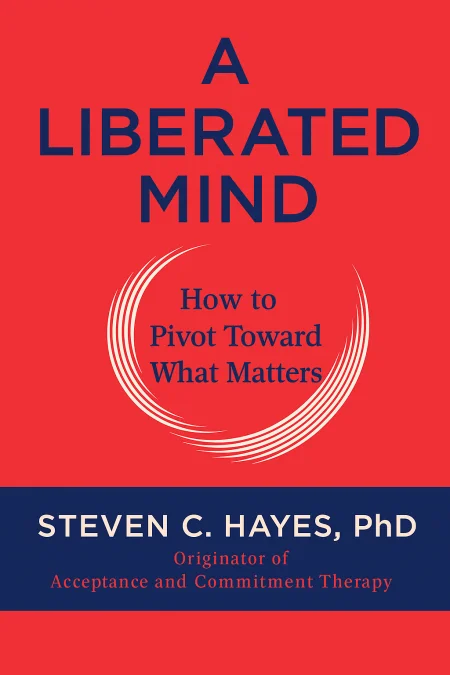
A Liberated Mind
How to Pivot Toward What Matters
Book Edition Details
Summary
When the mind whispers to flee from pain, Dr. Steven Hayes offers a radical alternative: embrace it. "A Liberated Mind" dives into the transformative power of Acceptance and Commitment Therapy (ACT), illustrating how psychological flexibility can lead to a life rich with meaning despite life's inevitable struggles. With insights born from a pivotal panic attack, Hayes lays out six mental shifts that guide readers toward a harmonious relationship with their thoughts and emotions. This book champions the courage to feel fully and think freely, empowering readers to align their actions with their deepest values. For anyone caught in the web of anxiety, depression, or chronic pain—or simply seeking a path to authenticity—this compelling narrative blends scientific discovery with heartfelt stories, making the case for vulnerability as a source of strength.
Introduction
Why do we often find ourselves trapped by our own thoughts, repeating destructive patterns despite knowing better? Modern psychology has long struggled with this fundamental question, offering solutions that frequently fall short of lasting change. The answer lies not in controlling our thoughts and emotions, but in fundamentally transforming our relationship with them through psychological flexibility. This revolutionary approach emerges from decades of rigorous scientific research into human cognition and behavior. At its core lies a sophisticated understanding of how language and symbolic thinking both empower and entrap us, creating internal dictators that govern our actions through fear and avoidance. The framework presented here offers a systematic method for liberation from these mental constraints, grounding abstract psychological concepts in concrete, measurable practices that have been validated across thousands of studies. The theoretical foundation rests on six interconnected processes that together constitute psychological flexibility: the ability to stay present with our experience while taking action guided by our values, even when that experience is difficult. This comprehensive model addresses fundamental questions about human suffering, resilience, and growth, providing both explanatory power and practical tools for transformation. Rather than viewing psychological distress as pathology to be eliminated, this approach recognizes it as information to be understood and integrated into a meaningful life.
The Dictator Within: Understanding Mental Rigidity
Mental rigidity emerges from what can be understood as an internal dictator, a voice within our minds that promises solutions to psychological pain through control and avoidance. This dictator represents the problem-solving aspect of human cognition gone awry, applying external world strategies to internal experiences where they prove not only ineffective but actively harmful. The dictator speaks in absolutes, demanding that we eliminate uncomfortable thoughts and feelings before we can live fully. The theoretical foundation of this rigidity lies in our evolutionary heritage and the development of human language. Our symbolic thinking abilities, while enabling remarkable achievements, also create a unique form of suffering unknown to other species. Through relational learning, we develop the capacity to relate anything to anything else in our minds, creating vast networks of associations that can be triggered automatically. A single anxious thought can cascade into elaborate scenarios of catastrophe, all experienced as vividly real despite existing only in imagination. This rigidity manifests through three primary mechanisms: experiential avoidance, cognitive fusion, and attachment to a conceptualized self. Experiential avoidance involves the systematic attempt to escape or control internal experiences, paradoxically increasing their intensity and impact. Cognitive fusion occurs when we become so identified with our thoughts that we mistake them for reality itself, losing the ability to see them as mental events. The conceptualized self represents our attachment to stories about who we are, stories that must be defended and maintained at great psychological cost. Consider the person who avoids social situations due to fear of rejection. The internal dictator promises that avoidance will eliminate anxiety, but instead creates a prison of isolation. Each avoided interaction strengthens the belief that social connection is dangerous, while simultaneously increasing the very anxiety it was meant to eliminate. The person becomes trapped in a cycle where the solution becomes the problem, and the problem demands more of the same ineffective solution.
Six Pivots of Psychological Flexibility
Psychological flexibility emerges through six interconnected skills, each representing a pivot away from rigid patterns toward adaptive responding. These pivots work synergistically, like dance steps that combine into fluid movement, transforming the energy trapped in rigid patterns into vitality and purpose. Understanding these as pivots rather than techniques emphasizes their dynamic nature and the way they redirect existing psychological energy rather than suppressing it. The first three pivots address our relationship with internal experiences. Defusion involves stepping back from thoughts to see them as mental events rather than literal truths, like watching clouds pass through the sky rather than being caught in the storm. Self-as-context connects us with the observing self that remains constant across all experiences, the "I" that notices thoughts and feelings without being defined by them. Acceptance involves making room for difficult experiences without struggling against them, recognizing that pain and purpose often intertwine. The second three pivots focus on engagement with life and action. Present-moment awareness involves flexible attention that can focus where needed rather than being hijacked by past regrets or future worries. Values clarification identifies chosen directions for living based on what matters most deeply, distinct from goals imposed by others or driven by avoidance. Committed action involves building patterns of behavior aligned with values, even when such action provokes discomfort or uncertainty. These skills address fundamental human needs in healthy ways. The yearning for coherence gets satisfied through functional rather than literal consistency. The need for belonging is met through authentic connection rather than image management. The desire for competence is fulfilled through values-based action rather than outcome-dependent achievement. Each pivot transforms a natural human drive from a source of suffering into a foundation for growth. The interconnected nature of these skills means that developing one supports the others. Defusion makes acceptance easier by reducing the literal impact of fearful thoughts. Values work provides motivation for difficult acceptance work. Present-moment awareness supports both defusion and committed action. This synergy explains why comprehensive approaches prove more effective than targeting individual symptoms or behaviors in isolation.
ACT Applications: Mental Health and Relationships
The practical application of psychological flexibility principles has demonstrated remarkable effectiveness across diverse populations and challenges, from chronic pain and addiction to workplace performance and parenting. What makes these applications particularly powerful is their focus on workability rather than symptom elimination, asking not whether interventions make people feel better, but whether they help people live better. In clinical settings, ACT interventions consistently show that psychological flexibility mediates positive outcomes across conditions. Cancer patients learning acceptance skills show not only reduced distress but increased post-traumatic growth, finding meaning and strength through their struggle rather than despite it. Veterans with PTSD discover that carrying their experiences with honor rather than shame allows them to reconnect with their values of service and protection. Addiction recovery programs incorporating ACT principles show superior long-term outcomes because they address the underlying patterns of experiential avoidance that drive substance use. The workplace applications reveal the broader relevance of these principles beyond clinical populations. Organizations implementing psychological flexibility training see improvements in employee engagement, creativity, and resilience. Leaders learn to respond rather than react to challenging situations, making decisions based on organizational values rather than immediate emotional impulses. Teams develop greater capacity for difficult conversations and innovative problem-solving when members can stay present with uncertainty and disagreement. Perhaps most significantly, these applications demonstrate that psychological flexibility is not merely a therapeutic intervention but a fundamental life skill. Parents using these principles raise children who are more emotionally intelligent and resilient. Students learning flexibility skills show improved academic performance and reduced anxiety. Even brief interventions, sometimes lasting only hours, can produce lasting changes because they target core processes that generalize across life domains. The transformative power lies not in the elimination of life's difficulties but in the development of a different relationship with those difficulties. People discover they can feel anxious and still give important presentations, experience grief and still find joy, face uncertainty and still take meaningful action. This shift from control to acceptance, from avoidance to engagement, represents a fundamental reorientation toward life that honors both its challenges and its possibilities.
Social Transformation Through Flexibility Skills
The implications of psychological flexibility extend far beyond individual therapy to encompass education, organizations, and society as a whole. When communities embrace these principles, they create environments that foster cooperation, resilience, and positive change rather than defensiveness and rigid adherence to failing systems. This represents a paradigm shift from pathology-focused approaches to ones that cultivate human potential and adaptive capacity. Educational applications demonstrate how psychological flexibility can transform learning environments. Schools implementing these principles see reductions in student anxiety and behavioral problems, while simultaneously improving academic performance and social skills. Students learn to approach challenges with curiosity rather than fear, viewing mistakes as learning opportunities rather than threats to their self-worth. Teachers develop greater resilience and job satisfaction when they can stay present with classroom difficulties while maintaining connection to their values of education and growth. Organizational transformation occurs when psychological flexibility principles guide leadership development and team dynamics. Companies report improved innovation and adaptability when employees feel safe to take risks and express diverse perspectives. Conflict resolution becomes more effective when participants can stay present with disagreement while maintaining focus on shared values and goals. The result is organizational cultures that thrive in uncertainty and change rather than being paralyzed by them. Perhaps most importantly, these principles offer hope for addressing large-scale social challenges like prejudice, environmental degradation, and political polarization. When individuals develop the capacity to hold their beliefs lightly while staying connected to deeper values like compassion and justice, they become more capable of engaging constructively with those who hold different views. This creates possibilities for collaborative problem-solving that transcends rigid ideological divisions. The ripple effects of widespread psychological flexibility training could fundamentally alter how societies approach complex problems. Instead of reactive, fear-based responses to challenges, communities could develop proactive, values-based approaches that honor both individual autonomy and collective well-being. This transformation requires not just individual change but systemic shifts in how institutions support human development and social cooperation.
Summary
True psychological liberation comes not from controlling our inner experiences but from changing our relationship with them, transforming the energy trapped in rigid patterns into flexible, values-guided action. This comprehensive framework offers both theoretical understanding and practical tools for this transformation, grounding ancient wisdom about acceptance and mindfulness in modern behavioral science. The implications extend far beyond individual therapy to encompass education, organizations, and society as a whole. As more people develop psychological flexibility, we create communities better equipped to handle complexity, uncertainty, and change. The ripple effects of this transformation touch every aspect of human experience, from intimate relationships to global challenges, suggesting that the cultivation of psychological flexibility may be essential for thriving in an increasingly complex world.
Related Books
Download PDF & EPUB
To save this Black List summary for later, download the free PDF and EPUB. You can print it out, or read offline at your convenience.
By Steven C. Hayes
