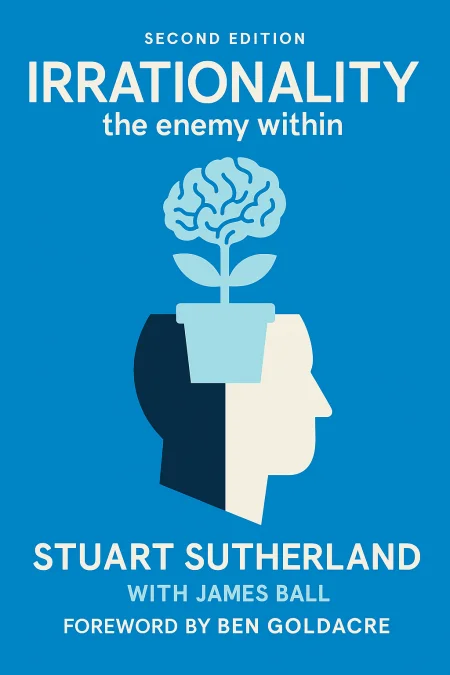
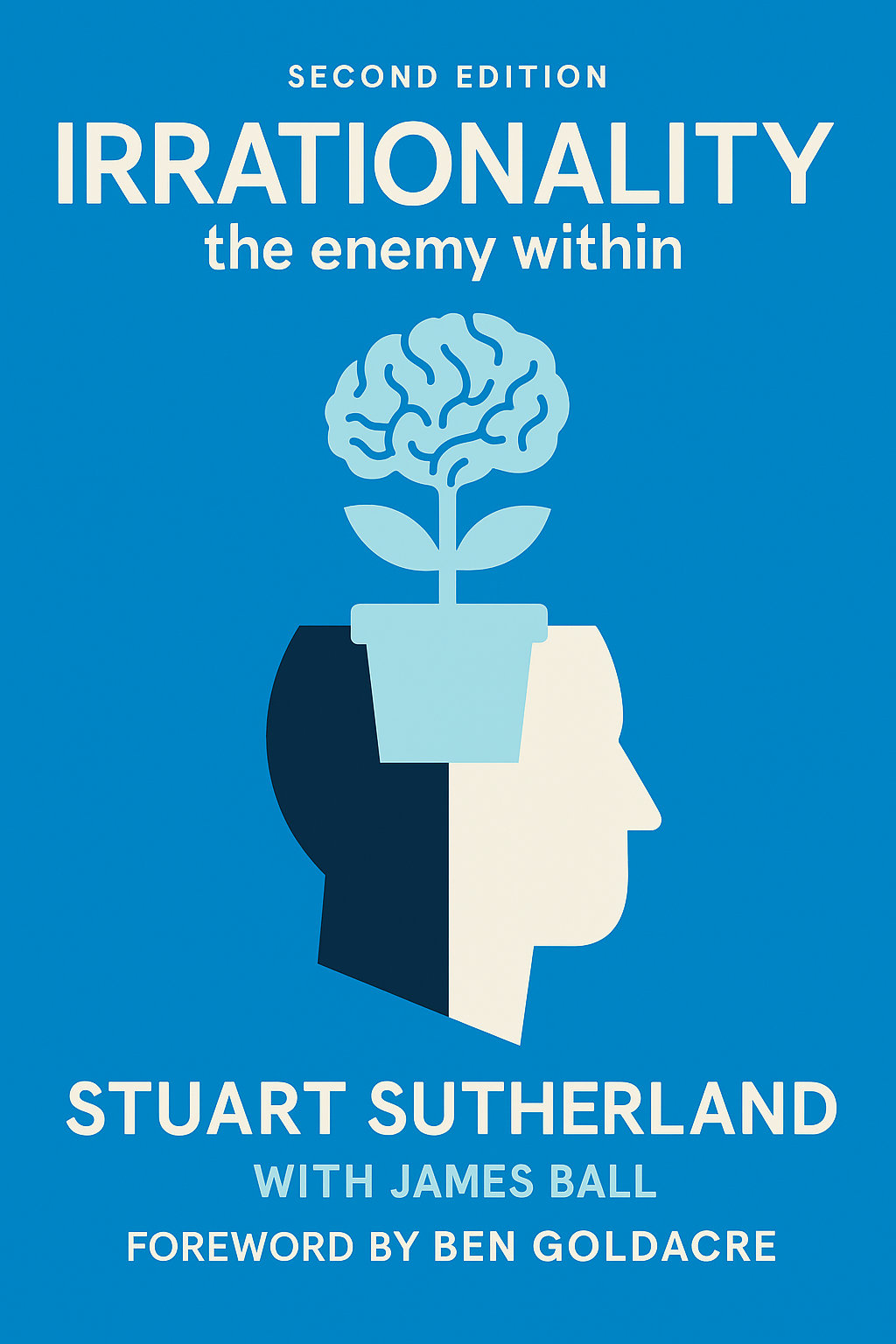
Irrationality
The Enemy Within
byBen Goldacre, Stuart Sutherland, James Ball
Book Edition Details
Summary
In a world where the irrational reigns supreme, even the best minds falter. "Irrationality" delves into the perplexing realm of flawed decision-making, revealing the paradoxes that plague our judgment. With a sharp wit and incisive analysis, this book uncovers the baffling errors of those in power—from doctors to generals—exposing the futility of conventional wisdom. Why do rewards and punishments fall short? Why is the interview process so flawed? Through the lens of statistics and probability, discover the surprising truths about human behavior and the elusive nature of logic. This 21st-anniversary edition, enriched by insights from Ben Goldacre and James Ball, remains a timeless exploration of the enigmatic human mind, challenging us to question our own reasoning in a world that demands clarity.
Introduction
Have you ever wondered why brilliant doctors sometimes ignore clear medical evidence, or why successful investors consistently lose money despite their expertise? Why do we believe fake news that confirms our opinions while dismissing well-researched facts that challenge them? The answer lies in a fascinating paradox: the human brain, despite its remarkable capabilities, is systematically flawed in ways that lead even the smartest people to make surprisingly poor decisions. These mental errors aren't random mistakes or signs of stupidity. Instead, they follow predictable patterns that scientists can study and map with remarkable precision. Our minds use shortcuts and rules of thumb that once helped our ancestors survive in a simpler world, but these same mental processes now lead us astray in our complex modern environment filled with statistics, probabilities, and abstract reasoning. Through decades of psychological research, we've discovered that our thinking is riddled with systematic biases that affect everyone from Nobel Prize winners to ordinary students. Understanding these patterns of irrationality isn't just academically interesting—it's essential for navigating daily life more effectively. You'll discover how social pressure can literally change what we see, why we're terrible at understanding risk and probability, and how our brains trick us into seeing patterns that don't exist. Most importantly, you'll learn to recognize these mental traps in your own thinking and develop strategies to make more rational decisions in an irrational world.
Cognitive Biases and Flawed Information Processing
Our brains are not neutral recording devices that simply capture reality as it exists. Instead, they're active interpreters that constantly filter, reshape, and distort information in predictable ways. Think of your mind as a funhouse mirror that systematically warps everything you see, making some things appear larger and more important while shrinking others into insignificance. One of the most powerful distortions is the availability bias, where we judge how likely something is based on how easily we can remember examples of it happening. This explains why people became terrified of shark attacks after watching the movie "Jaws," even though you're statistically more likely to be struck by lightning than eaten by a shark. Dramatic, memorable events stick in our minds and make us overestimate their probability, while boring but common dangers like heart disease fade into the background of our awareness. This bias doesn't just affect our fears—it shapes professional decisions with serious consequences. Doctors who recently treated a rare disease become more likely to diagnose it in future patients, even when symptoms point elsewhere. Investment advisors perform worse than random chance because they're swayed by recent market movements rather than long-term patterns. Even judges give harsher sentences right after lunch when they're in a bad mood, showing how irrelevant factors can influence supposedly objective decisions. Perhaps most troubling is how these biases reinforce our existing beliefs through confirmation bias. We unconsciously seek information that supports what we already think while ignoring contradictory evidence. It's like having a personal assistant who only shows you news articles that confirm your opinions while hiding everything else. This selective attention to evidence helps explain why people with access to the same information can reach completely opposite conclusions, each convinced that reality supports their view.
Social Influences on Irrational Behavior
Humans evolved as social creatures who survived by cooperating in groups, and this heritage profoundly shapes how we think and make decisions. Our need to fit in and be accepted by others can literally override the evidence of our own senses, leading us to abandon correct judgments in favor of group harmony. This isn't just about peer pressure among teenagers—it's a fundamental feature of human psychology that affects everyone. The classic experiments by Solomon Asch revealed just how powerful social influence can be. When people were asked to judge which of three lines matched the length of a target line—a task so simple that mistakes were virtually impossible when done alone—a shocking percentage gave obviously wrong answers when surrounded by others who had been secretly instructed to choose incorrectly. These weren't weak-willed individuals; they were ordinary people whose perception of reality was altered by social pressure. Group dynamics create their own forms of irrationality that go beyond simple conformity. When people with similar views come together, their opinions don't moderate toward a reasonable middle ground. Instead, they become more extreme through a process called group polarization. A group of people who are mildly concerned about an issue can talk themselves into panic, while those who are slightly optimistic can convince themselves that no problems exist at all. Perhaps most disturbing is how easily we form tribal loyalties based on completely arbitrary distinctions. Researchers have created instant prejudice by randomly dividing people into groups based on meaningless criteria like preferring one abstract painting over another. Within minutes, people show favoritism toward their own group and hostility toward the other, even though they know the division was random. This tribal thinking helps explain everything from sports rivalries to political polarization to ethnic conflict, revealing how our social nature can completely overwhelm rational judgment.
Poor Decision-Making and Faulty Predictions
When it comes to making decisions about uncertain outcomes, human intuition proves remarkably unreliable. Our minds employ shortcuts that work reasonably well for simple, everyday choices but fail dramatically when dealing with complexity, statistics, or long-term consequences. These failures follow predictable patterns that reveal fundamental flaws in how we process information about risk and probability. Consider how we handle medical test results, a situation where accuracy can be literally a matter of life and death. Most people, including many doctors, believe that if a test is 90 percent accurate and you test positive for a disease, there's a 90 percent chance you actually have the disease. This seems logical, but it's completely wrong. The actual probability depends on how common the disease is in the population being tested. If the disease affects only one person in a thousand, then even with a highly accurate test, most positive results will be false alarms. This confusion about conditional probabilities reflects a broader problem with statistical reasoning. We consistently ignore base rates—the underlying frequency of events—when making judgments. We're impressed by dramatic individual cases while dismissing comprehensive statistical evidence. We see meaningful patterns in random events while missing genuine correlations in complex data. These errors aren't just academic curiosities; they lead to everything from unnecessary medical procedures to poor investment decisions to ineffective public policies. Our confidence in our own predictions far exceeds our actual accuracy, a phenomenon known as overconfidence bias. Experts in every field, from weather forecasters to financial analysts to political pundits, consistently overestimate their ability to predict uncertain outcomes. Even more troubling, additional information often increases confidence without improving accuracy, creating a dangerous illusion of knowledge. This overconfidence, combined with our poor statistical intuition, helps explain why even smart, well-educated people make systematically poor decisions when facing uncertainty.
Summary
The most profound insight from studying human irrationality is that our thinking errors aren't random failures but systematic features of how our minds work. We didn't evolve to be rational calculating machines; we evolved to survive in small social groups where quick, intuitive judgments often mattered more than careful analysis. The same mental shortcuts that helped our ancestors navigate their world now lead us astray in our complex modern environment of abstract reasoning, statistical thinking, and global interconnection. This understanding raises fascinating questions about human nature and the future of decision-making. Can we train ourselves to think more rationally, or are we forever trapped by our cognitive limitations? How might we redesign institutions—from hospitals to financial markets to democratic governments—to account for predictable human biases? Should we rely more heavily on algorithms and artificial intelligence for important decisions, or would we lose something essentially human in the process? For readers interested in psychology, economics, and the intersection of human behavior with technology, these questions represent some of the most important challenges of our time.
Related Books
Download PDF & EPUB
To save this Black List summary for later, download the free PDF and EPUB. You can print it out, or read offline at your convenience.
By Ben Goldacre
