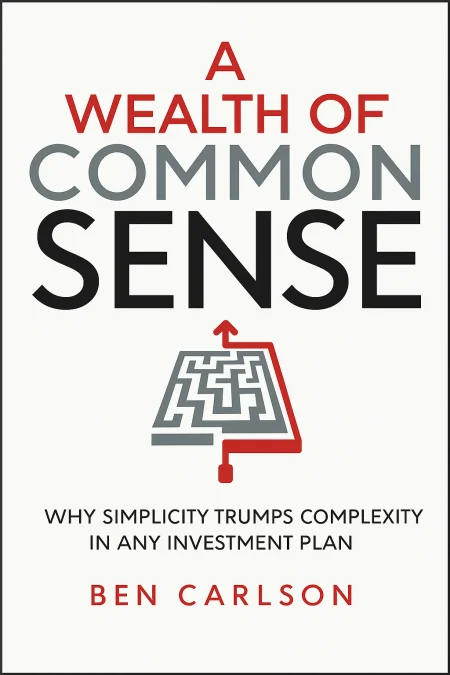
A Wealth of Common Sense
Why Simplicity Trumps Complexity in Any Investment Plan
Book Edition Details
Summary
In a world awash with financial jargon and complex strategies, "A Wealth of Common Sense" is your lighthouse, guiding you through the tumultuous seas of investing with a beacon of simplicity. Imagine demystifying the stock market's chaos, where clarity prevails over confusion, and thoughtful decisions replace impulsive gambles. This book is a manifesto for the individual investor, revealing how an uncomplicated approach can yield superior results. Forget the noise and complexity that often trap investors in a web of unnecessary choices; instead, embrace a strategy that champions the long view and leverages market volatility to your advantage. You’ll learn to outshine professional money managers not through outsmarting them, but by crafting a portfolio tailored to your unique goals. This is not just investment advice—it's an empowering tool that transforms how you view markets, decisions, and ultimately, success.
Introduction
In a world where financial markets seem increasingly complex and intimidating, millions of investors find themselves paralyzed by endless options, conflicting advice, and the fear of making costly mistakes. The investment industry thrives on selling complexity, promising sophisticated solutions that often lead to confusion and poor outcomes. Yet the most successful long-term investors share a common trait: they embrace simplicity over sophistication, understanding that wealth building is fundamentally about human behavior rather than market timing or stock picking. This exploration reveals a counterintuitive truth about investing: the more complicated your strategy, the more likely you are to fail. The author presents a behavioral finance framework that prioritizes emotional intelligence over raw intellect, systematic processes over active management, and patience over performance chasing. Through this lens, successful investing emerges not as a complex mathematical puzzle, but as a disciplined approach to managing human psychology in the face of market volatility. The framework addresses several fundamental questions that shape investment success: How do individual investors differ from institutional players, and how can these differences become advantages? What behavioral biases consistently destroy wealth, and how can systematic processes counteract them? Why does asset allocation matter more than security selection, and how should modern investors construct portfolios that survive both bull and bear markets? These questions form the foundation for a comprehensive investment philosophy rooted in common sense rather than complexity.
The Power of Simplicity: Avoiding Common Investment Mistakes
The psychology of investment errors reveals a fascinating paradox: intelligence often becomes a liability in financial markets. Unlike academic or professional settings where raw intellect correlates with success, investing rewards emotional intelligence and behavioral discipline far more than analytical sophistication. This framework identifies seven critical mistakes that consistently destroy wealth, from seeking get-rich-quick schemes to taking market movements personally. The theoretical foundation rests on understanding the difference between systematic and random errors. Random errors are inevitable and typically cancel out over time, but systematic errors compound and accelerate wealth destruction. These systematic mistakes share common psychological roots: overconfidence, loss aversion, recency bias, and the fundamental inability to separate short-term noise from long-term signal. The framework emphasizes that avoiding these systematic errors matters far more than optimizing investment selection. Consider the investor who sold everything during the 2008 financial crisis, convinced that this time was different and markets would never recover. This decision, driven by fear and recency bias, cost more than any sophisticated portfolio optimization could have gained. The framework suggests that successful investing is primarily a game of error avoidance rather than return maximization. By focusing on what not to do, investors naturally gravitate toward behaviors that compound wealth over time. This negative knowledge approach transforms investing from a complex prediction game into a straightforward discipline of avoiding self-destruction while letting markets do the heavy lifting.
Asset Allocation and Diversification: Building a Sensible Portfolio
Asset allocation represents the single most important investment decision, typically explaining over ninety percent of portfolio performance variation. This framework positions asset allocation as the cornerstone of investment success, far outweighing security selection or market timing in determining long-term outcomes. The theory recognizes that while individual stocks and bonds grab headlines, the mix of asset classes determines both risk and return characteristics of any portfolio. The framework operates on three interconnected principles: strategic asset allocation, diversification across asset classes and geographies, and systematic rebalancing. Strategic asset allocation matches portfolio composition to individual circumstances, risk tolerance, and time horizon. Diversification spreads risk across investments that respond differently to economic conditions, ensuring that no single event can destroy the entire portfolio. Systematic rebalancing forces the discipline of selling high and buying low by returning portfolios to target allocations. Real-world application reveals the framework's power through historical examples. During Japan's lost decades from 1990 to 2014, a home-biased Japanese investor experienced nearly zero returns, while a globally diversified portfolio continued growing. Similarly, American investors who diversified internationally during the technology bubble of the late 1990s avoided the worst of the subsequent crash. The framework doesn't eliminate volatility but transforms it from a source of panic into a tool for wealth building. By maintaining discipline during market extremes, investors systematically buy assets when they're cheap and sell when they're expensive, the fundamental driver of long-term wealth creation.
Behavioral Investing: Managing Emotions and Staying the Course
The behavioral investing framework addresses the central challenge of investment success: human psychology consistently works against sound financial decision-making. Markets function as massive psychological experiments where fear and greed drive prices far from fundamental values, creating both opportunities and traps for investors. The framework identifies specific cognitive biases that reliably lead to poor outcomes and provides systematic methods for counteracting these natural tendencies. The theory operates through two complementary mechanisms: understanding behavioral patterns and implementing systematic constraints. Understanding involves recognizing how loss aversion makes people feel losses twice as intensely as equivalent gains, how recency bias causes extrapolation of recent trends indefinitely into the future, and how overconfidence leads to excessive trading and risk-taking. Systematic constraints include automatic investment plans that remove timing decisions, written investment policies that prevent emotional overrides, and rebalancing schedules that force contrarian behavior. The framework's practical application becomes clear during market crises. In March 2009, when the S&P 500 hit its lowest point during the financial crisis, surveys showed that individual investors had become maximum pessimists, convinced that stocks would never recover. Yet those who continued systematic investing during this period captured extraordinary returns as markets rebounded. The behavioral framework doesn't eliminate the discomfort of market volatility but channels it productively. By accepting that successful investing requires periodic emotional discomfort, investors can make decisions based on evidence rather than feelings, transforming natural human psychology from an enemy into an ally for long-term wealth building.
Creating a Comprehensive Investment Plan That Works
A comprehensive investment plan serves as the operational framework that transforms investment theory into practical reality. Unlike a simple portfolio or collection of investments, a comprehensive plan integrates all aspects of financial life: goals, risk tolerance, time horizon, tax considerations, and behavioral constraints. The plan functions as both roadmap and guardrail, providing direction during calm markets and preventing costly mistakes during turbulent periods. The framework encompasses three essential components: written investment policy, systematic implementation, and regular review process. The written investment policy documents specific goals, asset allocation targets, rebalancing rules, and conditions that would trigger plan modifications. Systematic implementation removes emotion from routine decisions through automatic contributions, dividend reinvestment, and scheduled rebalancing. The review process ensures the plan evolves appropriately with changing life circumstances while maintaining long-term discipline. Consider two investors with identical starting points and market returns. The first follows detailed written guidelines, automatically contributes to diversified index funds, and rebalances annually regardless of market conditions. The second makes ad hoc decisions based on market news, economic forecasts, and emotional reactions to volatility. Historical studies consistently show the first investor achieving significantly better outcomes, not through superior market timing or stock selection, but through systematic adherence to sound principles. The comprehensive investment plan framework recognizes that investment success depends far more on following a good plan consistently than on finding the perfect strategy and executing it poorly.
Summary
The essence of successful investing lies not in conquering markets through complex strategies, but in conquering oneself through disciplined simplicity. This behavioral finance framework demonstrates that wealth building success flows from understanding human psychology, embracing systematic processes, and maintaining long-term perspective despite short-term market noise. The greatest investment edge available to individual investors is their ability to think and act with a decades-long time horizon while professional competitors face quarterly performance pressures. This framework offers profound implications for how we approach not just investing, but decision-making under uncertainty more broadly. By recognizing the limits of prediction and the power of systematic behavior, investors can achieve financial freedom through patient discipline rather than market wizardry. The principles extend beyond portfolio management to encompass a philosophy of rational decision-making that serves individuals throughout their financial lives, transforming the intimidating world of investing into a manageable journey toward long-term prosperity.
Related Books
Download PDF & EPUB
To save this Black List summary for later, download the free PDF and EPUB. You can print it out, or read offline at your convenience.
By Ben Carlson
