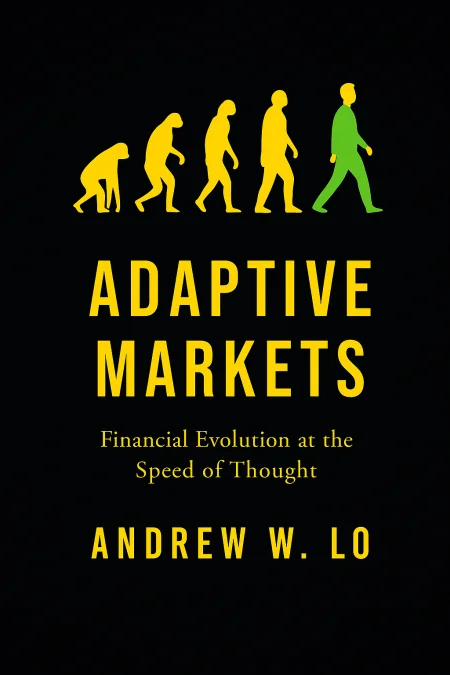
Adaptive Markets
Financial Evolution at the Speed of Thought
Book Edition Details
Summary
Picture a world where the dance between logic and impulse dictates the fate of financial markets. Andrew W. Lo's "Adaptive Markets" unravels this intricate ballet, presenting a revolutionary thesis that challenges the black-and-white views of traditional economics. Here, the market isn’t a rigid machine but a living ecosystem, teeming with instinctual reactions and evolutionary adaptations. Drawing from a rich tapestry of psychology, biology, and beyond, Lo introduces the Adaptive Markets Hypothesis, a paradigm where chaos and order coexist, revealing how investors’ primal instincts can both stabilize and disrupt. As you journey through tales of financial evolution, you'll uncover the mysteries behind past meltdowns and the keys to a resilient future. This is not just a book—it's an invitation to rethink the very fabric of finance, a must-read for anyone eager to understand the unpredictable heartbeat of the market.
Introduction
Traditional financial theory rests on the assumption that markets are perfectly efficient and investors behave rationally, yet this elegant framework crumbles when confronted with the reality of market crashes, bubbles, and persistent behavioral anomalies. The fundamental disconnect between theoretical predictions and observed market behavior reveals a critical flaw in how we understand financial systems. Rather than viewing markets as mechanical constructs governed by mathematical certainties, a revolutionary perspective emerges that treats financial markets as living ecosystems subject to evolutionary pressures and adaptive processes. This evolutionary approach draws from neuroscience, psychology, and biology to construct a comprehensive framework that explains why markets sometimes appear rational and efficient while at other times exhibit seemingly irrational behaviors. The investigation reveals that human financial decision-making operates through neural circuits evolved for survival in prehistoric environments, creating systematic patterns that traditional models cannot capture. By understanding markets as complex adaptive systems where strategies compete for survival and participants continuously evolve their approaches, we gain powerful insights into the true nature of financial behavior. The analytical journey challenges readers to abandon static thinking about market efficiency and embrace a dynamic understanding where success depends not on perfect rationality but on the ability to adapt to changing conditions. This perspective offers practical implications for investors, regulators, and policymakers who must navigate an ever-evolving financial landscape where yesterday's winning strategies may become tomorrow's catastrophic failures.
The Limits of Market Efficiency and Human Rationality
The Efficient Market Hypothesis stands as one of finance's most influential theories, asserting that asset prices fully incorporate all available information and that consistent outperformance is impossible except through luck. This framework provided the intellectual foundation for passive investing strategies and shaped decades of financial regulation. However, mounting empirical evidence reveals persistent anomalies that challenge its core assumptions about human rationality and market behavior. Experimental research demonstrates that humans exhibit systematic biases in financial decision-making that contradict rational choice theory. Loss aversion causes people to feel the pain of losses more intensely than the pleasure of equivalent gains, leading to suboptimal portfolio decisions. Overconfidence bias drives excessive trading and risk-taking, while herding behavior creates momentum effects that persist far longer than efficient market theory would predict. These patterns appear not just among amateur investors but also among sophisticated professionals who should theoretically know better. The mathematical elegance of efficient market models obscures their fundamental weakness: the assumption that human cognitive capabilities are unlimited and that emotional responses play no role in financial decisions. Real investors operate under severe cognitive constraints, processing information through mental shortcuts that work well in most situations but can lead to systematic errors under certain conditions. Time pressure, stress, and uncertainty amplify these limitations, causing even rational individuals to make decisions that appear irrational from a traditional economic perspective. Rather than dismissing these behavioral patterns as temporary aberrations, the evidence suggests they represent fundamental characteristics of human nature that cannot be eliminated through education or experience alone. The challenge becomes understanding when these cognitive limitations help or hinder financial decision-making and how market structures can be designed to account for human psychological realities rather than assuming away their existence.
Evolutionary Biology and Neuroscience of Financial Behavior
Modern neuroscience reveals that financial decision-making engages brain systems that evolved millions of years ago to solve survival problems in hunter-gatherer societies. The limbic system, responsible for emotional responses and threat detection, treats financial losses as genuine dangers, triggering fight-or-flight responses complete with stress hormones and elevated heart rates. This neurological reality explains why portfolio losses feel genuinely threatening and why rational analysis becomes difficult during market downturns. The brain's reward circuitry responds to financial gains using the same dopamine pathways activated by food, sex, and addictive drugs. Neuroimaging studies show that monetary rewards light up the nucleus accumbens in patterns virtually identical to those observed in cocaine addiction. This biological response explains why successful trading can become compulsive and why investors often take excessive risks after experiencing gains, chasing the neurochemical high associated with profitable trades. Fear and greed, rather than representing character flaws, emerge as adaptive mechanisms that enhanced survival in ancestral environments but may prove counterproductive in modern financial contexts. The tendency to panic during market crashes reflects an ancient fear response that helped our ancestors escape predators, while overconfidence in bull markets mirrors the risk-taking behaviors that enabled successful hunting and territorial expansion. These emotional responses served crucial functions in small-scale societies but can lead to catastrophic outcomes when applied to complex financial instruments. Cognitive biases like pattern recognition and narrative construction also reflect evolutionary adaptations that helped humans navigate uncertain environments by quickly identifying threats and opportunities. However, these same mechanisms lead investors to see meaningful patterns in random market movements and to construct compelling stories that justify poor investment decisions. Understanding the evolutionary origins of financial behavior provides crucial insights into why certain biases persist despite their apparent irrationality and how market participants can develop strategies to work with, rather than against, their biological heritage.
The Adaptive Markets Hypothesis: A New Framework
The Adaptive Markets Hypothesis reconciles the apparent contradiction between market efficiency and behavioral irrationality by recognizing that both represent different phases of an ongoing evolutionary process. Markets exhibit efficiency when environmental conditions remain stable and participants have sufficient time to learn and adapt their strategies. However, when conditions change rapidly or when new participants enter with different approaches, markets can appear highly inefficient as the competitive landscape shifts and new equilibria emerge. This framework treats market participants as biological entities engaged in a continuous struggle for survival and reproduction, where successful strategies attract capital and imitators while unsuccessful approaches are eliminated through losses and exits. The degree of market efficiency depends on the intensity of competition, the diversity of participants, and the stability of underlying conditions. Markets dominated by sophisticated professionals operating in stable environments should exhibit greater efficiency than markets with inexperienced participants facing rapidly changing conditions. Financial innovation creates new ecological niches that temporarily offer profit opportunities to early adopters, but competitive pressures eventually eliminate these advantages as more participants enter and arbitrage away the inefficiencies. This process mirrors biological evolution, where new species can thrive in unexploited environments until competition intensifies and only the best-adapted survive. The constant cycle of innovation, exploitation, and competitive elimination drives the ongoing evolution of financial markets. The hypothesis predicts that market behavior will vary systematically across time periods, asset classes, and participant types based on the underlying evolutionary dynamics. Bull markets represent periods of abundant resources where multiple strategies can coexist, while bear markets create harsh selection pressures that eliminate poorly adapted approaches. Understanding these evolutionary cycles provides valuable insights for investors, regulators, and researchers seeking to navigate or understand financial market behavior.
Implications for Crisis, Regulation, and Future Finance
Financial crises emerge as evolutionary bottlenecks where environmental changes occur too rapidly for effective adaptation, leading to widespread failure of previously successful strategies. The 2008 financial crisis exemplifies this dynamic, as strategies optimized for rising housing prices and abundant credit became catastrophically inappropriate when conditions reversed. Participants who had learned to expect continued growth found themselves trapped by obsolete mental models, creating the panic and deleveraging that amplified the crisis. Traditional regulatory approaches, based on static rules and assumptions of rational behavior, prove inadequate for managing adaptive market systems where participants continuously evolve new strategies to circumvent existing constraints. Effective regulation must itself be adaptive, incorporating feedback mechanisms that allow for continuous monitoring and adjustment as market conditions change. The goal should be maintaining ecosystem health and diversity rather than trying to eliminate all risks or prevent all failures. Systemic risk arises when market participants converge on similar strategies in response to common environmental pressures, creating hidden correlations that only become apparent during stress periods. Regulatory frameworks should encourage diversity in approaches and prevent the emergence of monocultures that can lead to system-wide failures. This might involve limits on institutional size, requirements for different risk management approaches, or incentives for contrarian strategies that provide natural hedges against prevailing trends. Future financial stability depends on designing systems that account for human evolutionary limitations while harnessing our adaptive capabilities. This requires moving beyond mechanical models toward biological metaphors that recognize markets as living ecosystems requiring careful cultivation rather than simple control. Technology can augment human decision-making capabilities, but it cannot eliminate the fundamental biological constraints that shape financial behavior. Success will depend on working with human nature rather than assuming it away.
Summary
The evolutionary perspective fundamentally transforms our understanding of financial markets from mechanical systems governed by mathematical laws to living ecosystems subject to the same adaptive pressures that shape all life on Earth. This framework reveals that market efficiency and behavioral irrationality are not contradictory phenomena but different phases of an ongoing evolutionary process where success depends on the ability to adapt to changing environmental conditions rather than maintaining static optimization. The insights prove invaluable for investors seeking to understand why certain strategies succeed or fail, regulators attempting to maintain financial stability without stifling innovation, and anyone interested in the deeper biological and psychological forces that drive human economic behavior in an increasingly complex and rapidly evolving financial landscape.
Related Books
Download PDF & EPUB
To save this Black List summary for later, download the free PDF and EPUB. You can print it out, or read offline at your convenience.
By Andrew W. Lo
