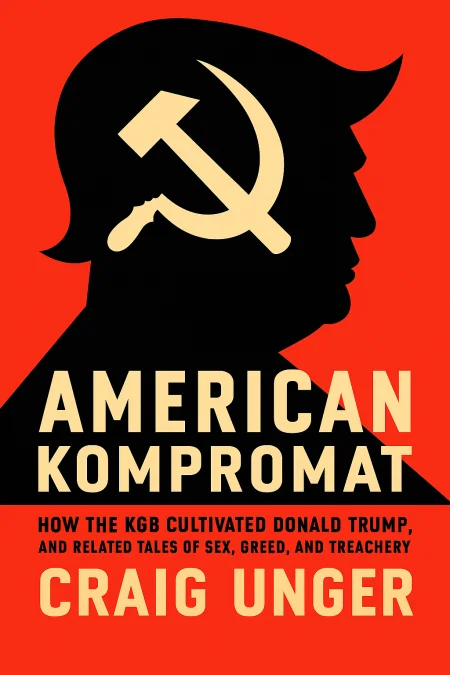
American Kompromat
How the KGB Cultivated Donald Trump, and Related Tales of Sex, Greed, Power, and Treachery
Book Edition Details
Summary
Power. Secrets. Betrayal. "American Kompromat" exposes the tangled web of espionage and intrigue at the heart of global politics, where shadowy figures pull the strings. This gripping narrative draws from exclusive interviews and top-secret documents to unravel the question: Was Donald Trump a Russian asset? Follow the chilling accounts of KGB operations and their decades-long manipulation of influential figures, from the corridors of Moscow to the opulent penthouses of New York City. This book not only dives into Trump's alleged ties but also sheds light on the murky alliances between Jeffrey Epstein, Soviet intelligence, and the enigmatic world of kompromat. Here lies a tale of deception, where the stakes are nothing less than the fate of nations.
Introduction
In the autumn of 1984, a young Manhattan real estate developer walked into a modest electronics store on Fifth Avenue to purchase television sets for his latest hotel project. This seemingly mundane transaction would later be recognized as the opening move in one of the most audacious intelligence operations in modern history. What began as a simple business deal between Donald Trump and Soviet émigré shop owners would evolve into a four-decade campaign that ultimately reached the highest levels of American government. This remarkable story reveals how Russian intelligence services, beginning with the KGB and continuing through today's FSB, methodically identified and cultivated American assets through an intricate web of financial relationships, sexual blackmail, and institutional infiltration. The operation succeeded not through dramatic spy-versus-spy confrontations, but through patient exploitation of American vulnerabilities: the influence of money in politics, the revolving door between private practice and public service, and the susceptibility of democratic institutions to corruption from within. The narrative exposes three converging streams of influence that nearly destroyed American democracy: a decades-long Russian cultivation program targeting business and political elites, the systematic penetration of legal and judicial institutions by religious extremists, and a sophisticated kompromat operation that compromised powerful figures across multiple sectors. This account is essential reading for anyone seeking to understand how foreign adversaries exploit democratic freedoms to undermine democratic governance, and what lessons we must learn to protect our institutions from similar threats in the future.
Cold War Genesis: KGB Asset Cultivation (1980s-1991)
The foundations of America's democratic crisis were laid during the final decade of the Cold War, when Soviet intelligence launched an ambitious long-term operation to cultivate assets within American society. Under General Vladimir Kryuchkov's direction, the KGB's First Chief Directorate issued explicit orders to move beyond traditional ideological recruits and target wealthy, ambitious Americans who might prove useful decades later. The operation centered on seemingly legitimate business relationships. Joy-Lud Electronics, owned by Soviet émigrés Semyon Kislin and Tamir Sapir, served as both a front operation and a spotting post for identifying potential assets. When Trump purchased hundreds of television sets from their Manhattan store, Soviet handlers took careful note of his psychological profile: desperate for validation, financially vulnerable, and possessed of grandiose ambitions that far exceeded his actual capabilities. The cultivation process followed classic tradecraft principles. KGB operatives fed Trump's fantasies about becoming a nuclear arms negotiator and international dealmaker, while simultaneously creating financial dependencies through his business ventures. His 1987 Moscow trip, ostensibly to explore hotel development opportunities, served as a crucial assessment phase where Soviet intelligence evaluated their investment's potential. Simultaneously, the KGB was establishing networks designed to survive the Soviet Union's collapse. Hundreds of commodity firms were created to siphon wealth from Soviet enterprises and establish footholds in Western financial systems. These operations, often involving figures like media mogul Robert Maxwell, created the infrastructure that would later enable massive money-laundering schemes. By 1991, when the Soviet flag was lowered for the final time, Russian intelligence had successfully planted the seeds for an operation that would ultimately compromise American democracy itself.
Post-Soviet Evolution: Institutional Penetration and Criminal Networks (1992-2008)
The Soviet Union's collapse marked not the end of Russian intelligence operations, but their transformation into something far more dangerous. As the West celebrated Cold War victory, Russian operatives quietly implemented plans laid years earlier, converting KGB networks into hybrid criminal-intelligence enterprises that combined organized crime with state-sponsored espionage. The decade's most devastating security breach involved FBI agent Robert Hanssen, whose espionage activities revealed the dangerous intersection of religious extremism and foreign intelligence. Hanssen's connections to Opus Dei, a secretive Catholic organization with authoritarian roots, created a network of enablers who knew of his treachery but failed to report it. His brother-in-law John Paul Wauck, working as a speechwriter for Attorney General William Barr, represented just one node in a web of connections that should have triggered intensive counterintelligence scrutiny. Instead, Barr's Justice Department systematically dismantled America's defenses against Russian organized crime. In one of the largest manpower shifts in FBI history, three hundred Russian-speaking agents were transferred away from counterintelligence work, ostensibly to fight the crack epidemic. This decision, made precisely when Russian criminal networks were establishing themselves in American cities, represented either catastrophic incompetence or deliberate sabotage. The period witnessed the emergence of sophisticated money-laundering operations that blended legitimate business with criminal enterprise. Figures like Semion Mogilevich, the "Brainy Don" of Russian organized crime, worked closely with both intelligence operatives and Western assets to launder billions through legitimate businesses, including Trump properties. These financial relationships created the dependencies and vulnerabilities that would later be exploited for political purposes. By 2008, Russian intelligence had successfully penetrated American law enforcement, established vast criminal networks, and begun the systematic compromise of political figures through financial entanglement and kompromat operations.
The Blackmail Web: Epstein Operations and Elite Compromise (2009-2016)
The Jeffrey Epstein network represented the evolution of traditional intelligence gathering into a sophisticated kompromat operation that combined sexual blackmail with cutting-edge technology and legitimate business relationships. Building on foundations laid by Robert Maxwell, whose intelligence connections spanned multiple services, the operation targeted American elites across politics, business, academia, and entertainment with unprecedented scope and sophistication. Epstein's mysterious fortune, which appeared to lack legitimate sources, likely originated from Maxwell's money-laundering operations and was supplemented by payments from intelligence services seeking kompromat on their targets. The operation's genius lay in its apparent legitimacy: Epstein presented himself as a philanthropist and financial advisor, hosting scientific conferences and cultivating relationships with Nobel laureates, tech billionaires, and political leaders who had no idea they were entering an intelligence trap. The network's reach extended far beyond Epstein's private properties through modeling agencies like MC2, run by Jean-Luc Brunel, which imported young women from Eastern Europe, many connected to Russian intelligence through figures like Peter Listerman. These women were trained not merely to provide sexual services, but to gather intelligence and create compromising materials that could be weaponized for blackmail purposes. The operation's protection came through its deep integration with American legal systems. High-powered law firms, particularly Kirkland & Ellis, represented both Epstein and his alleged victims while maintaining clients connected to Russian intelligence. When Epstein was finally prosecuted in 2008, the resulting plea agreement was so favorable that it effectively immunized the entire network from further investigation. This protection continued even after Epstein's mysterious death in federal custody, with key evidence remaining sealed and potential co-conspirators avoiding prosecution. The network's true significance lies not in individual crimes, but in demonstrating the complete capture of American justice systems by foreign intelligence services and corrupt elites.
Democratic Capture: Presidential Asset and Authoritarian Consolidation (2017-2021)
The culmination of decades of patient cultivation came with Trump's presidency, which represented the most successful foreign intelligence operation in American history. The administration's personnel decisions revealed the extent to which Russian-friendly networks had penetrated American institutions, with key positions filled by individuals with financial ties to Russian oligarchs, members of compromised organizations, or lawyers who had previously defended Russian interests. William Barr's return as Attorney General marked the systematic dismantling of democratic accountability mechanisms. Drawing on his experience covering up Republican scandals during the George H.W. Bush administration, Barr deployed his theory of the "unitary executive" to shield the president from investigation while transforming the Justice Department from an independent law enforcement agency into a personal protection service. His network of allies, many connected to Opus Dei and the Federalist Society, occupied key positions throughout the federal judiciary, ensuring coordinated resistance to challenges to presidential power. The administration's foreign policy decisions consistently favored Russian objectives over American interests. NATO was weakened, sanctions were lifted or undermined, and American troops were withdrawn from positions that had contained Russian expansion for decades. When Russian intelligence offered bounties for killing American soldiers in Afghanistan, the information was ignored rather than acted upon, suggesting a level of compromise that transcended mere policy disagreement. The COVID-19 pandemic provided additional opportunities for chaos and division that served Russian strategic interests. Rather than mounting a coordinated national response, the administration politicized basic public health measures and encouraged the social discord that Russian active measures had long sought to promote. The 2020 election and its aftermath revealed the full scope of the threat, as the refusal to accept electoral defeat and the violent assault on the Capitol demonstrated how thoroughly foreign influence operations had succeeded in weaponizing American political divisions against democracy itself.
Summary
The four-decade operation revealed in this investigation represents the successful execution of the most ambitious foreign intelligence campaign in modern history: the systematic compromise of American democracy through financial corruption, sexual blackmail, and institutional capture. Russian intelligence services understood that they did not need to destroy American democracy through military force; they could simply corrupt it from within by exploiting the very openness and pluralism that made democracy attractive. The operation succeeded because it identified and exploited fundamental vulnerabilities in American society: the influence of money in politics, the secrecy surrounding intelligence operations, and the willingness of elites to prioritize personal advancement over national security. By cultivating assets across multiple sectors and creating networks capable of protecting themselves from investigation, foreign operatives achieved a level of influence that would have been impossible through conventional espionage. The convergence of Russian intelligence operations with domestic authoritarian movements, particularly those connected to religious extremist organizations, created a perfect storm that nearly destroyed constitutional government. The lessons are clear: democracies must strengthen their defenses against foreign influence operations through comprehensive campaign finance reform, increased transparency requirements for public officials, and robust oversight of intelligence and law enforcement agencies. Most importantly, citizens must recognize that democracy requires active protection, not passive assumption that institutions will function automatically. The price of freedom truly is eternal vigilance against those who would destroy democratic governance from within.
Related Books
Download PDF & EPUB
To save this Black List summary for later, download the free PDF and EPUB. You can print it out, or read offline at your convenience.
By Craig Unger
