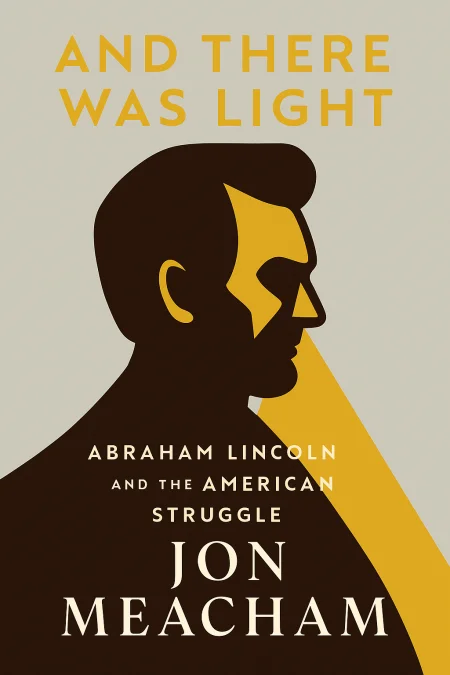
And There Was Light
Abraham Lincoln and the American Struggle
Book Edition Details
Summary
A young boy born on the rugged frontier of Kentucky embarks on a journey that will reshape a nation embroiled in chaos and contradiction. Abraham Lincoln's life unfolds as a vivid tapestry of ambition, conviction, and the enduring struggle against the chains of slavery. In a landscape marred by secession and unrest, Lincoln emerges not as a distant icon but as a man of flesh and blood—haunted by failures, uplifted by his resolve, and driven by a moral compass that refuses to yield. This compelling biography unravels the enigma of a leader navigating a fractured America, revealing his tireless quest for justice amidst the clamor of power, identity, and faith. It paints a portrait of a president whose trials and triumphs resonate through history, urging us to reflect on the complexities of our own time. Here lies a testament to the perseverance of the human spirit, a clarion call to confront the shadows of our past with courage and conscience.
Introduction
On a rain-soaked March morning in 1865, Abraham Lincoln stood before the nation to deliver his Second Inaugural Address, speaking words that would echo through history: "With malice toward none, with charity for all." The man who uttered these profound words had traveled an extraordinary journey from a one-room log cabin in Kentucky to the pinnacle of American power, arriving at the presidency during the nation's darkest hour. Lincoln's story is one of remarkable transformation—a self-educated frontier lawyer who became the Great Emancipator, a melancholy man who found the strength to hold a fracturing nation together through its bloodiest conflict. Few figures in American history embody the promise and struggle of democracy quite like Lincoln. His life reveals the power of moral conviction wedded to political pragmatism, showing us how an individual can rise from the humblest circumstances to reshape the destiny of a nation. Through Lincoln's experiences, we discover the complex interplay between personal character and historical moment, witnessing how one man's unwavering commitment to human equality ultimately transformed the American experiment. His journey illuminates the price of principled leadership and the enduring power of words to heal a wounded nation.
From Frontier Boy to Prairie Lawyer
Abraham Lincoln's origins could hardly have been more humble. Born in 1809 in a one-room log cabin in Kentucky, he entered a world of grinding poverty and limited opportunity. His father Thomas was an unsuccessful farmer who struggled to provide for his family, while his mother Nancy Hanks Lincoln died when Abraham was just nine years old. The boy grew up in what he later called "the short and simple annals of the poor," surrounded by the harsh realities of frontier life where survival often took precedence over education. Yet even in these austere circumstances, young Lincoln displayed an insatiable hunger for learning. He devoured every book he could find, from the Bible to Aesop's Fables, often reading by firelight late into the night. His stepmother, Sarah Bush Lincoln, recognized his intellectual gifts and encouraged his studies despite his father's preference for manual labor. Lincoln's famous image as the "rail-splitter" was real—he spent countless hours clearing forests and splitting fence rails—but his true passion lay in the world of ideas and words. The death of his beloved Ann Rutledge in 1835 plunged Lincoln into a profound depression, yet it also marked a turning point in his development. Grief taught him about the fragility of life and the importance of making one's mark on the world. He threw himself into the study of law, teaching himself through borrowed books and careful observation of court proceedings. By his late twenties, Lincoln had transformed himself from an unschooled farm boy into a respected attorney, demonstrating the remarkable capacity for self-improvement that would define his entire life. This period of Lincoln's life reveals the foundational elements of his character: an unquenchable thirst for knowledge, a deep empathy born of personal suffering, and an unwavering belief in the possibility of human improvement. These qualities, forged in the crucible of frontier hardship, would later enable him to understand and speak for the common people of America during their greatest trial.
The House Divided: Political Awakening and Antislavery Conviction
Lincoln's entry into politics in the 1830s coincided with his growing awareness of slavery's moral dimensions. As a young legislator in Illinois, he witnessed the brutal realities of human bondage and began to form the convictions that would later define his presidency. His famous 1837 protest in the Illinois legislature, declaring slavery "founded on both injustice and bad policy," marked his first public stand against the institution, even as he acknowledged the constitutional protections it enjoyed. The Kansas-Nebraska Act of 1854 proved to be Lincoln's political awakening. Stephen Douglas's proposal to allow slavery's expansion into new territories violated what Lincoln saw as the Founders' intention to place the institution on a path toward "ultimate extinction." This betrayal of America's founding principles aroused Lincoln "as he had never been before," propelling him back into active politics after years of focusing primarily on his law practice. His speeches during this period revealed a man grappling with the fundamental contradiction between American ideals and American realities. The Lincoln-Douglas debates of 1858 showcased Lincoln's evolving philosophy on slavery and race. While he stopped short of advocating for immediate abolition or full racial equality, Lincoln articulated a moral vision that placed him far ahead of most white Americans of his time. He insisted that Black Americans were entitled to the natural rights enumerated in the Declaration of Independence, particularly "the right to eat the bread, without leave of anybody else, which his own hand earns." This position required considerable political courage in a nation where anti-Black prejudice was nearly universal. Lincoln's "House Divided" speech crystallized his belief that America could not permanently endure half slave and half free. This wasn't merely a political calculation but a moral conviction rooted in his understanding of the Declaration of Independence as a universal statement of human equality. Though he lost the Senate race to Douglas, Lincoln had established himself as the voice of principled antislavery politics, setting the stage for his presidential nomination in 1860.
President in Crisis: Union, War, and Emancipation
Lincoln assumed the presidency facing an unprecedented crisis. Seven states had already seceded, and more threatened to follow. His inaugural address struck a careful balance between firmness and conciliation, assuring the South that he had no intention of interfering with slavery where it existed while making clear that secession was both illegal and impractical. When Confederate forces fired on Fort Sumter in April 1861, Lincoln faced the choice that would define his presidency: preserve the Union at all costs or allow the nation to dissolve. The early years of the war tested Lincoln's resolve and political skills to their limits. He had to balance competing pressures from Radical Republicans who demanded immediate emancipation, War Democrats who supported the Union but opposed abolition, and border state politicians who threatened to join the Confederacy if Lincoln moved too quickly against slavery. His decision to issue the Emancipation Proclamation in 1863 transformed the conflict from a war to preserve the Union into a war for human freedom, though he carefully framed it as a military necessity rather than a moral imperative. Lincoln's growth as a war leader was remarkable. Initially uncertain about military strategy and hesitant to challenge his generals, he gradually assumed greater control over the war effort. His ability to communicate with the American people through speeches and letters helped sustain Northern morale during the darkest periods of the conflict. The Gettysburg Address, delivered in just two minutes, redefined the war's purpose and America's mission in language that elevated the struggle beyond mere political conflict to a test of democratic ideals. Perhaps most remarkably, Lincoln managed to expand executive power while maintaining democratic institutions. He suspended habeas corpus, imposed press censorship, and took other extraordinary measures, yet he never lost sight of the constitutional principles he was fighting to preserve. His willingness to face harsh criticism and political opposition, even from within his own party, demonstrated his commitment to democratic governance even in wartime.
Lincoln's Legacy: Democracy, Justice, and Moral Leadership
Lincoln's assassination in April 1865, just days after the war's end, transformed him from a controversial political figure into a martyred saint of American democracy. Yet his true legacy lies not in his martyrdom but in his demonstration of how moral conviction can be translated into political action. His commitment to the principle that "all men are created equal" ultimately led to the abolition of slavery and the constitutional guarantee of citizenship for African Americans, even though he did not live to see these achievements fully realized. The Lincoln presidency established crucial precedents for moral leadership in American politics. He showed that a democratic leader could maintain both pragmatic flexibility and unwavering principle, adapting tactics while never abandoning core values. His ability to frame political issues in moral terms—while remaining sensitive to political realities—offers a model for how leaders can elevate public discourse and build coalitions for transformative change. Lincoln's approach to leadership during crisis provides enduring lessons for democratic governance. He understood that preserving democratic institutions sometimes requires expanding executive power, but he never lost sight of the constitutional limits on that power. His willingness to engage with critics, maintain open debate, and submit to electoral judgment even during wartime demonstrated his deep commitment to democratic values. Most importantly, he showed that moral progress in a democracy requires both visionary leadership and patient coalition-building.
Summary
Abraham Lincoln's life stands as perhaps the greatest testament to the transformative power of moral conviction in American politics. From his humble origins on the frontier to his martyrdom in the cause of human freedom, Lincoln demonstrated that individual character and principled leadership can indeed change the course of history. His unwavering commitment to the idea that "all men are created equal" ultimately led to the abolition of slavery and the preservation of democratic government, achievements that seemed impossible when he first entered politics. Lincoln's example offers two crucial lessons for contemporary leaders and citizens. First, that moral progress requires both vision and pragmatism—the ability to see beyond current limitations while working skillfully within existing constraints to achieve incremental change. Second, that democratic leadership demands the courage to maintain principles even when they are unpopular, combined with the wisdom to build coalitions and communicate effectively with diverse audiences. Lincoln's legacy reminds us that in a democracy, the arc of justice may be long, but it can be bent toward righteousness through persistent moral leadership and unwavering commitment to human dignity.
Related Books
Download PDF & EPUB
To save this Black List summary for later, download the free PDF and EPUB. You can print it out, or read offline at your convenience.
By Jon Meacham
