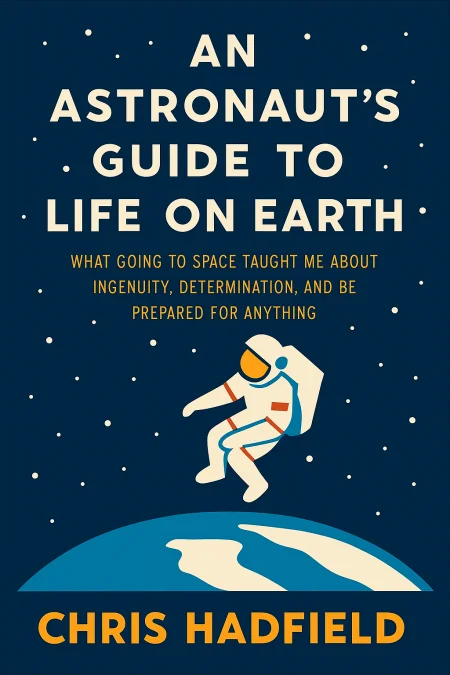
An Astronaut’s Guide to Life on Earth
What Going to Space Taught Me About Ingenuity, Determination, and Being Prepared for Anything
Book Edition Details
Summary
Chris Hadfield's life is a breathtaking tale of audacity and precision, set against the backdrop of the cosmos. Picture yourself clutching the side of a spacecraft, blinded, or deftly ridding a cockpit of a snake while flying at breakneck speed. In "An Astronaut's Guide to Life on Earth," Hadfield distills the wisdom forged in the crucible of space missions and zero-gravity dilemmas. He challenges the norms: embrace meticulousness, relish critiques, and eschew the allure of visualizing triumph. His narrative is a profound lesson on transforming the improbable into the achievable, reshaping our terrestrial outlook. With unparalleled anecdotes and profound insights, Hadfield offers a fresh perspective on life, teaching us to think like astronauts and savor each moment, whether among the stars or on our home planet.
Introduction
When Chris Hadfield was nine years old, watching Neil Armstrong take humanity's first steps on the Moon, he made a decision that would define his entire life: he would become an astronaut. At the time, this seemed impossible for a Canadian farm boy, as NASA only accepted American citizens and Canada didn't even have a space agency. Yet forty-four years later, Hadfield would command the International Space Station, becoming a global sensation through his breathtaking photographs and videos from space, including his famous rendition of David Bowie's "Space Oddity" that captivated millions worldwide. What makes Hadfield's story extraordinary isn't just his achievement of an impossible childhood dream, but how he transformed the very process of pursuing that dream into a philosophy for living. His journey from a small-town Ontario farm to the commander's chair of humanity's most advanced outpost reveals profound lessons about preparation, persistence, and finding meaning in the mundane. Through his experiences as a fighter pilot, test pilot, and astronaut, Hadfield developed counterintuitive approaches to success that challenge conventional wisdom. Rather than thinking positively, he learned the power of negative thinking. Instead of trying to stand out, he discovered the value of aiming to be a zero. From his story, readers will discover how to transform impossible dreams into achievable goals, how to find purpose and satisfaction in everyday moments, and how the skills needed to survive in space can help anyone thrive on Earth.
From Dream to Training Ground
Hadfield's transformation from dreamer to astronaut began with a simple but profound realization: if he wanted to be ready when opportunity came, he had to start preparing immediately, even without knowing if that opportunity would ever arrive. At age nine, after watching the Moon landing, he began asking himself a crucial question at every decision point: "What would an astronaut do?" This wasn't just child's play; it was the beginning of a methodical approach to life that would carry him through decades of preparation. Growing up on a corn farm in Ontario instilled in Hadfield the patience and work ethic that space exploration demands. His parents expected their children to be responsible for the consequences of their actions, a lesson driven home when young Chris broke a tractor's drawbar twice in one day while showing off. His father didn't coddle him but instead taught him to weld the bar back together and return to work. This early lesson in accountability and persistence would prove invaluable in an astronaut's world, where small mistakes can have fatal consequences. The path to space required not just physical preparation but intellectual rigor. Hadfield threw himself into academics with new purpose, joined Air Cadets at thirteen, earned his glider license at fifteen, and began flying powered aircraft at sixteen. Every choice was filtered through his astronaut ambition, yet he remained realistic about the odds. This balance between determined preparation and practical expectations became a hallmark of his approach. He understood that the journey itself had to be meaningful, because the destination might never be reached. When the impossible began to seem merely improbable in 1983, when Canada selected its first astronauts, Hadfield was ready. Years of deliberate preparation had built the foundation of skills, experience, and mental toughness he would need. His childhood dream had evolved into a systematic life philosophy: prepare for the opportunity you want, even if it seems impossible, because when that moment comes, there won't be time to get ready.
The Making of an Astronaut
Becoming an astronaut requires more than just getting to space; it demands a complete transformation of how you think, prepare, and respond to the world around you. When Hadfield finally received the call from the Canadian Space Agency in 1992, he discovered that selection was just the beginning. The real work lay in developing what he calls "the right stuff for space flight," which had less to do with courage and more to do with methodical competence and unshakeable preparation. The astronaut training philosophy turned conventional wisdom on its head. While most people are taught to think positively and expect the best, astronauts are trained to imagine worst-case scenarios constantly. They practice responding to emergencies that have only a tiny chance of occurring because in space, preparation can mean the difference between life and death. Hadfield learned to ask himself, "What's the next thing that could kill me?" not out of paranoia, but as a practical tool for staying alive. This negative thinking became a source of confidence: when you've mentally rehearsed every possible disaster and know how to handle it, fear transforms into readiness. The training regimen was relentlessly detailed, covering everything from the physics of orbital mechanics to the proper technique for using a space toilet. Hadfield spent countless hours in simulators, underwater in the Neutral Buoyancy Lab practicing spacewalks, and learning Russian for the inevitable partnership with cosmonauts. Each skill had to be mastered to the point of unconscious competence, because in space there's rarely time to consult a manual or think through basic procedures. The complexity was staggering, yet every detail mattered. Perhaps most importantly, Hadfield learned that astronauts succeed not by being superheroes but by being supremely competent team players. The days of the lone-wolf test pilot were over; modern space exploration requires people who can work effectively with others in the most challenging conditions imaginable. This meant developing not just technical skills but emotional intelligence, cultural sensitivity, and the ability to remain calm and focused when everything is going wrong.
Life Among the Stars
Living in space reveals the profound strangeness and unexpected beauty of existence beyond Earth's boundaries. When Hadfield first floated into the International Space Station in December 2012, he entered a world where the most basic assumptions about daily life no longer applied. Water doesn't pour; it forms perfect spheres that float through the air. There is no up or down, only the orientation you choose. Sleep happens while strapped to a wall, and tears don't fall but form bubbles over your eyes. The International Space Station became Hadfield's home for five months, a football-field-sized laboratory orbiting Earth at seventeen thousand miles per hour. Life there required constant adaptation to weightlessness, which affected everything from brushing teeth to exercising. Without gravity, the body's fluids shift upward, creating a perpetually congested feeling, while muscles and bones begin to weaken despite two hours of daily exercise. Every ordinary task became extraordinary: eating floating M&Ms that danced through the air, or playing with spheres of water that reflected the entire station in their curved surfaces. The view from space provided an unparalleled perspective on Earth's beauty and fragility. Through the cupola's windows, Hadfield watched the planet turn below, witnessing sunrises and sunsets every ninety minutes. He could see the deforestation in Madagascar, the shrinking Aral Sea, and the lights of cities spreading across continents. This vantage point reinforced his sense of responsibility as a planetary steward and inspired him to share these images with the world through social media, helping millions of people see Earth through an astronaut's eyes. The isolation of space, rather than being lonely, felt surprisingly connected. Communication with Earth was constant, and the crew of six became a tight-knit international family. They worked together on cutting-edge scientific experiments, maintained the station's complex systems, and dealt with emergencies like the ammonia leak that required an unplanned spacewalk. Despite being farther from home than any human had regularly traveled before, Hadfield found that space amplified rather than diminished his appreciation for life, relationships, and the remarkable planet that supports us all.
Coming Back Down to Earth
The return from space is both literal and metaphorical descent, requiring the same careful attention to detail that made the journey possible. Landing in a Soyuz capsule is notoriously rough, involving a fiery plunge through Earth's atmosphere followed by what Hadfield describes as "fifteen explosions followed by a car crash." After floating weightlessly for months, the sudden return of gravity hits like a physical blow, making every part of the body protest the return to Earth's embrace. The physical readjustment was profound and lasting. Hadfield's feet, unused to bearing weight, felt like they'd been beaten with hammers. His spine compressed painfully as it readjusted to gravity, and his heart had to relearn how to pump blood upward against gravitational force. Simple tasks like standing up became challenges, requiring careful planning to avoid fainting. The recovery process took months, guided by specialists who understood how space changes the human body and how to help it adapt back to terrestrial life. But the more significant transition was psychological and professional. After commanding the world's most advanced spacecraft and capturing global attention with his space photography and videos, Hadfield had to navigate the descent from the pinnacle of his career. NASA's organizational structure helps with this transition by immediately reintegrating returning astronauts into support roles, preventing the hero worship that might otherwise make the adjustment difficult. The system recognizes that today's commander becomes tomorrow's team member, and this cycling through roles builds both humility and organizational strength. Hadfield approached retirement not with sadness but with satisfaction, viewing his career as a completed mission rather than an ending. His space flights were merely the visible peaks of a lifetime dedicated to preparation, service, and pushing human boundaries. The same philosophy that guided him to space, being ready for opportunities while finding meaning in the journey itself, now guides his post-astronaut life. He continues to serve as an educator and advocate for space exploration, understanding that his most important contribution may not be the time he spent in space, but how he helps others reach for their own impossible dreams.
Summary
Chris Hadfield's extraordinary journey from farm boy to space commander demonstrates that the most impossible dreams become achievable not through luck or exceptional talent alone, but through methodical preparation, relentless competence, and the wisdom to find meaning in the process rather than just the destination. His life teaches us that success comes not from visualizing victory but from preparing for failure, not from trying to be a hero but from learning to be thoroughly competent, and not from seeking the spotlight but from serving something greater than ourselves. Whether we dream of commanding spaceships or simply want to live more purposefully on Earth, Hadfield's approach offers a practical philosophy: prepare thoroughly for the opportunities you want, sweat the small stuff because details matter, and remember that the journey of becoming ready for your dreams is itself a worthy and fulfilling way to spend a life.
Related Books
Download PDF & EPUB
To save this Black List summary for later, download the free PDF and EPUB. You can print it out, or read offline at your convenience.
By Chris Hadfield
