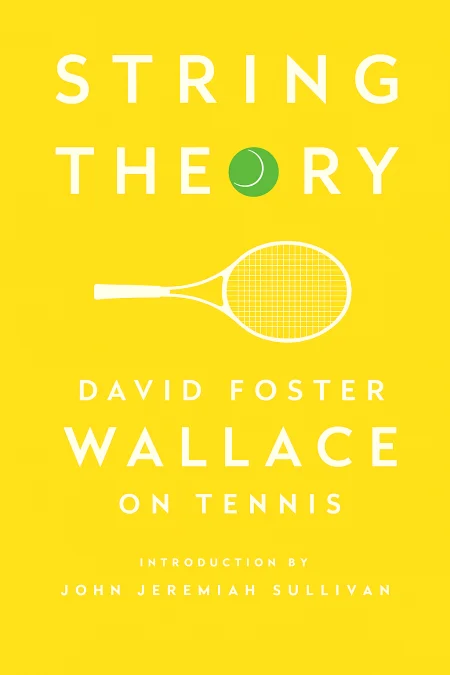
String Theory
On Tennis
byDavid Foster Wallace, John Jeremiah Sullivan
Book Edition Details
Summary
Brace yourself for a whirlwind journey through the kaleidoscopic world of tennis as seen through the unparalleled intellect of David Foster Wallace. In "String Theory," Wallace crafts a series of essays that transcend mere sports commentary, painting vivid portraits of the athletes who transform this game into an art form. With a deft hand, he unravels the mystique of Roger Federer's grace, critiques Tracy Austin's memoir with razor-sharp wit, and delves into Michael Joyce's disciplined rise to prominence. Wallace's own reflections on his "near-great" junior career add a personal touch, inviting readers into his love affair with the sport. In this collector’s edition, complete with a thoughtful introduction by John Jeremiah Sullivan, Wallace's writing shines as a testament to the sacrifices and soaring heights of tennis, elevating these essays into a literary grand slam.
Introduction
In the summer of 2006, a young Swiss tennis player named Roger Federer stepped onto Centre Court at Wimbledon, moving with what one observer would later describe as both "flesh and light." Watching from the press box was an American writer whose own relationship with tennis ran deeper than mere spectatorship—David Foster Wallace had once been ranked among the top junior players in his region, wielding a racket with the same precision he would later apply to sentences. Wallace possessed a rare gift: the ability to translate the kinesthetic poetry of sport into prose that captured not just what happened on court, but what it meant to be human in motion, striving for perfection under impossible pressure. Wallace's tennis writing reveals three profound dimensions of understanding. First, his intimate knowledge of the game's technical and psychological demands, born from years of competitive play in the wind-whipped courts of Illinois. Second, his capacity to see tennis as a metaphor for broader human struggles—the tension between control and chaos, the pursuit of beauty within rigid constraints, the loneliness of individual excellence. Finally, his recognition that watching greatness in any form offers a kind of redemption, a glimpse of what humans can achieve when body and mind unite in transcendent purpose.
Midwest Origins: Wind, Mathematics, and Early Tennis
David Foster Wallace's relationship with tennis began in the geometric precision of rural Illinois, where farmland stretched in perfect grids and tennis courts were carved from nitrogen-depleted soil. Born in 1962 and raised in Philo, a tiny collection of corn silos and academic housing, Wallace discovered tennis not as recreation but as a mathematical puzzle played against the elements. The courts of his youth were flawed—cracked, tilted, infested with weeds—but these imperfections became his teachers. Central Illinois existed in what meteorologists called a "thermal anomaly," where competing air masses created winds of legendary ferocity. While other junior players cursed these conditions, Wallace found in them a kind of cosmic curriculum. The wind transformed tennis from a simple matter of hitting balls over a net into three-dimensional calculus, requiring players to account for gusts, crosscurrents, and the parabolic trajectories of spinning spheres moving through unstable air. Most players fought the wind; Wallace learned to dance with it. His game evolved around accommodation rather than domination. Too slight and slow to overpower opponents, he developed what he called a "weird robotic detachment" from conditions beyond his control. He could hit serves that curved like sliders, groundstrokes that dropped just fair after traveling impossible angles through crosswinds. This acceptance of chaos within order, this ability to find advantage in apparent disadvantage, would later characterize both his writing and his understanding of what made certain athletes transcendent. The young Wallace achieved modest success—ranked seventeenth in the USTA's Western Section, winner of small-town tournaments throughout the Midwest. But his true education came from learning to see tennis as geometry in motion, as a sport where the mental game mattered more than raw athleticism. The boy who could calculate wind angles and court tilts would grow into the writer who could decode the psychological complexities that separated good players from great ones, and great ones from the sublime few who seemed to operate beyond normal physical laws.
The Professional Circuit: Observing Athletic Excellence
When Wallace turned his writer's eye to professional tennis, he brought the perspective of someone who had tested himself against the game's demands and found his limitations. His 1996 profile of Michael Joyce, then ranked 79th in the world, revealed not just the unglamorous reality of life on the ATP tour, but the profound gap between athletic competence and true excellence. Wallace watched Joyce with the fascination of someone who understood exactly how impossible the Australian's seemingly routine shots actually were. Professional tennis, Wallace discovered, existed in a realm beyond casual comprehension. Television flattened the experience, obscuring the ball's true velocity and the split-second reactions required to return shots traveling at hurricane speeds. Standing courtside, he was stunned by the pace, the angles, the sheer physicality of world-class play. Joyce, struggling in qualifying rounds for the recognition that would grant him entry into main draws, possessed skills that dwarfed those of any recreational player, yet remained invisible to mainstream sports culture. Wallace's portraits of tour professionals captured the loneliness and dedication required to reach such rarefied levels. These athletes had sacrificed normal childhoods, educational opportunities, and social development to pursue mastery in a single domain. They lived in airports and hotels, speaking in clichés to reporters, their entire identities compressed into world rankings and win-loss records. The beauty they created on court came at the cost of becoming, in Wallace's words, "grotesquely limited" human beings. Yet Wallace refused to sentimentalize this sacrifice. He recognized that elite athletes offered something valuable to the rest of us—concrete proof of human potential, demonstrations of what bodies and minds could achieve through total commitment. Their performances served as a kind of secular revelation, showing spectators possibilities they could never reach themselves but could appreciate with an almost religious intensity.
Federer and Transcendence: Beauty in Motion
In Roger Federer, Wallace found something he had never quite seen before: an athlete who transcended the brutal efficiency of modern power tennis to achieve something approaching art. Writing about Federer's 2006 Wimbledon campaign, Wallace struggled with vocabulary adequate to describe performances that seemed to suspend physical laws. The Swiss player moved with what Wallace called "uneccentric" grace, striking balls with timing so perfect that difficult shots appeared effortless. Federer represented evolution within revolution. The tennis world had been dominated for two decades by power-baseline players who hit with increasing force and topspin, turning matches into wars of attrition. But Federer proved that this style wasn't tennis's final form. He possessed all the power of his contemporaries while adding dimensions of touch, anticipation, and tactical variety that recalled the game's more elegant past. Watching him play was like seeing someone discover new possibilities within supposedly exhausted traditions. Wallace's famous description of a sixteen-stroke rally between Federer and Rafael Nadal reads like poetry, each shot building toward an impossible conclusion that only Federer could envision and execute. The Swiss player didn't just hit winners; he constructed them through psychological manipulation, setting up opponents with shots that appeared defensive but were actually establishing the geometry for angles that shouldn't have existed. His excellence lay not in single moments of brilliance but in sustained sequences of tactical thinking several moves ahead of his opponents. For Wallace, Federer's performances offered something beyond entertainment—they provided what he called "Federer Moments," instants when athletic beauty became so overwhelming that viewers found themselves making involuntary sounds of amazement. These moments suggested that human potential remained unlimited, that even in a supposedly analyzed and optimized sport, genius could still emerge to show new ways of being excellent.
Summary
David Foster Wallace's tennis writing ultimately reveals that sport at its highest level offers a unique form of human transcendence—the reconciliation of flesh with aspiration, of individual will with cosmic indifference. His own experience as a junior player who learned to find advantage in disadvantage, combined with his writer's gift for precise observation, allowed him to capture both the technical mastery and existential weight of athletic excellence. Through players like Michael Joyce and Roger Federer, Wallace showed how the pursuit of perfection in any domain requires sacrifices that most of us cannot fathom, yet produces beauty that enriches everyone who witnesses it. His work suggests that we need our athletic artists not just for entertainment, but as proof that humans can indeed touch something approaching the sublime, even if only for moments, even if only a few among us can reach such heights while the rest of us watch in grateful amazement.
Related Books
Download PDF & EPUB
To save this Black List summary for later, download the free PDF and EPUB. You can print it out, or read offline at your convenience.
By David Foster Wallace
