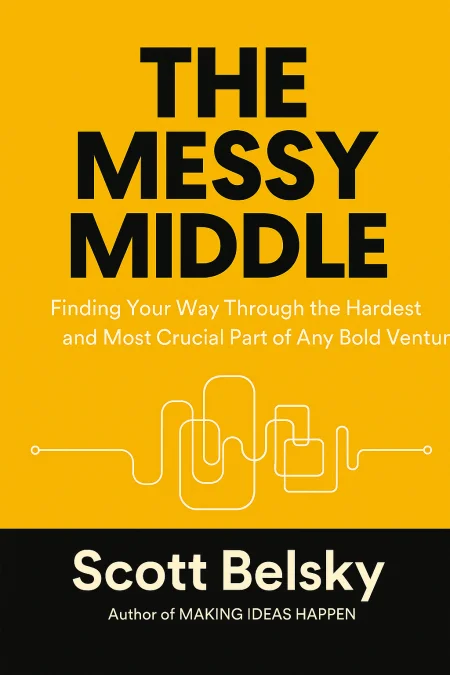
The Messy Middle
Finding Your Way Through the Hardest and Most Crucial Part of Any Bold Venture
Book Edition Details
Summary
In the chaotic heart of creation lies the true test of innovation—a turbulent stretch that Scott Belsky calls The Messy Middle. Far from the glamor of bright beginnings or the accolades at the finish line, this essential guide dives deep into the unpredictable journey that shapes the soul of every groundbreaking venture. Belsky, a visionary force at Adobe and a trusted advisor to startups like Airbnb and Pinterest, distills wisdom from his own experiences and those of trailblazing entrepreneurs. This book offers more than 100 practical lessons to help you weather the storms of success and failure, refine what works, and navigate the delicate art of completion. For those daring to transform ideas into reality, The Messy Middle is your steadfast companion through the exhilarating, often overlooked, center of the entrepreneurial odyssey.
Introduction
Picture yourself three years deep into your most ambitious project. The honeymoon phase of endless possibilities has long faded, replaced by a relentless cycle of firefighting, team tensions, and sleepless nights questioning every decision you've made. Your friends ask how things are progressing, and you flash that practiced smile while your inner voice screams through the chaos of missed deadlines, dwindling resources, and the growing weight of everyone's expectations. Welcome to the messy middle—that brutal stretch between the intoxicating launch and the celebrated finish line that nobody warns you about but everyone must navigate. This is where dreams either crystallize into reality or dissolve into cautionary tales. The messy middle is not a detour from success; it's the very crucible where success is forged through countless small battles, strategic pivots, and the gradual transformation of fragile ideas into resilient enterprises. While the world celebrates the glamorous moments of breakthrough and acquisition, the real magic happens in these unglamorous years of iteration, relationship-building, and incremental progress that test every assumption you hold about leadership and innovation. The journey ahead will teach you to reframe chaos as opportunity, showing you how to lead with conviction when the path forward is shrouded in uncertainty. You'll discover why the most resilient teams aren't built from perfect resumes but from diverse perspectives that challenge conventional thinking. Most importantly, you'll learn that mastering the middle isn't about avoiding the mess—it's about developing the skills to dance gracefully within it, transforming obstacles into stepping stones toward extraordinary outcomes.
From Anxiety to Action: Leading Through Uncertainty
Scott Belsky developed a peculiar morning ritual during Behance's early years that revealed the psychological toll of leading through uncertainty. Each day began with him scrolling through dozens of screenshots captured during anxious late-night sessions—website bugs, competitor launches, customer complaints, and financial projections that kept him awake. In some months, these anxiety-driven screenshots outnumbered his personal photos. One image particularly haunted him: a forced smile during his honeymoon in Thailand, where even surrounded by elephants and paradise, his mind remained consumed by his struggling team back home, just months away from potentially missing payroll. This wasn't merely startup stress; it was the invisible warfare of leadership in the unknown. Belsky realized he was pouring enormous mental energy into what he termed "insecurity work"—compulsively refreshing analytics, diving into spreadsheets, and checking metrics not because these activities moved the business forward, but because they provided momentary relief from the crushing weight of uncertainty. The cruel irony was that while these behaviors felt productive, they were actually stealing precious time and focus from the strategic work that would determine Behance's fate. The most dangerous trap for leaders navigating uncertainty is mistaking frantic motion for meaningful progress. When you can't see the destination clearly, it becomes tempting to stay busy with tasks that offer immediate gratification rather than wrestling with the ambiguous, uncomfortable problems that will actually shape your future. True leadership through chaos requires accepting that you'll spend significant mental bandwidth processing the unknown while developing systems to compartmentalize that anxiety so it doesn't paralyze your decision-making. The leaders who not only survive but thrive in the messy middle are those who learn to hold space for uncertainty without letting it consume their capacity for decisive action. They understand that anxiety is not a sign of weakness but a natural response to pushing into uncharted territory where breakthrough solutions live. Your ability to process fear while continuing to move forward becomes your greatest competitive advantage in a world where most people retreat to the safety of the familiar.
The Underqualified Dream Team: Building Through Diversity
When Behance was still operating on borrowed time and borrowed money, Scott Belsky made a series of hiring decisions that seemed to defy conventional wisdom. His cofounder Matias Corea had recently arrived from Barcelona, spoke primarily Spanish, and had designed little more than a saxophone brochure for a local music store. Dave Stein was fresh out of college with a psychology degree whose most impressive web project was an e-commerce site for lingerie. Chris Henry brought barely two years of post-graduation experience building basic websites for small businesses. And Belsky himself was working at Goldman Sachs with zero engineering background and had never led a company through any phase of growth. By traditional hiring standards, this team was wildly underqualified for the ambitious vision they were pursuing—building the definitive platform for creative professionals worldwide. Yet this apparent weakness became their secret weapon. Because none of them came from the established creative industry, they weren't constrained by conventional wisdom about how creative portfolios should be organized or presented online. While competitors simply offered image galleries that mimicked physical portfolios, Behance structured their platform around storytelling projects with context, process, and narrative depth. This approach initially created friction—it was more time-consuming for users to create rich project pages compared to simply uploading images, resulting in slower early growth that worried investors. But this friction ultimately positioned Behance as the more professional, comprehensive platform that serious creatives preferred. Their diversity of backgrounds spanning different languages, educational disciplines, and life experiences allowed them to see solutions that industry veterans couldn't imagine because they weren't trapped by existing assumptions about what was possible or proper. The magic of truly diverse teams isn't about checking demographic boxes or avoiding discrimination lawsuits; it's about cognitive diversity that exponentially expands your solution space for every challenge you encounter. When you surround yourself with people who think in different languages, process information through different frameworks, and have endured different struggles, you create an environment where breakthrough thinking becomes inevitable. The most dangerous hiring mistake is building a team of people who think like you do—comfort and familiarity in team dynamics often signal that you're missing the contrarian perspectives that could unlock your next quantum leap forward.
Less is More: The Pivot That Changes Everything
In the early days of building Behance's creative network, the team became intoxicated by their own cleverness and innovation. They created elaborate custom terminology, calling creative disciplines "realms" instead of the more straightforward "fields." They built intricate onboarding flows with multiple steps and dozens of customization options, proud of giving users unprecedented control over their creative identity. They were so enamored with their sophisticated features that they lost sight of a fundamental truth: customers don't engage with functionality—they engage with experiences that feel effortless and intuitive. The wake-up call came through brutal user data that shattered their assumptions. New users were spending an average of 120 seconds just trying to navigate the signup process, and more than 10 percent abandoned the platform entirely at a single step where they had to select their creative disciplines from an overwhelming dropdown menu of options. The team realized they were losing potential users not because their product was inferior, but because it was too complicated for people to understand its value before giving up in frustration. The transformation required ruthless simplification that felt like creative surgery. They eliminated beloved features, streamlined every interaction, and moved complex decisions later in the user journey when people were already invested in the platform. When they removed that time-consuming creative fields selection step from the initial signup and made it optional during profile completion, signups increased by 14 percent overnight. This single change had more impact on growth than any new feature they had built during the entire previous year. Product excellence isn't about adding more capabilities or options; it's about relentlessly removing everything that doesn't serve your core value proposition with surgical precision. The most successful products follow a predictable lifecycle: customers initially flock to something beautifully simple, the product gradually adds complexity to serve edge cases and power users, it becomes bloated and confusing, and then customers flee to the next simple alternative that captures the original magic. Breaking this cycle requires the discipline to make one subtraction for every addition, constantly asking not "what else can we build?" but "what should we remove to make this more powerful?" Your competitive advantage lies not in what you can do, but in what you have the wisdom and courage to choose not to do.
Constraints Breed Innovation: Growing Within Boundaries
When the founders of Sweetgreen opened their first location, they were constrained by a tiny 500-square-foot space that seemed to limit every aspect of their business model. They couldn't offer smoothies, retail products, extensive seating, or the dozens of menu variations they might have considered in a larger space. Instead, they were forced to focus obsessively on doing one thing exceptionally well: fast-casual salads made from local, seasonal ingredients. What initially felt like a crushing limitation became the foundation of their entire business philosophy and competitive advantage. Years later, as Sweetgreen expanded across the country and gained access to larger spaces and more capital, the founders faced constant pressure to diversify their offerings. Customers regularly requested smoothies and breakfast items, investors suggested adding retail components to increase revenue per square foot, and the competitive landscape seemed to reward companies with broader, more comprehensive menus. But the founders remembered the clarity and focus that emerged from their original constraints. As cofounder Nate Ru reflected, "We talked about adding smoothies, retail stores, all these things that we could convince ourselves fit into the core mission, but that first restaurant demonstrated that they weren't necessary and the brand was actually stronger without them." The breakthrough came when they established "constant evolution" as a core company value but defined innovation narrowly around their central mission rather than expanding horizontally into new categories. Instead of adding smoothies or breakfast, they encouraged team members to experiment with new combinations of existing ingredients during slow periods. One employee's personal creation—combining chicken and cheese over their chickpea lentil soup with quinoa—became the inspiration for an entire "warm bowl" category that drove significant revenue growth during winter months when salad sales traditionally declined. This approach created a culture where every team member felt empowered to contribute to the company's evolution while staying true to its focused identity. Rather than innovation coming from expensive consultants or executive brainstorming retreats, the best ideas emerged organically from employees who understood both the brand values and customer needs intimately. The founders learned to recognize and scale these grassroots innovations while maintaining the discipline to decline opportunities that didn't align with their core mission, no matter how lucrative they appeared. Sustainable innovation doesn't come from constantly chasing new markets—it emerges from creating safe spaces for experimentation within clearly defined boundaries where constraints become catalysts for creative breakthroughs.
Summary
The messy middle isn't a problem to be solved or a phase to be endured—it's the crucible where ordinary ideas are transformed into extraordinary realities through the patient alchemy of endurance, optimization, and unwavering commitment to core principles. Start by developing systems to process anxiety and uncertainty without letting them paralyze your decision-making capacity, recognizing that discomfort often signals you're pushing into uncharted territory where breakthrough solutions live. Build teams that prioritize cognitive diversity over comfortable consensus, hiring for different perspectives and fresh thinking rather than familiar backgrounds and predictable chemistry. Embrace constraints as creative catalysts rather than limitations, using focused boundaries to drive innovation within your core mission instead of chasing every attractive opportunity that crosses your path. Most importantly, remember that the struggles and setbacks you're experiencing aren't detours from success—they're the very foundation upon which lasting value is built, one small improvement and hard-won insight at a time.
Related Books
Download PDF & EPUB
To save this Black List summary for later, download the free PDF and EPUB. You can print it out, or read offline at your convenience.
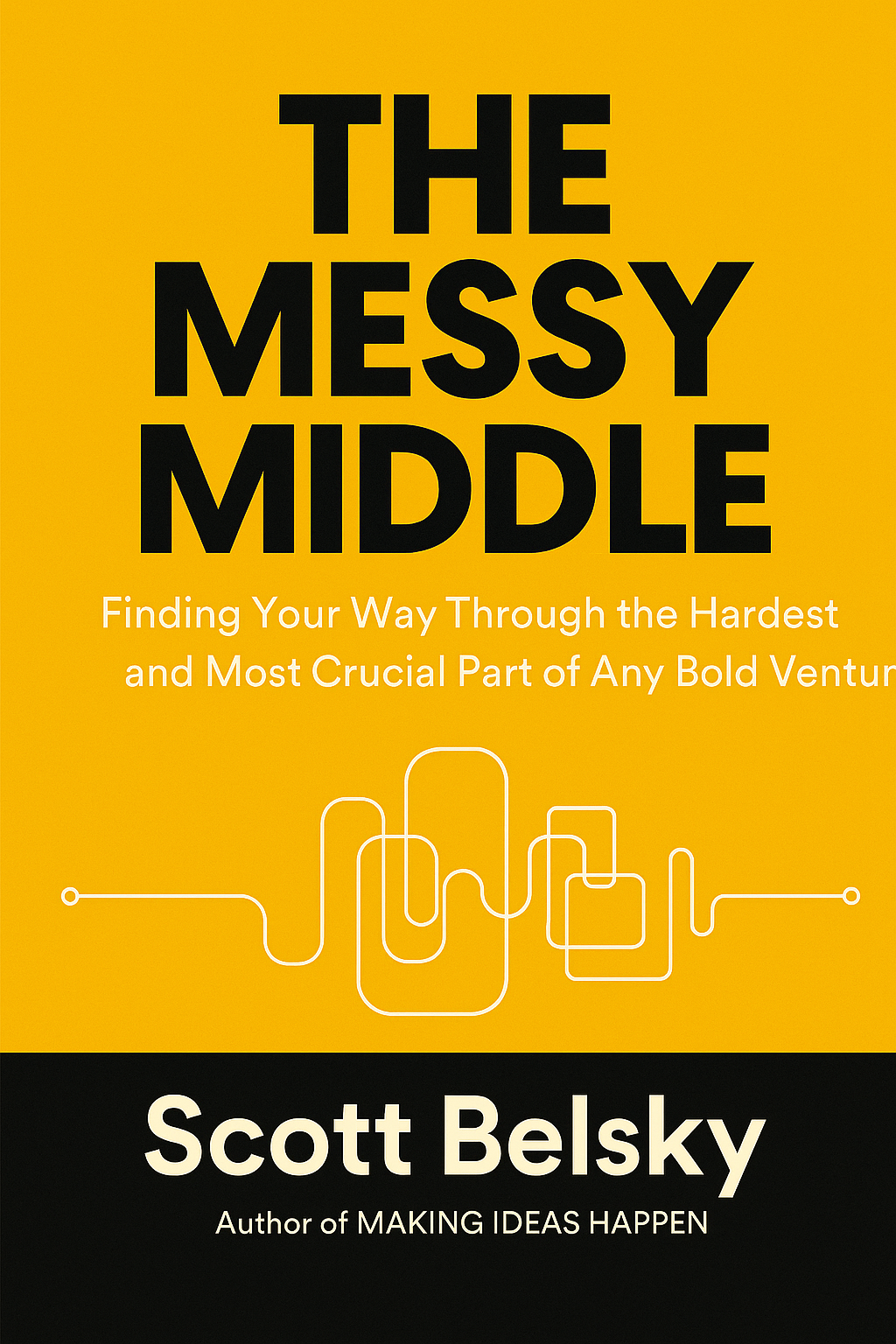
By Scott Belsky
