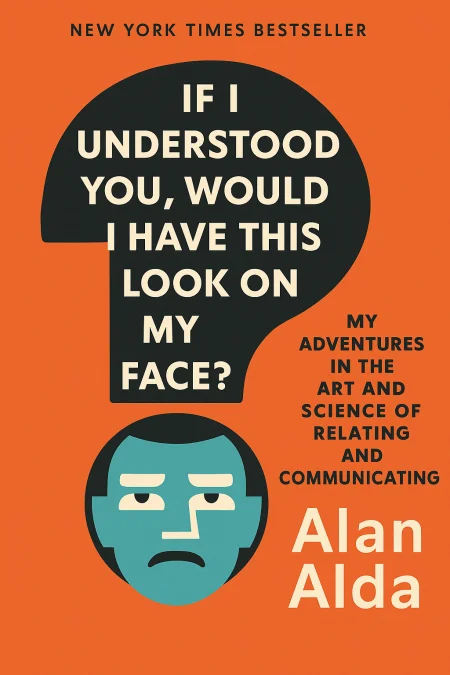
If I Understood You, Would I Have This Look On My Face?
My Adventures in the Art and Science of Relating and Communicating
Book Edition Details
Summary
When Alan Alda, the beloved actor and former host of Scientific American Frontiers, tackles the art of communication, he does so with a flair that marries improvisation and storytelling with the nuanced science of human interaction. His book, "If I Understood You, Would I Have This Look on My Face?", is a delightful revelation on the power of connecting through spontaneity and empathy. With a dash of his signature humor and candid storytelling, Alda distills years of acting wisdom into practical lessons on understanding others and being understood in return. Whether you’re navigating conversations with loved ones, colleagues, or strangers, Alda's insights offer a fresh perspective on breaking down barriers and fostering genuine connection. This isn’t just a book—it’s an invitation to transform the way we relate to the world around us.
Introduction
Picture yourself sitting in a dentist's chair, vulnerable and anxious, when your dentist casually mentions there will be "some tethering" as he approaches with a scalpel. The confusion and fear that floods through you in that moment captures something profound about human communication. We live in a world where understanding each other seems increasingly difficult, where the gap between what we say and what others hear can have consequences ranging from minor frustration to life-threatening misunderstandings. When patients can't relate to their doctors, when engineers can't convince communities about safety risks, when parents struggle to reach their children, the stakes couldn't be higher. Yet within each of us lies an extraordinary capacity for connection, a natural ability to read minds and hearts that we rarely tap into fully. Through decades of experience as an actor learning to truly see and respond to others on stage, and years of working with scientists to help them share their discoveries, we discover that the key to meaningful communication isn't found in clever techniques or perfect presentations. It lies in something far more fundamental and transformative: our ability to step into another person's world, to feel what they feel, and to understand what they're thinking. This is the art of relating, and it changes everything about how we connect with others, whether we're explaining complex ideas, building relationships, or simply trying to be understood in our daily lives.
From Scripts to Connection: The Theater of Human Communication
Standing before a solar panel scientist for the first time, confidence quickly melted into confusion. The interview had barely begun when three critical mistakes shattered any hope of connection. First came the assumption of knowledge that wasn't there, confidently declaring the scientist had assembled the panel from "off the shelf" parts, only to see his face tighten with mild offense. "They're not off the shelf," he corrected, explaining they had crafted many components themselves. Next came the misguided attempt at familiarity, reaching out to pat the delicate equipment despite the growing distress visible in his expression. "Please don't touch the panel," he said urgently. "You could ruin it." The third mistake was perhaps the most telling: asking questions that came from personal assumptions rather than listening to what he was actually saying. Three ways of not listening had created three barriers to understanding. This moment became a revelation about the difference between performing and truly connecting. In improvisational theater, actors learn to abandon their prepared responses and instead let themselves be changed by their scene partner. They practice what's called "responsive listening," where your next line doesn't come from a script but from genuinely reacting to what the other person has just done. It's the difference between waiting for your turn to speak and actually being affected by what someone else is communicating. When we approach conversations like true improvisation, we discover that listening isn't passive reception but active engagement, where we allow ourselves to be transformed by what we hear. This kind of relating becomes the foundation for all meaningful communication, turning mechanical exchanges into dynamic dances of mutual understanding.
Reading Minds and Hearts: The Science of Empathy
Two people stand face to face, looking intently into each other's eyes. One begins to move very slowly, and immediately the other mirrors the movement exactly, as if connected by invisible threads. This mirror exercise, simple as it appears, unlocks something profound about human connection. At first, the follower lags behind, struggling to keep up with movements that come too quickly. But when the leader takes responsibility for the partnership, slowing down to ensure the other can follow, something magical happens. They begin to move in perfect synchrony, and suddenly neither one is leading. They're finding the motion together, reading each other's intentions in milliseconds, anticipating movements before they happen. What's occurring in this exercise reflects deeper truths about how our brains are wired for connection. Scientists have discovered that when we observe others, certain neurons fire in our brains as if we were performing those same actions ourselves. This neural mirroring may help explain our capacity for empathy, the ability to feel what another person is feeling. But empathy goes hand in hand with what researchers call Theory of Mind, our awareness of what another person is thinking. Together, these abilities allow us to step into someone else's experience, understanding both their emotional state and their mental perspective. Children don't develop this capacity until around age four or five, when they suddenly realize that other people's thoughts and knowledge might be different from their own. But once we have these abilities, they become the foundation for all deep communication, allowing us to truly see and respond to the whole person standing before us.
Stories That Stick: Making Complex Ideas Clear and Memorable
The question seemed simple enough when it appeared in a science journal: "Would you be willing to explain what a flame is, in a way that an eleven-year-old would find intelligible, maybe even fun?" The challenge would be judged by real eleven-year-olds, and what emerged was extraordinary. Scientists from around the world submitted videos, essays, and demonstrations, competing not for academic prestige but for the approval of curious young minds. The winner created an animated musical video comparing atoms in a flame to Legos boxing in a ring, complete with technical terms like "pyrolysis" and "chemiluminescence" woven into catchy lyrics. Rather than being intimidated by fancy words, the children embraced them, singing the song long after the contest ended and learning complex chemistry concepts almost effortlessly. This transformation reveals something crucial about how we learn and remember. Memory researchers have discovered that we retain information far better when it's coupled with emotion, whether that emotion is joy, surprise, or even mild stress. The children weren't just receiving facts about combustion; they were experiencing the excitement of discovery, the pleasure of being taken seriously by adult experts, and the joy of understanding something previously mysterious. Stories become the perfect vehicle for this kind of emotional engagement because they naturally create suspense, obstacles, and resolution. When a scientist shares not just their findings but the journey of discovery, complete with failed experiments and breakthrough moments, they transform abstract concepts into human dramas that our brains are naturally equipped to understand and remember. The flame becomes more than oxidation; it becomes a story of dancing atoms and invisible forces that captures both mind and heart.
Summary
The deepest insights about communication emerge not from studying techniques but from recognizing a fundamental truth: meaningful connection happens when we genuinely see and respond to the whole person before us. Whether we're mirroring movements in an improvisation exercise, listening to a patient's concerns in a medical setting, or explaining complex ideas to curious minds, the magic occurs when we take responsibility for the other person's understanding and allow ourselves to be genuinely affected by their presence. This isn't about manipulation or clever persuasion tactics; it's about developing our natural capacity for empathy and mind-reading in service of authentic human connection. The transformation that occurs when we master this art of relating ripples through every area of our lives. Scientists discover their research comes alive when they share not just facts but the human drama of discovery. Doctors find that patients heal faster when they feel truly seen and understood. Parents connect more deeply with children when they remember what it's like to see the world through young eyes. The common thread is always the same: when we step out of our own heads and into genuine awareness of another person's thoughts and feelings, communication transforms from a mechanical exchange into a dynamic dance. In a world where misunderstanding can have profound consequences, this capacity for deep listening and authentic relating becomes not just a valuable skill but an essential gift we offer to everyone we encounter.
Related Books
Download PDF & EPUB
To save this Black List summary for later, download the free PDF and EPUB. You can print it out, or read offline at your convenience.
By Alan Alda
