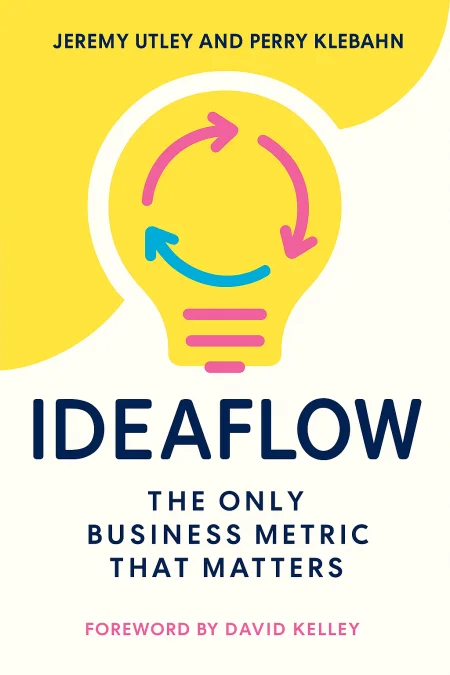
Ideaflow
The Only Business Metric That Matters
byJeremy Utley, David Kelley, Perry Klebahn
Book Edition Details
Summary
In the realm of creativity, the greatest triumphs often hinge on the flow of ideas—an art mastered by Jeremy Utley and Perry Klebahn of Stanford's d.school. "Ideaflow" unveils a dynamic approach to cultivating innovation, transcending the confines of mere brainstorming sessions. Imagine unlocking a torrent of inspiration that shatters conventional barriers, propelling you and your team to new heights of ingenuity. This insightful guide distills decades of experience from the masterminds behind Stanford's Launchpad accelerator, revealing how to sidestep mental pitfalls, ignite creativity in the most unlikely places, and transform tentative notions into revolutionary breakthroughs. Whether you're leading a Fortune 500 company or sparking creativity in a local startup, "Ideaflow" equips you with the tools to turn fleeting thoughts into a sustainable cascade of genius. Embrace the power of ideaflow and watch as it transforms your world—one brilliant idea at a time.
Introduction
In an era where technological disruption reshapes entire industries overnight, organizations face a critical paradox: while access to information and tools has never been greater, the ability to consistently generate breakthrough solutions remains frustratingly elusive. Most companies approach innovation as an unpredictable lightning strike, hoping that occasional brainstorming sessions or expensive consultants will deliver the transformative ideas they desperately need. This reactive approach proves inadequate when competing against organizations that have mastered the systematic generation of creative solutions. The ideaflow framework represents a fundamental shift from treating creativity as an art to understanding it as a measurable science. This methodology reveals that innovation capacity follows predictable patterns and can be systematically developed through specific practices and principles. Rather than waiting for inspiration, successful innovators create conditions where breakthrough ideas emerge consistently through structured processes. The framework addresses three essential questions that determine organizational survival in dynamic markets: How can we reliably generate novel solutions to emerging challenges? What systematic approaches transform creative potential into measurable business outcomes? How do we build sustainable innovation capabilities that compound over time rather than depending on individual genius or market luck?
The Ideaflow Principle: Quantity Drives Quality
The foundational principle of systematic innovation challenges our most basic assumptions about creativity and quality. Traditional thinking suggests that generating good ideas requires careful deliberation, patient reflection, and the pursuit of perfection over proliferation. However, extensive research across multiple domains reveals a counterintuitive truth: creative breakthroughs emerge from volume rather than careful curation, following what researchers term the equal-odds rule. Ideaflow measures the rate at which individuals or organizations generate novel solutions to specific problems within defined timeframes. This metric serves as a leading indicator of innovation capacity, providing early warning when creative output begins to decline and allowing leaders to intervene before stagnation sets in. Unlike traditional metrics that focus on outcomes, ideaflow captures the generative process itself, recognizing that human judgment proves remarkably poor at predicting which ideas will succeed in real-world conditions. The framework operates on the understanding that even experienced professionals struggle to distinguish promising concepts from mediocre ones without market validation. This limitation makes the conventional approach of generating a few carefully considered options fundamentally flawed. Instead, successful innovators embrace systematic proliferation, recognizing that breakthrough solutions often emerge from unexpected combinations or seemingly impractical starting points. Consider how this principle manifests in breakthrough innovations. When James Dyson developed his revolutionary vacuum cleaner, he created over 5,000 prototypes before achieving the design that transformed the industry. Similarly, Edison's laboratory generated thousands of experiments and iterations before producing the practical incandescent light bulb. These innovators succeeded not because their initial ideas were superior, but because they maintained systematic processes for generating and testing far more possibilities than their competitors, creating mathematical advantages that compound over time.
Building Innovation Pipelines Through Systematic Experimentation
The innovation pipeline transforms the traditionally chaotic process of creative development into a systematic methodology for validating assumptions and scaling successful solutions. This framework recognizes that even the most sophisticated analysis cannot predict market success when dealing with genuinely novel approaches, making rapid experimentation essential for separating viable concepts from attractive fantasies. The pipeline operates through three interconnected stages: hypothesis generation, assumption testing, and iterative refinement. Each stage employs specific tools and metrics designed to maximize learning while minimizing investment, allowing organizations to explore multiple possibilities simultaneously without betting everything on single concepts. This approach transforms innovation from a binary success-or-failure outcome into a continuous learning process where each experiment generates insights that inform better experiments. The methodology addresses one of the most common innovation failures: the tendency to scale promising ideas too quickly based on limited positive feedback. When early tests show encouraging results, leaders often rush to full implementation without understanding the specific conditions that created that success. This premature scaling frequently leads to expensive failures that could have been prevented through additional validation stages. The pipeline maintains discipline by requiring evidence at each development phase. The framework draws inspiration from successful technology companies that have institutionalized experimentation as core business practice. Netflix runs hundreds of simultaneous experiments on their platform, testing everything from user interface changes to content recommendation algorithms. Amazon famously experiments with new business models and services, maintaining a portfolio approach where successful experiments can scale rapidly while failures provide valuable learning without threatening the overall organization. These companies succeed because they have built systematic capabilities for generating, testing, and scaling innovations rather than relying on occasional breakthrough moments.
Mining Diverse Perspectives for Breakthrough Solutions
The perspective mining framework addresses one of the most significant limitations on creative output: the narrow range of viewpoints that most individuals and organizations bring to problem-solving. When teams consist of people with similar backgrounds, training, and experiences, they inevitably generate similar solutions, creating blind spots that prevent breakthrough thinking even when novel approaches are readily available. This methodology involves systematically seeking input from individuals who approach challenges from fundamentally different angles, going beyond demographic diversity to include cognitive diversity in thinking styles, professional backgrounds, and life experiences. The goal is accessing intellectual resources that would otherwise remain untapped, recognizing that expertise, while valuable, can become a liability when it creates rigid assumptions about how problems should be approached. The framework employs several key techniques for expanding perspective range. Cross-domain pollination involves bringing insights from completely unrelated fields to current challenges, recognizing that solutions often exist in unexpected places. Novice integration deliberately includes individuals without domain expertise who can question fundamental assumptions that experts take for granted. Systematic rotation exposes team members to different contexts and challenges, preventing the intellectual stagnation that comes from working exclusively within familiar domains. Consider how breakthrough innovations often emerge from perspective collisions. The development of Velcro resulted from observing how burr seeds attach to animal fur, connecting botanical mechanisms to fastening challenges. The computer mouse emerged from studying how radar operators tracked objects on screens, translating military technology to personal computing. These innovations succeeded not because their creators possessed deeper expertise within existing domains, but because they systematically connected insights across different fields of knowledge, creating solutions that pure specialization could never achieve.
Leading Creative Organizations and Managing Innovation Culture
The creative leadership framework addresses the unique challenges leaders face when building and sustaining innovation capabilities across entire organizations. Unlike traditional management approaches that emphasize control and predictability, creative leadership requires comfort with ambiguity and the ability to maintain productive momentum even when outcomes remain uncertain and traditional metrics provide limited guidance. Effective creative leadership operates through four core competencies: diagnostic sensitivity, intervention timing, resource orchestration, and cultural cultivation. Diagnostic sensitivity involves recognizing different types of creative challenges and distinguishing between productive struggle and destructive stagnation. This requires understanding when teams need more time for ideas to develop versus when they require immediate direction or resource reallocation. Intervention timing focuses on knowing when to provide structure, when to step back, and when to introduce new elements into creative processes. Resource orchestration involves allocating time, attention, and materials in ways that support rather than constrain creative work, recognizing that innovation follows different rhythms than operational activities. Breakthrough insights often emerge during periods of apparent inactivity or when attention is focused elsewhere, requiring leaders to resist the urge to constantly monitor progress or demand immediate results. Cultural cultivation emphasizes building organizational norms and practices that sustain innovation over extended periods rather than depending on individual talent or inspiration. The framework draws lessons from organizations that have successfully institutionalized creative capacity. Companies like 3M allocate percentage of employee time for exploratory projects, while Google's innovation labs provide structured environments for systematic experimentation. These organizations succeed because they have developed systematic approaches to managing the tensions between structure and flexibility, individual autonomy and collective coordination, short-term pressures and long-term vision. Their leaders have learned to make interventions that enhance rather than diminish creative capacity, building sustainable competitive advantages through superior innovation capabilities.
Summary
Sustainable innovation emerges not from sporadic bursts of inspiration but from systematic practices that consistently generate, validate, and scale breakthrough solutions, transforming creativity from an unpredictable art into a measurable organizational capability that can be developed and managed like any other critical business function. This comprehensive framework reveals that long-term competitive advantage depends less on executing existing strategies perfectly and more on building superior capacity to generate novel solutions to emerging challenges, ultimately providing individuals and organizations with practical tools for thriving in an increasingly dynamic and uncertain world.
Related Books
Download PDF & EPUB
To save this Black List summary for later, download the free PDF and EPUB. You can print it out, or read offline at your convenience.
By Jeremy Utley
