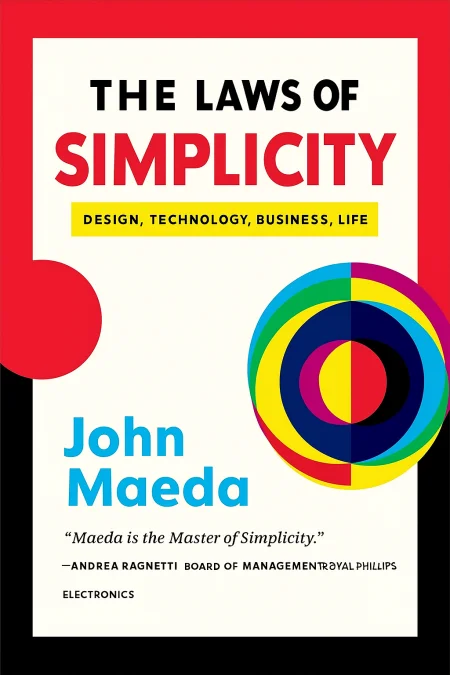
The Laws of Simplicity
Design, Technology, Business, Life
Book Edition Details
Summary
Tired of drowning in the digital deluge? Enter a world where less truly is more. John Maeda, a visionary at MIT's Media Lab and a maestro of design, unveils a transformative manifesto for our tech-saturated lives in "The Laws of Simplicity." With ten profound principles, Maeda illuminates the delicate dance between simplicity and complexity, urging us to pare down without losing essence. Here, simplicity isn't about mere subtraction; it's about crafting meaningful experiences that resonate. From his first law, "Reduce," to the liberating truth in Law 9, "Failure," Maeda’s insights carve a path to clarity in business and design. This book isn't just a guide—it's a blueprint for embracing elegance in a complex world.
Introduction
In our increasingly complex world, we find ourselves drowning in features, choices, and technological capabilities that promise to make life easier but often achieve the opposite. The modern paradox reveals itself daily: we want products that are simple and intuitive, yet we also demand they perform every conceivable function we might ever need. This tension between simplicity and functionality has become one of the defining challenges of contemporary design and life. The theoretical framework presented here establishes simplicity not as mere reduction or minimalism, but as a sophisticated design philosophy governed by systematic principles. These laws operate as interconnected guidelines that help navigate the balance between essential functionality and unnecessary complexity. The framework addresses fundamental questions about human perception, trust, emotional connection, and the contextual nature of simplicity itself. Rather than treating simplicity as an aesthetic choice, this approach positions it as a strategic methodology for creating meaningful experiences that respect both human cognitive limitations and our deep need for capability and control.
The Foundation Laws: Reduce, Organize, and Time
The foundational tier of simplicity rests upon three fundamental principles that address the most immediate and practical aspects of complexity management. These laws form the bedrock of any simplification effort, providing concrete methodologies that can be applied across diverse contexts from product design to personal organization. The first principle, Reduce, operates through thoughtful elimination rather than arbitrary cutting. The methodology employs what can be termed the SHE approach: Shrink physical or cognitive footprints to lower expectations and create forgiveness for complexity; Hide unnecessary features until needed, creating progressive disclosure; and Embody quality to compensate for what has been removed or concealed. This isn't about making things smaller or less capable, but about managing the relationship between capability and perceived complexity. Organization transforms chaos into comprehensible systems by leveraging human pattern recognition capabilities. The principle recognizes that our minds naturally seek to group and categorize information, a phenomenon explained by Gestalt psychology. When many elements can be organized into fewer meaningful groups, the system appears simpler even when the underlying complexity remains unchanged. The process involves systematic sorting, labeling, integration, and prioritization to create hierarchies that match human cognitive preferences. Time operates as a simplicity accelerator because efficiency feels inherently simple. When processes happen quickly or when waiting is eliminated, users attribute this speed to system simplicity rather than mere performance. This creates opportunities to make complex systems feel simple through temporal manipulation, progress indication, and expectation management. The perception of saved time translates directly into perceived simplicity, making this principle particularly valuable in service design and user experience optimization.
The Contextual Laws: Learn, Differences, and Context
The intermediate layer addresses the more nuanced aspects of simplicity that depend on knowledge, contrast, and environmental factors. These principles recognize that simplicity cannot exist in isolation but must be understood within broader contexts of learning, differentiation, and surrounding conditions. Learning transforms complexity into simplicity through knowledge acquisition and skill development. As users become more familiar with a system, their perceived complexity decreases even when the system itself remains unchanged. The principle emphasizes the importance of educational design, progressive skill building, and the creation of mental models that allow users to predict and understand system behavior. Effective learning design creates pathways from novice confusion to expert fluency, using repetition, clear instruction, and meaningful practice to build competence. Differences establishes that simplicity and complexity exist in a symbiotic relationship, each defining the other through contrast. Without complexity as a reference point, simplicity loses its meaning and value. This principle introduces the concept of rhythm in experience design, where alternating moments of simplicity and complexity create engaging patterns that maintain user attention and appreciation. The most effective designs orchestrate this rhythm carefully, using complexity to highlight moments of simplicity and vice versa. Context recognizes that what appears peripheral often proves central to the simplicity experience. The principle directs attention to environmental factors, background elements, and surrounding conditions that influence how users perceive and interact with primary tasks. Ambient design, white space utilization, and contextual awareness become critical tools for creating simplicity that feels natural and unforced. The challenge lies in managing the vast array of contextual factors that can either support or undermine simplicity efforts.
The Human Laws: Emotion, Trust, and Failure
The deepest layer of simplicity addresses fundamental human needs and limitations, acknowledging that pure rationality alone cannot create truly satisfying simple experiences. These principles recognize that humans are emotional, social beings who require trust, meaning, and acknowledgment of imperfection. Emotion challenges the notion that simplicity must be sterile or minimal. Instead, it argues that more emotions create better experiences than fewer emotions, provided those emotions are positive and meaningful. This principle validates the human need for expression, personality, and emotional connection with tools and systems. The approach involves understanding when to add richness, decoration, or emotional cues that enhance rather than complicate the user experience. It recognizes that different users have different emotional needs and cultural backgrounds that influence their simplicity preferences. Trust forms the foundation of advanced simplicity, where systems take on greater responsibility for decision-making and task execution. As systems become more capable and autonomous, users must develop comfort with delegation and reduced direct control. The principle explores the balance between user agency and system automation, examining when it's appropriate to trust machines versus when human oversight remains essential. Trust-based simplicity requires exceptional reliability, transparency about capabilities and limitations, and graceful handling of edge cases and failures. Failure acknowledges that some things genuinely cannot be made simple and that the pursuit of simplicity has inherent limitations. This principle provides permission to recognize when complexity serves important purposes and when simplification efforts should be abandoned in favor of other approaches. It also establishes that failed simplification attempts provide valuable learning opportunities and can lead to innovative solutions that embrace rather than eliminate complexity.
The Ultimate Principle and Future Keys
The culminating principle distills all preceding laws into a single, actionable framework while three technological keys point toward future directions for simplicity in an increasingly connected world. This synthesis provides both immediate practical guidance and long-term strategic vision. The ultimate principle states that simplicity is about subtracting the obvious and adding the meaningful. This directive transcends mere reduction to encompass value creation through careful curation of features, information, and interactions. It requires deep understanding of what users truly need versus what they think they want, distinguishing between apparent necessities and genuine value drivers. The principle demands both analytical rigor in identifying the obvious and creative insight in recognizing the meaningful. The three technological keys address emerging opportunities for simplification through technological advancement. The Away principle leverages cloud computing and distributed systems to hide complexity through geographical and architectural separation. The Open principle harnesses collective intelligence and shared resources to simplify development and maintenance through community collaboration. The Power principle addresses sustainability and energy efficiency as fundamental simplicity enablers, recognizing that truly simple systems must be environmentally sustainable and resource-conscious. These future-oriented principles acknowledge that simplicity strategies must evolve alongside technological capabilities and social needs. They provide frameworks for evaluating new technologies and approaches based on their potential to create genuine simplification rather than merely shifting complexity from one domain to another.
Summary
True simplicity emerges not from the absence of complexity but from the masterful orchestration of human needs, technological capabilities, and contextual factors into coherent, meaningful experiences. The systematic approach to simplicity reveals it to be neither accident nor aesthetic preference, but a disciplined methodology for creating value through thoughtful design decisions. By understanding simplicity as a multifaceted framework rather than a single principle, designers and individuals can create solutions that honor both human limitations and aspirations, ultimately leading to technologies and systems that enhance rather than complicate human flourishing.
Related Books
Download PDF & EPUB
To save this Black List summary for later, download the free PDF and EPUB. You can print it out, or read offline at your convenience.
By John Maeda
