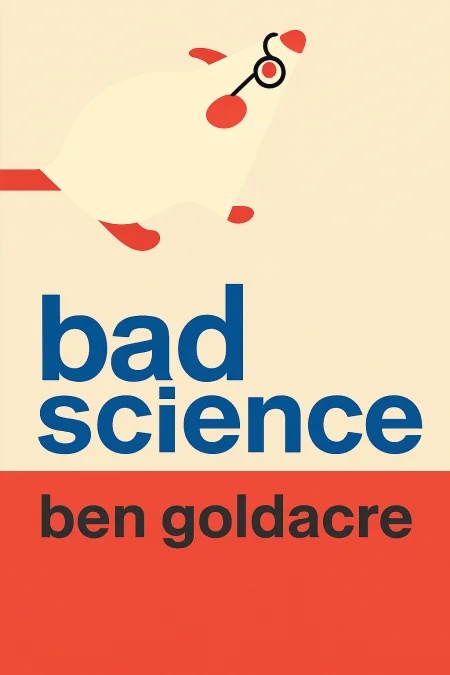
Bad Science
A behind-the-scenes look at the bogus science used to mislead us every day.
Book Edition Details
Summary
In the labyrinth of modern medicine and media, truth often wears a mask. Ben Goldacre peels it away with surgical precision in "Bad Science," a riveting exposé that untangles the web of misinformation spun by big pharma, alternative healers, and the press. Who truly benefits when a miracle cure hits the headlines, and how often do we swallow the placebo of pseudoscience instead of genuine discovery? Through a series of eye-opening investigations, Goldacre not only challenges the misconceptions that clutter our understanding but also empowers readers with the tools to discern fact from fiction. This book is not just a critique; it's a call to arms for the curious minds ready to question the status quo and seek truth in a world awash with scientific charlatans.
Introduction
Contemporary society confronts an unprecedented challenge in distinguishing legitimate scientific evidence from sophisticated pseudoscience that masquerades as credible research. This pervasive confusion extends far beyond academic circles, infiltrating healthcare decisions, media coverage, and public policy with potentially devastating consequences for individuals and communities. The proliferation of misleading scientific claims has created a landscape where cherry-picked studies, misinterpreted data, and outright fabrications compete for attention alongside rigorous research, making it increasingly difficult for non-experts to navigate the information environment effectively. The stakes of this confusion extend well beyond intellectual curiosity or consumer choices. When people cannot effectively evaluate scientific claims, they become vulnerable to exploitation by those who profit from their misunderstanding, from expensive supplements marketed with dubious health promises to dangerous medical advice that contradicts established treatments. The challenge becomes even more complex considering that many misleading claims contain just enough legitimate science to appear credible to those lacking specialized training. Understanding how to identify and counter bad science requires developing analytical skills that can be applied across diverse contexts, from evaluating news reports about breakthrough treatments to assessing claims made by charismatic health gurus. The tools for this critical evaluation are neither mysterious nor exclusive to experts; they represent fundamental principles of logical reasoning and evidence assessment that anyone can learn and apply to protect themselves and their communities from scientific misinformation.
The Anatomy of Pseudoscience: Detox, Homeopathy, and Manufactured Authority
Pseudoscience reveals its true nature through predictable patterns that become apparent once you understand what to look for. The detox industry exemplifies these characteristics perfectly, making grand claims about removing mysterious toxins from the body without ever specifying what these toxins actually are or providing measurable evidence of their removal. When subjected to basic scientific testing, detox products consistently fail to demonstrate their purported effects, yet they persist in the marketplace through clever marketing that exploits people's desire for simple solutions to complex health concerns. Homeopathy represents another fascinating case study in pseudoscientific thinking, where the fundamental premise involves two key assertions that can be subjected to controlled testing: that substances causing symptoms in healthy people can treat similar symptoms in sick people, and that extreme dilution increases therapeutic potency. These claims contradict basic principles of chemistry and physics, as modern homeopathic preparations are often diluted to the point where not a single molecule of the original substance remains, yet practitioners claim these solutions become more potent through the dilution process. The cosmetics industry provides perhaps the most sophisticated examples of pseudoscientific marketing, where companies invest heavily in creating the appearance of scientific rigor without the substance. Complex-sounding ingredient names and references to cellular processes create an impression of advanced research, while the actual evidence for dramatic anti-aging effects remains conspicuously absent. The industry has mastered the art of making claims that sound specific and scientific while remaining legally defensible through careful wording that technically avoids making explicit promises. These examples share common features that serve as warning signs for identifying pseudoscience in any context. They typically involve proprietary products or methods, rely heavily on testimonials rather than controlled studies, make claims that sound too good to be true, and respond to criticism with attacks on critics rather than additional evidence. Understanding these patterns provides a foundation for evaluating more complex scientific claims across different fields and protecting oneself from exploitation by those who would profit from confusion.
Media Distortion and Statistical Manipulation: How Evidence Gets Twisted
Statistical manipulation represents one of the most effective tools for distorting scientific evidence, particularly because most people lack the mathematical literacy to recognize these distortions. Media outlets routinely present relative risk increases rather than absolute risks, transforming modest statistical findings into alarming headlines. A treatment that reduces risk from 2 in 1000 to 1 in 1000 represents a 50% relative reduction that sounds impressive, but only a 0.1% absolute reduction, which more accurately reflects the actual benefit to individual patients. The selective reporting of research findings creates systematic bias in public understanding of scientific evidence. Studies showing positive results receive extensive media coverage, while negative results are often ignored entirely, creating the false impression that scientific evidence overwhelmingly supports particular treatments or interventions when the complete picture might tell a very different story. This publication bias becomes particularly problematic when commercial interests drive the selective presentation of data to promote specific products or services. Correlation and causation represent another frequent source of confusion in media reporting, where journalists routinely present observational studies as if they demonstrate causal relationships. Complex statistical concepts like confounding variables, selection bias, and regression to the mean are rarely explained, leaving readers unable to properly evaluate the significance of reported findings. The misrepresentation of scientific uncertainty further compounds these problems, as media coverage treats each new study as definitive rather than as contributing pieces to larger puzzles. The transformation of nutrition from common-sense dietary advice into a complex pseudoscientific enterprise demonstrates how legitimate scientific concepts can be distorted for commercial purposes. Nutritionism takes the reasonable observation that diet affects health and transforms it into an elaborate system of specific molecular interventions, creating a market for expensive supplements where simple dietary wisdom once sufficed, while media coverage amplifies preliminary findings while ignoring subsequent studies that fail to confirm initial promising results.
Case Study Analysis: The MMR Vaccine Scandal and Public Health Consequences
The MMR vaccine controversy demonstrates how a single flawed study can generate years of public health damage when amplified by irresponsible media coverage. The original 1998 paper involved only twelve children and made no definitive claims about vaccine safety, yet it sparked a decade-long scare campaign that significantly reduced vaccination rates and contributed to outbreaks of preventable diseases. The study's methodology was fundamentally inadequate for establishing any causal relationship between vaccination and autism, as it was merely a case series rather than a controlled study that could demonstrate causation. The children in the study were not randomly selected but were referred specifically because their parents suspected vaccine-related injuries, creating an obvious selection bias that undermined any conclusions about general vaccine safety. Subsequent investigations revealed serious ethical and methodological problems with the original research, including undisclosed financial conflicts of interest, as the lead researcher had been paid by lawyers preparing lawsuits against vaccine manufacturers. Many of the children were already involved in legal cases before the research began, raising questions about how they were selected and whether the invasive medical procedures performed were clinically justified. The broader scientific community conducted numerous large-scale studies involving hundreds of thousands of children to investigate potential links between vaccination and autism. These studies consistently found no evidence of any connection, yet media coverage continued to present the issue as a genuine scientific controversy rather than acknowledging the overwhelming weight of contradictory evidence. The persistence of vaccine fears despite this evidence illustrates how emotional narratives can override rational evaluation of scientific data. This case reveals the devastating real-world consequences that can result when pseudoscientific claims gain traction in public discourse. The reduction in vaccination rates led directly to outbreaks of measles, mumps, and other preventable diseases, causing unnecessary suffering and death. The scandal demonstrates how the systematic distortion of scientific evidence represents not merely an academic concern but a serious threat to public health that requires active resistance from scientists, healthcare providers, and informed citizens.
Defending Evidence-Based Medicine Against Commercial and Ideological Attacks
Evidence-based medicine represents humanity's most reliable method for distinguishing effective treatments from ineffective ones, yet it faces constant attack from those who profit from promoting unproven therapies. The systematic evaluation of medical interventions through controlled trials, meta-analyses, and peer review provides the foundation for rational healthcare decisions, but this methodology is often dismissed as narrow-minded or corrupted by commercial interests by those who prefer to rely on tradition, authority, or anecdotal evidence. The hierarchy of evidence provides a crucial framework for evaluating the reliability of different types of research. Randomized controlled trials, where participants are randomly assigned to receive either treatment or placebo, provide much stronger evidence than observational studies or anecdotal reports because they can control for confounding variables and demonstrate causal relationships. Systematic reviews that combine data from multiple studies offer even greater reliability by reducing the impact of individual study limitations and providing more robust estimates of treatment effects. Critics of evidence-based medicine often argue that it ignores individual variation and reduces patients to statistical averages, but this criticism misunderstands how evidence-based practice actually works. Clinical trials provide information about average treatment effects, which physicians then apply to individual patients based on their specific circumstances, preferences, and values. The goal is not to eliminate clinical judgment but to inform it with the best available evidence, ensuring that treatment decisions are based on systematic evaluation rather than arbitrary preferences. The alternative to evidence-based medicine is not individualized care but arbitrary treatment based on tradition, authority, or commercial promotion. When medical decisions are divorced from systematic evidence evaluation, patients become vulnerable to exploitation by those who prioritize profit over effectiveness. Defending evidence-based medicine requires not blind faith in authority but critical evaluation of evidence quality, transparent discussion of treatment benefits and risks, and constant vigilance against those who would substitute wishful thinking for rigorous analysis in matters of life and death.
Summary
The systematic distortion of scientific evidence represents one of the most significant challenges facing modern society, with consequences extending far beyond individual health decisions to encompass public policy, resource allocation, and social trust in institutions. The patterns of deception examined throughout this analysis reveal how easily scientific authority can be exploited for commercial or ideological purposes, from statistical manipulation and selective reporting to the manufacture of false controversies that confuse public understanding of well-established scientific knowledge. The solution lies not in abandoning scientific methodology but in developing widespread scientific literacy that enables individuals to distinguish between legitimate research and its superficial imitation, requiring understanding of basic principles of study design, statistical interpretation, and evidence evaluation, as well as recognition of the psychological biases that make people vulnerable to pseudoscientific claims. The defense of rational inquiry against popular delusions requires constant vigilance and active engagement from scientists, educators, journalists, and citizens, as only through sustained commitment to evidence-based reasoning can society hope to navigate complex challenges while avoiding costly detours imposed by those who substitute wishful thinking for rigorous analysis.
Related Books
Download PDF & EPUB
To save this Black List summary for later, download the free PDF and EPUB. You can print it out, or read offline at your convenience.
By Ben Goldacre
