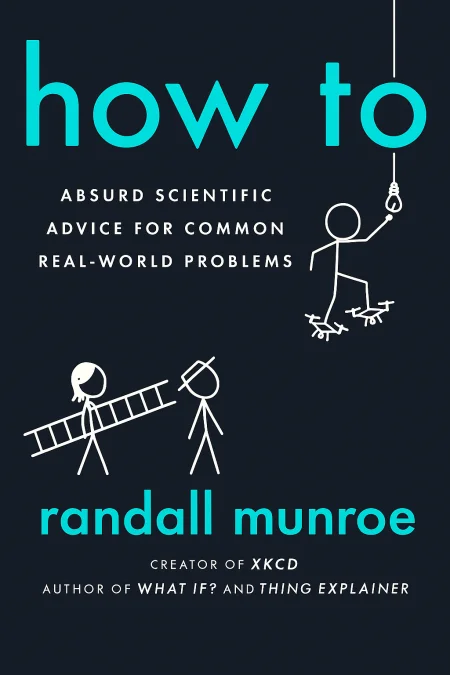
How To
Absurd Scientific Advice for Common Real-World Problems
Book Edition Details
Summary
For those who dare to embrace the wildly impractical, Randall Munroe's "How To" serves up a delightful banquet of absurdity, offering a kaleidoscope of convoluted methods to tackle the mundane. From the imaginative mastermind behind xkcd, this book invites you to contemplate life’s simplest tasks through a lens of delightful complexity. Ever wondered how to land a plane with maximum drama or boil a river to cross it? Munroe’s got you covered. Through quirky infographics and witty illustrations, he transforms science into a playground of possibility, challenging you to rethink the boundaries of the feasible. It's not just a guide; it’s a whimsical exploration of the fantastical potential hidden in everyday routines, crafted for those who relish the joy of the ludicrous.
Introduction
Every day, we encounter problems that seem impossible to solve, from the mundane challenge of getting somewhere on time to the extraordinary task of powering a house on Mars. The beauty of seemingly ridiculous problems lies not just in their solutions, but in the creative thinking process they inspire. When we abandon conventional wisdom and embrace the absurd, we often discover that the impossible is merely improbable, and the improbable is surprisingly achievable. This journey through unconventional problem-solving will challenge your assumptions, spark your curiosity, and demonstrate that even the most outlandish ideas can lead to breakthrough insights. The key is learning to ask better questions, think beyond traditional boundaries, and find joy in the process of exploration itself.
Breaking Physics: When Normal Rules Don't Apply
At first glance, physics seems like an immutable set of rules that govern everything around us. But the most fascinating discoveries happen when we push against these apparent limitations and discover that the "impossible" often has hidden loopholes. Take the story of astronaut Chris Hadfield, who spent years learning to land aircraft in impossible situations. When asked how to land a plane from the cockpit doorway with only objects to throw at the controls, Hadfield didn't dismiss the question as absurd. Instead, he methodically worked through the physics: "In a plane with multiple engines, you can control things with power. By moving the throttles up and down you can climb, and you can turn that way, too." He referenced a real incident where a DC-10 lost all hydraulics over Sioux City, and pilots managed to steer using only throttles, successfully bringing the plane around to the runway. This approach transformed what seemed like a joke scenario into a legitimate survival strategy. Hadfield's willingness to engage seriously with ridiculous premises revealed genuine insights about aircraft control systems and emergency procedures that could actually save lives. The lesson extends far beyond aviation. When facing any "impossible" challenge, start by questioning which rules are truly fixed and which are merely conventional. Look for the underlying physics or principles that might offer unexpected pathways. Test your assumptions by running calculations, even for seemingly absurd scenarios. Often, the math will surprise you and reveal solutions hiding in plain sight.
Creative Problem-Solving: Turning Constraints into Opportunities
The most innovative solutions often emerge from the most severe constraints. When normal approaches fail, constraint-driven creativity forces us to discover entirely new possibilities that we never would have considered otherwise. Consider the challenge of sending a file when you can't find reliable internet access. The conventional solution involves finding better connectivity, but creative constraint-solving leads to extraordinary alternatives. Researchers have discovered that monarch butterflies, during their epic migrations across North America, can carry small data storage devices thousands of miles with remarkable reliability. By encoding information into DNA storage systems, weighing just five milligrams per butterfly, a colony of ten million monarchs could theoretically transport ten zettabytes of data, roughly equivalent to the entire internet circa 2019. This butterfly-based data transfer system emerged from treating severe bandwidth limitations not as obstacles, but as design parameters. The constraints of weight, distance, and reliability led to a biomimetic solution that combines natural navigation systems with cutting-edge storage technology. While impractical for daily use, the concept demonstrates how extreme limitations can inspire breakthrough thinking. When facing your own "impossible" problems, deliberately embrace the constraints rather than fighting them. List every limitation you face, then ask how each constraint might actually be an advantage. Look for systems in nature or other fields that have solved similar challenges under comparable constraints. Transform each "you can't" into "what if you could only." This reframing often reveals hidden opportunities and unconventional resources that turn limitations into competitive advantages.
The Art of Scientific Absurdity: Learning Through Extremes
Scientific thinking reaches its full creative potential when we deliberately pursue ideas that sound completely ridiculous. The most valuable insights often hide behind concepts that seem too strange to take seriously. The question of whether you could power your house by harnessing the movement of tectonic plates perfectly illustrates this principle. On the surface, it sounds absurd, but working through the calculations reveals fascinating insights about energy, geology, and engineering. The math shows that while theoretically possible, generating meaningful power would require enormous pistons anchored across fault lines with "roots" extending kilometers in each direction. The steel structure alone would cost around $40 billion and take 36 million years to pay for itself through electricity savings. What makes this exercise valuable isn't the impractical conclusion, but the journey of discovery. By taking the ridiculous premise seriously, we learn about fault mechanics, pressure systems, energy conversion efficiency, and the true scale of geological forces. The process forces us to research real-world constraints and develop a deeper understanding of multiple scientific disciplines simultaneously. This approach to absurd problems reveals patterns and principles that apply to more practical challenges. When you encounter a seemingly impossible problem, resist the urge to dismiss it immediately. Instead, start calculating, researching, and modeling as if the solution were entirely feasible. Break down the physics, investigate the materials, estimate the costs, and map out the engineering requirements. Even when the final answer is "this won't work," the process will teach you something valuable about the underlying systems and might reveal related approaches that actually could succeed.
Summary
The art of tackling impossible problems lies not in finding perfect solutions, but in developing the courage to think creatively and the persistence to follow ideas wherever they lead. As this exploration demonstrates, "impossible" is often just another word for "not yet properly understood." The most important skill isn't knowing the right answers, but learning to ask better questions and maintaining curiosity even when conventional wisdom says to stop. Whether you're planning to catch a drone with sports equipment or contemplating the logistics of mailing a package from space, the process of serious engagement with ridiculous problems builds exactly the kind of creative problem-solving muscles you need for real-world challenges. Start today by picking one "impossible" problem in your own life and spending thirty minutes calculating, researching, or sketching potential approaches, no matter how absurd they might seem.
Related Books
Download PDF & EPUB
To save this Black List summary for later, download the free PDF and EPUB. You can print it out, or read offline at your convenience.
By Randall Munroe
