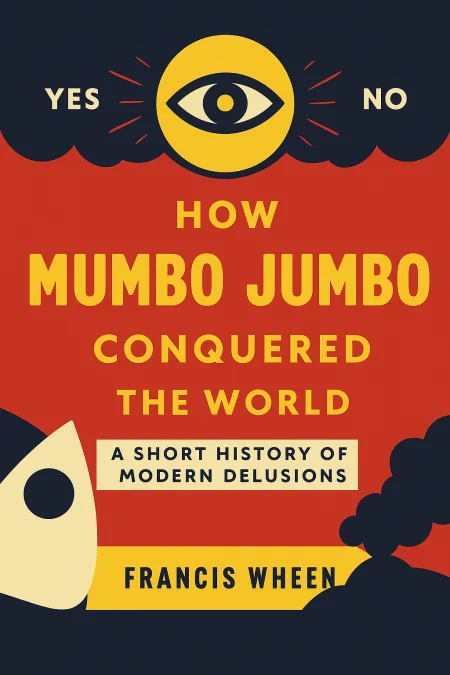
How Mumbo-Jumbo Conquered the World
A Short History of Modern Delusions
Book Edition Details
Summary
What if reason was dethroned by the fantastical, and the absurd reigned supreme? In "How Mumbo-Jumbo Conquered the World," Francis Wheen embarks on a riveting exposé of our descent into an era awash with charlatans and mystical nonsense. From the proliferation of quacks and spiritual zealots to the unsettling rise of moral ambiguity, Wheen paints a vivid picture of a world straying far from Enlightenment ideals. With an astute gaze, he scrutinizes everything from religious fanaticism in the Middle East to the cultural bedlam of America, where superstition and pseudoscience thrive. Hilarious yet haunting, Wheen's narrative is a clarion call for critical thinking amidst the cacophony of modern irrationality.
Introduction
The late twentieth and early twenty-first centuries present a striking paradox: as humanity achieved unprecedented scientific breakthroughs and technological capabilities, large segments of society simultaneously embraced increasingly irrational beliefs and anti-intellectual attitudes. This phenomenon extends far beyond harmless eccentricity, representing a fundamental challenge to the foundations of democratic discourse, scientific progress, and evidence-based decision-making. The retreat from rational inquiry manifests across multiple domains, from political leadership that consults astrologers to academic institutions that reject objective truth, from economic policies based on mystical faith in market forces to popular culture that celebrates emotion over evidence. Understanding this intellectual crisis requires examining how various cultural, political, and academic movements converged to undermine the Enlightenment values that once promised to liberate humanity from superstition and dogma. The analysis reveals not merely a collection of isolated phenomena, but a systematic pattern of intellectual abdication that threatens the very possibility of reasoned public discourse. By tracing the specific mechanisms through which irrationality gained cultural authority, we can better comprehend both the scope of the challenge and the urgent necessity of defending rational inquiry as an essential tool for human flourishing and democratic governance.
The Perfect Storm: Converging Forces Against Rational Discourse
Multiple cultural and political movements converged during the final decades of the twentieth century to create an unprecedented assault on rational thinking. The 1980s marked a pivotal moment when Margaret Thatcher's market fundamentalism and Ronald Reagan's political mysticism established a template for governance that combined economic dogma with supernatural beliefs. Reagan's consultation with astrologers for matters of state policy exemplified this fusion of political power and irrational thinking, while Thatcher's insistence that society consisted only of atomized individuals pursuing self-interest destroyed the communal bonds that traditionally provided meaning and stability. This political transformation coincided with the explosive growth of New Age spirituality, which offered a seductive alternative to both traditional religion and secular materialism. The New Age movement promised personal transformation through crystals, chakras, and channeled wisdom from ancient civilizations, appealing to individuals seeking meaning in an increasingly fragmented world. Yet this spiritual marketplace operated according to the same consumer logic that governed economic life, where truth became whatever made people feel good about themselves, regardless of evidence or logical coherence. The media landscape accelerated these trends by privileging emotional impact over factual accuracy. Television news increasingly resembled entertainment programming, with dramatic music, sensational graphics, and human interest stories replacing serious analysis of complex issues. The rise of talk shows and reality television normalized the public display of private emotions while teaching audiences to value authenticity over truth, sincerity over accuracy, and personal testimony over empirical evidence. These converging forces created a cultural environment where rational discourse became increasingly difficult to maintain. When political leaders modeled irrational decision-making, when spiritual movements rejected empirical evidence, and when media rewarded sensationalism over substance, the foundations for reasoned public debate began to crumble, leaving society vulnerable to demagogues and charlatans who exploited public confusion for their own ends.
Market Fundamentalism and Academic Relativism: Parallel Assaults on Truth
Two seemingly opposed intellectual movements launched simultaneous attacks on rational inquiry from different directions. Market fundamentalism transformed economics from a practical discipline concerned with human welfare into a quasi-religious faith system that elevated abstract theoretical models above empirical observation. This ideology treated markets as mystical entities possessed of supernatural wisdom and self-correcting mechanisms, ignoring centuries of evidence demonstrating that financial markets are subject to manias, panics, and systematic irrationalities that can persist for years or decades. The intellectual framework supporting market fundamentalism relied heavily on mathematical models that assumed away the very human behaviors that drive real economic activity. These models treated individuals as perfectly rational calculators while ignoring the psychological, social, and institutional factors that actually determine economic outcomes. The result was a body of theory that appeared scientifically rigorous while being fundamentally divorced from observable reality, leading to policies that consistently failed to deliver their promised benefits while concentrating wealth and impoverishing the majority. Simultaneously, academic postmodernism launched its own assault on rational inquiry by rejecting the very possibility of objective truth or universal knowledge. Beginning in French universities during the 1960s and spreading rapidly across American campuses, this intellectual movement provided cover for the most outrageous forms of pseudo-scientific nonsense by claiming that all knowledge is socially constructed and culturally relative. If physics and astrology were merely different "ways of knowing" with equal validity, then no belief system could be dismissed as false or harmful. The Sokal affair of 1996 exposed the intellectual bankruptcy of academic postmodernism when physicist Alan Sokal successfully submitted a meaningless article filled with fashionable jargon to a leading postmodernist journal. His hoax demonstrated that academic postmodernists had abandoned basic scholarly standards of evidence and argument in favor of ideological conformity and linguistic obscurity, yet rather than prompting soul-searching, the exposure only intensified their hostility toward scientific rationality and empirical methodology.
Religious Revival and Therapeutic Culture: Emotion Over Evidence
The final decades of the twentieth century witnessed an unexpected resurgence of religious fundamentalism that rejected the compromises with modernity that had characterized mainstream religion for generations. American evangelicalism transformed from a marginalized subculture into a dominant political force through sophisticated media operations and grassroots organizing, while televangelists like Pat Robertson and Jerry Falwell built media empires that reached millions of viewers. Their success demonstrated how effectively emotional appeals and apocalyptic imagery could overwhelm rational discourse in the public sphere. The fusion of religious certainty with political power proved particularly dangerous when applied to foreign policy, as Reagan's characterization of the Soviet Union as an "evil empire" reflected not strategic analysis but theological conviction about cosmic battles between good and evil. This moralistic framework simplified complex geopolitical realities into melodramatic narratives that justified extreme measures and precluded diplomatic compromise, while similar patterns emerged globally as Islamic fundamentalism followed parallel trajectories of rejecting both Western secular values and traditional scholarship. Parallel to religious revival, therapeutic culture elevated emotion above reason as the primary guide for both personal and political decision-making. Popular psychology movements promoted the idea that feelings were more authentic and trustworthy than rational analysis, while self-help gurus encouraged people to "follow their hearts" and "trust their instincts" while dismissing critical thinking as cold and mechanistic. This emotional populism found political expression in leaders who emphasized empathy and personal connection over policy expertise or intellectual rigor. The death of Princess Diana in 1997 crystallized this cultural shift, as the unprecedented outpouring of public grief revealed how desperately people craved emotional communion in an atomized society, even with a celebrity they had never met. Politicians who understood this hunger for feeling over substance mastered the art of public empathy while pursuing policies that contradicted their compassionate rhetoric, demonstrating how therapeutic culture could be manipulated to serve anti-rational political agendas.
Defending Enlightenment: The Urgent Case for Rational Inquiry
The defense of rational inquiry requires more than cataloguing the failures of irrationalist alternatives; it demands a positive articulation of why empirical methods, logical reasoning, and open debate represent humanity's best tools for understanding the world and solving practical problems. The historical record provides compelling evidence for the practical value of Enlightenment approaches to knowledge, as the scientific revolution and its technological applications have dramatically improved human welfare, extending lifespans, reducing suffering, and expanding opportunities for human flourishing. Democratic institutions, despite their imperfections, have proven more responsive to human needs than alternatives based on traditional authority or ideological purity, while the gradual expansion of human rights and dignity reflects the practical application of universalist principles derived from rational moral philosophy. The case for rational discourse extends beyond its practical benefits to encompass its role in preserving human dignity and freedom, since systems of thought that reject the possibility of objective truth inevitably devolve into contests of power where the strongest voices prevail regardless of the merit of their arguments. Only by maintaining standards of evidence and logical consistency can societies preserve space for minority viewpoints and protect individuals from the tyranny of popular prejudice. The challenge lies not in defending some impossible standard of perfect objectivity, but in maintaining institutional and intellectual practices that allow for the gradual correction of errors and the progressive refinement of understanding. This requires cultivating intellectual virtues of curiosity, humility, and respect for evidence while resisting the temptation to subordinate inquiry to predetermined conclusions. The defense of rational inquiry becomes particularly urgent in an era when complex global challenges require sophisticated analysis and evidence-based solutions. Climate change, technological disruption, economic inequality, and pandemic responses all demand the kind of careful reasoning and empirical investigation that irrationalist movements systematically undermine, making the restoration of intellectual integrity not merely an academic exercise but a practical necessity for human survival and flourishing.
Summary
The systematic abandonment of rational discourse in contemporary society results from the convergence of market fundamentalism, academic relativism, religious extremism, and therapeutic culture, each reinforcing the others in their common hostility toward Enlightenment values of reason, evidence, and universal human rights. This intellectual chaos has left democratic societies vulnerable to demagogues, charlatans, and fanatics who exploit public confusion for their own ends, while undermining the capacity for evidence-based decision-making on critical issues affecting human welfare. The defense of rational thinking and empirical methodology emerges not as mere academic preference but as an urgent political necessity for anyone committed to human freedom and dignity. The analysis reveals that preserving rational discourse requires constant vigilance against persistent human tendencies toward wishful thinking and tribal loyalty, demanding institutional practices and intellectual virtues that make genuine knowledge possible. Understanding how irrationality gained cultural authority provides essential insights for those seeking to restore intellectual integrity to public discourse and maintain the foundations necessary for democratic governance and scientific progress in an increasingly complex world.
Related Books
Download PDF & EPUB
To save this Black List summary for later, download the free PDF and EPUB. You can print it out, or read offline at your convenience.
By Francis Wheen
