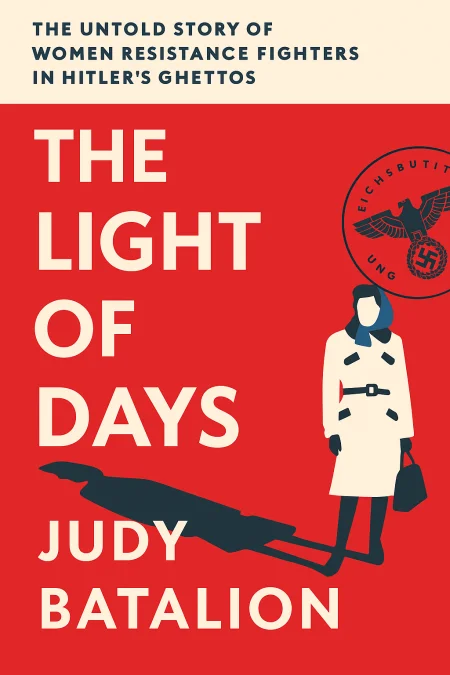
The Light of Days
The Untold Story of Women Resistance Fighters in Hitler's Ghettos
Book Edition Details
Summary
In the shadow of history's darkest hour, a remarkable tale emerges—one of fearless defiance and untold heroism. As Nazi forces tightened their grip on Poland, a courageous league of Jewish women, often mere teenagers, stepped into the fray as resistance fighters. These unsung warriors turned youth groups into clandestine cells, engaging in audacious acts of rebellion from smuggling arms to orchestrating sabotage. Their story, meticulously unveiled by Judy Batalion, reveals a clandestine world where bravery knew no gender. With gripping detail, "The Light of Days" follows these women through perilous missions and harrowing escapes, spotlighting their indomitable spirit and the profound bonds of sisterhood forged in the crucible of war. This is a narrative of survival and defiance, a testament to the unyielding fight for freedom and the enduring power of human resilience.
Introduction
In the autumn of 1942, a young woman named Renia Kukielka stepped off a train in Nazi-occupied Warsaw, carrying forged papers and a heart full of determination. She was not there as a victim awaiting deportation, but as a courier for the Jewish resistance, smuggling weapons and coordinating uprisings across Poland. Her story, like those of hundreds of other young Jewish women, challenges everything we thought we knew about resistance during humanity's darkest hour. This remarkable history reveals how women became the backbone of Jewish resistance networks, serving as couriers, fighters, and organizers who risked everything to save lives and preserve dignity. These women navigated a world where discovery meant torture and death, yet they chose action over despair, resistance over submission. Their experiences illuminate three crucial historical questions that have remained largely hidden: How did ordinary people find extraordinary courage when facing systematic evil? What role did women play in organized resistance that history has largely forgotten? And how do we understand the complex relationship between survival and moral action under extreme oppression? This narrative speaks to anyone seeking to understand the complexity of human response to persecution, the hidden stories of women's leadership in crisis, and the ongoing struggle to preserve historical memory. It offers profound insights into how individuals can maintain agency and hope even when confronting seemingly insurmountable forces of dehumanization, providing timeless lessons about courage, resistance, and the power of collective action in the face of overwhelming odds.
From Youth Movements to Underground Networks (1939-1942)
The transformation from idealistic young Zionists to hardened resistance fighters began in the vibrant youth movements of 1930s Poland. Organizations like Freedom, The Young Guard, and Akiva had trained thousands of Jewish teenagers in leadership, self-reliance, and collective action. When Nazi forces invaded Poland in September 1939, these networks became the unexpected foundation for organized resistance against the occupation. The early years revealed the gradual but relentless escalation of Nazi persecution. What began with discriminatory laws and forced relocations evolved into systematic ghettoization and increasingly brutal restrictions. Young women like Zivia Lubetkin and Frumka Plotnicka found themselves thrust into leadership roles as their communities faced unprecedented challenges. They organized soup kitchens when starvation threatened, maintained underground schools when Jewish education was banned, and created communication networks to share vital information across isolated ghettos. The turning point came in 1942 with the arrival of devastating reports from the eastern territories. News of mass executions at Ponary and the systematic murder of entire Jewish communities shattered any remaining illusions about Nazi intentions. As one resistance leader observed, "Our greatest enemy was false hope." This brutal realization forced a fundamental strategic shift from accommodation and survival strategies to active resistance and preparation for armed struggle. The decision to embrace violence was not made lightly by these young people, many of whom had been raised on ideals of education and peaceful progress. They understood they were choosing almost certain death, but they also recognized that passive compliance offered no real alternative to systematic extermination. This period established the networks, relationships, and moral framework that would prove crucial in the desperate battles to come, as ordinary teenagers transformed themselves into the architects of one of history's most remarkable resistance movements.
Armed Resistance and the Warsaw Ghetto Uprising (1943)
The year 1943 marked the climax of Jewish armed resistance, with uprisings erupting across Nazi-occupied Poland like flames spreading through dry timber. The Warsaw Ghetto Uprising in April became the most famous, but it was part of a broader pattern of desperate last stands in cities like Białystok, Będzin, and Częstochowa. Women played central roles in these battles, serving not just as support personnel but as fighters, commanders, and the crucial intelligence networks that made organized resistance possible. The Warsaw Ghetto Uprising revealed both the extraordinary potential and tragic limitations of armed Jewish resistance. For nearly a month, fewer than a thousand poorly armed fighters held off the German army, proving to the world that Jews would not go quietly to their deaths. Women like Zivia Lubetkin coordinated complex logistics while fighters like Niuta Teitelbaum became legends for their audacious attacks on Nazi installations. The sight of the burning ghetto, visible from the Polish side of Warsaw, sent a powerful message about Jewish determination to resist that reverberated across occupied Europe. The tactical evolution of the uprising demonstrated remarkable innovation under impossible circumstances. When the Nazis began systematically burning buildings to force out the fighters, the resistance adapted by moving underground, using Warsaw's sewer system as both refuge and battlefield. Women couriers like Vladka Meed continued their deadly work of smuggling weapons from the Aryan side, while others maintained communication between isolated fighting units as the ghetto burned around them. Yet the uprisings also highlighted the tragic isolation of Jewish resistance efforts. Despite desperate appeals for support, the Polish underground provided minimal assistance, and the broader population remained largely indifferent to Jewish suffering. The fighters understood they were choosing symbolic victory over survival, as one commander noted: "We knew we were going to die, but we wanted to choose how." Their sacrifice was intended not just to inflict casualties on the enemy, but to preserve Jewish honor and inspire future generations to remember that resistance was possible even in humanity's darkest hour.
Forest Fighters and Survival Networks (1943-1944)
As the ghettos were systematically destroyed throughout 1943 and 1944, the nature of resistance necessarily evolved from urban warfare to forest guerrilla operations and desperate survival networks. For the women who had served as the backbone of ghetto resistance, this transition meant adapting their skills to an even more dangerous environment where every day brought new challenges to staying alive while continuing the fight against their oppressors. The escape routes that had been established for moving weapons and intelligence now became lifelines for human cargo. Couriers who had once carried false documents for underground operations now used their expertise to create new identities for themselves and other survivors. Women like Faye Schulman, who had lost her entire family in a mass shooting, convinced partisan commanders to accept her by claiming medical knowledge she didn't possess, then quickly learned battlefield surgery while treating wounded fighters whose injuries reminded her constantly of her murdered relatives. The forest phase of resistance revealed both remarkable achievements and heartbreaking limitations. While some women succeeded as fighters and even leaders within partisan units, many others faced sexual exploitation and discrimination from non-Jewish partisans who were often hostile to Jewish fighters. The establishment of all-Jewish partisan groups offered better protection but required constant vigilance against both German forces and local populations who frequently betrayed Jewish fighters to the authorities. The psychological challenges of this period were immense. Living under false identities while maintaining their Jewish identity and mission required extraordinary mental discipline. Every interaction with strangers, every document check, every moment in public demanded perfect performance of assumed roles. Yet many maintained their covers for months or years, all while continuing to help others escape and resist. Their success demonstrated that resistance could take many forms, and that the quiet work of preserving lives and maintaining hope was as important as any military victory in the larger struggle against Nazi genocide.
Liberation, Legacy, and the Politics of Memory (1945-Present)
The end of the war brought liberation but not the peace that might have been expected for the surviving women fighters. They faced the enormous challenge of rebuilding lives from nothing while carrying traumatic memories that few could understand or acknowledge. Many struggled with survivor's guilt, wondering why they had lived when so many others perished. The transition from wartime heroines who had commanded respect and wielded life-and-death authority to ordinary citizens in peacetime societies proved surprisingly difficult and psychologically complex. The early post-war period saw these stories celebrated in the newly formed State of Israel, where tales of Jewish resistance fit perfectly into the national narrative of strength, self-reliance, and the rejection of victimhood. However, as Holocaust memory became institutionalized over the following decades, the focus increasingly shifted toward victimization rather than resistance, and women's contributions were progressively marginalized. The complex realities of their experiences were simplified into more palatable narratives that emphasized male leadership and traditional gender roles. Many survivors chose silence over testimony, focusing their energies on building new families and communities rather than dwelling on traumatic memories they wanted to leave behind. They hoped their children could have normal lives, free from the shadows of the past. Yet this protective silence often created new problems, as subsequent generations struggled to understand their parents' experiences and the source of their own inherited anxieties about safety, identity, and belonging. The gradual recovery of these stories in recent decades reflects broader changes in how we understand both Holocaust history and women's experiences during wartime. Scholars, family members, and survivors themselves have worked to preserve testimonies and documents that might otherwise have been lost forever. These efforts reveal not just individual acts of heroism, but the complex networks of support, resistance, and survival that enabled some to endure and resist systematic genocide. Their legacy reminds us that even in the face of the most determined efforts to destroy human dignity, ordinary people can choose extraordinary courage and maintain their moral agency against overwhelming odds.
Summary
The story of Jewish women's resistance during the Holocaust reveals a fundamental truth about human nature under extreme oppression: that the capacity for moral action and collective resistance persists even in the most impossible circumstances. These women faced a regime dedicated to their complete dehumanization and physical annihilation, yet they chose to maintain their agency, protect their communities, and fight for their dignity with whatever means available. Their experiences demonstrate that resistance takes many forms, from the simple act of preserving one's humanity to the complex operations of armed rebellion and underground networks. The historical significance of their stories extends far beyond the Holocaust itself, offering crucial insights into how ordinary people respond to systematic oppression and how resistance movements form and operate under totalitarian regimes. They challenge us to reconsider our understanding of heroism, survival, and moral courage, showing that effective resistance requires networks of trust, careful planning, and the willingness to sacrifice individual safety for collective goals. Their experiences reveal that the most powerful weapon against dehumanization is often the determination to maintain human connections and moral purpose regardless of the personal cost. For contemporary readers facing our own challenges with rising authoritarianism and ethnic hatred, these stories offer both inspiration and practical wisdom about the nature of resistance and moral action. They remind us that standing against injustice requires not just individual courage but collective organization and mutual support. They teach us to recognize the early warning signs of systematic oppression and the critical importance of acting before resistance becomes impossible. Most crucially, they demonstrate that preserving human dignity and moral agency is possible even in the darkest circumstances, but only through conscious choice, sustained effort, and the courage to act when action seems futile. Their legacy calls us to remain vigilant against all forms of dehumanization and to remember that the price of freedom is indeed eternal vigilance.
Related Books
Download PDF & EPUB
To save this Black List summary for later, download the free PDF and EPUB. You can print it out, or read offline at your convenience.
By Judy Batalion
