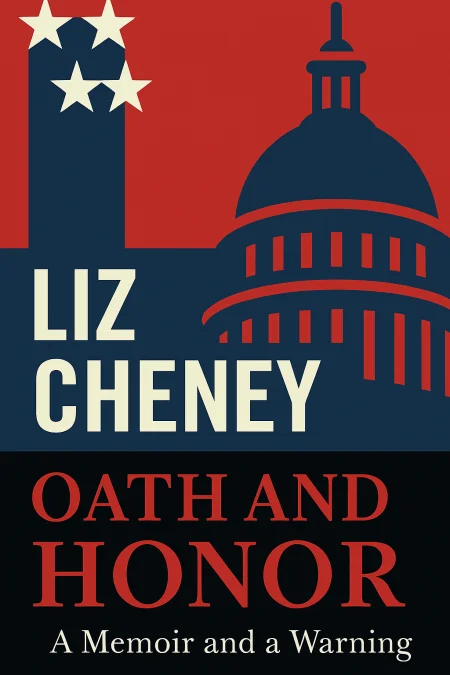
Oath and Honor
A Memoir and a Warning
Book Edition Details
Summary
Amidst the corridors of power and chaos, "Oath and Honor" reveals the tumultuous battle for the soul of a nation. Penned by Liz Cheney, who stood at the frontline of political integrity, this gripping account chronicles the storm unleashed in the wake of the 2020 U.S. presidential election. Witness Cheney's courageous stand against the tide of deceit as she unravels the chilling saga of betrayal that culminated in the January 6th Capitol assault. With unparalleled access and insight, Cheney not only dissects the machinations that threatened democracy but also underscores the ongoing vigilance needed to safeguard its future. This is more than a book; it’s a clarion call to action and awareness in the face of enduring threats.
Introduction
In the winter of 2021, American democracy faced its gravest test since the Civil War. For the first time in the nation's history, a sitting president refused to accept electoral defeat and instead orchestrated a systematic campaign to overturn the results through lies, intimidation, and ultimately violence. The events that culminated on January 6th didn't emerge from nowhere—they were the product of a carefully constructed assault on the very foundations of constitutional government. This extraordinary account takes us inside the corridors of power during those perilous months, revealing how a small group of principled leaders stood against enormous pressure to defend the rule of law. Through firsthand testimony and meticulous investigation, we witness the fragility of democratic institutions when confronted by those willing to abandon their oaths for political survival. The narrative illuminates three crucial questions that define our democratic moment: How did the world's oldest democracy come so close to collapse? What does it truly cost to choose constitutional duty over partisan loyalty? And perhaps most urgently, how do we ensure that such an assault on democracy never happens again? This is essential reading for anyone seeking to understand not just the mechanics of democratic backsliding, but the eternal vigilance required to preserve freedom for future generations. The story serves as both warning and guide for citizens grappling with the ongoing tension between authoritarianism and liberty that defines our age.
The Big Lie: Seeds of Insurrection (November 2020 - January 2021)
The assault on American democracy began not with the violent scenes of January 6th, but in the weeks following Election Day 2020, when Donald Trump launched an unprecedented campaign to overturn legitimate election results. This wasn't a spontaneous reaction to unexpected defeat—it was premeditated deception designed to undermine faith in democratic institutions themselves. Even before votes were counted, Trump's advisor Steve Bannon had outlined the strategy: declare victory regardless of the actual results, then claim the election was stolen. What made this period so dangerous was the systematic nature of the deception. Trump's own campaign officials, Justice Department appointees, and White House staff repeatedly told him there was no evidence of fraud sufficient to change the outcome. Attorney General Bill Barr called the fraud claims "bullshit" directly to Trump's face. Yet Trump continued spreading these lies, raising over $250 million from supporters who believed they were donating to fight election fraud. The money instead went to Trump's political operation, making the Big Lie both a tool of power and a profitable grift. The most insidious aspect of this campaign was how it exploited the trust of millions of Americans. By convincing ordinary citizens that their democracy was a sham, Trump created the combustible conditions for violence. Republican members of Congress, initially skeptical of fraud claims, gradually succumbed to pressure from Trump and his base. The transformation was stark—leaders who privately acknowledged the election's legitimacy publicly embraced conspiracy theories to maintain their political standing. This period reveals a fundamental truth about democratic erosion: it often begins not with tanks in the streets, but with the systematic destruction of shared facts and common ground. The Big Lie became the foundation upon which all subsequent attacks on democracy would be built, demonstrating how quickly authoritarian tactics can take root in even the most established democratic systems.
January 6th: When Democracy Faced Its Gravest Assault
The morning of January 6, 2021, dawned with thousands of Trump supporters gathering in Washington, summoned by their president's promise of a "wild" protest as Congress prepared to count electoral votes. What unfolded over the next several hours would mark the first time in American history that a sitting president actively encouraged violence to prevent the peaceful transfer of power. The attack was both chaotic and coordinated—while some rioters acted spontaneously, others came prepared with weapons, tactical gear, and detailed knowledge of the Capitol's layout. The violence itself was medieval in its brutality. Police officers were beaten with flagpoles, shocked with tasers, and crushed in doorways as they fought desperately to hold the line against thousands of attackers. Inside the Capitol, the constitutional process ground to a halt as lawmakers fled for their lives. The symbolic heart of American democracy—the chamber where representatives of the people gather to conduct the nation's business—was defiled by a mob carrying Confederate flags and chanting threats against specific officials. Most chilling was Trump's response during the attack. As his supporters rampaged through the building, hunting for Vice President Pence and other officials, Trump remained in his dining room, watching television coverage and refusing repeated pleas to call off the mob. For 187 minutes, he did nothing while democracy hung in the balance. When he finally issued a video message, he told the rioters "we love you" and "you're very special" while asking them to go home. The message was unmistakable: the violence was regrettable only because it had failed to achieve its purpose. The day revealed both the fragility and resilience of American institutions. While the physical attack was repelled and Congress ultimately completed its constitutional duty, the precedent had been set. A president had weaponized his supporters against the democratic process itself, crossing a line that had never been crossed in American history and creating a template for future assaults on democracy.
The Choice Between Truth and Power (January 2021 - Present)
In the immediate aftermath of January 6th, a brief window opened for accountability and democratic renewal. Senior Republicans, including Senate Leader Mitch McConnell, initially condemned Trump's actions in stark terms. There was talk of impeachment, resignation, and the 25th Amendment. For a moment, it seemed the Republican Party might finally break free from Trump's grip and recommit to constitutional governance. But this moment of clarity proved tragically brief. Within days, the same leaders who had privately expressed horror at Trump's conduct began walking back their criticism. Corporate donors threatened to cut off funding, creating financial pressure that drove many back into Trump's orbit. House Minority Leader Kevin McCarthy's journey epitomized this capitulation—after initially saying Trump bore responsibility for the violence, McCarthy traveled to Mar-a-Lago just weeks later, posing for photos and launching joint fundraising efforts with the former president. The formation of the House Select Committee to Investigate January 6th became democracy's attempt to heal itself through truth-telling. What emerged from eighteen months of investigation was far more damning than even Trump's harshest critics had imagined—a detailed portrait of a president who had systematically attempted to overturn an election through multiple coordinated schemes. The committee's case was built almost entirely on testimony from Republicans, Trump's own appointees and staff who had finally reached their breaking point. This period revealed the ongoing nature of America's democratic crisis. While some election deniers were defeated in 2022 midterm races, Trump's grip on the Republican Party remained strong. His announcement of another presidential campaign ensured that the battle between democratic norms and authoritarian impulses would continue. The choice between truth and power, it became clear, was not a one-time decision but an ongoing test that each generation of Americans must face anew.
The Price of Principle: Courage in Constitutional Crisis
The final phase of this story reveals the enormous personal and political costs of choosing constitutional duty over partisan loyalty. For those who stood up to Trump's lies and participated in holding him accountable, the price was severe and immediate. Death threats became routine, primary challenges ended careers, and exile from their own party became the reward for defending democracy. Yet these individuals understood that some principles are worth more than political survival. The courage displayed during this crisis took many forms. Capitol Police officers like Harry Dunn and Caroline Edwards showed physical bravery in defending democracy with their bodies, suffering injuries that would last a lifetime. Election officials in states like Georgia and Arizona withstood enormous pressure to falsify results, choosing professional integrity over political convenience. Members of Congress who joined the January 6th Committee knew they were likely ending their political careers but proceeded anyway, understanding that the stakes transcended personal ambition. The international implications of America's democratic crisis cannot be understated. Allies watched with alarm as the world's oldest democracy struggled with basic questions about the peaceful transfer of power. Adversaries like China and Russia pointed to January 6th as evidence that American democracy was failing, using it to justify their own authoritarian systems. The crisis demonstrated that America's democratic health affects not just Americans, but the global balance between freedom and authoritarianism. The ongoing legal consequences of January 6th—from the prosecution of hundreds of rioters to investigations of Trump himself—demonstrate that the rule of law, while tested, has not been broken. Yet the persistence of election denial within the Republican Party and Trump's continued political viability suggest that America's democratic crisis is far from over. The price of principle, it turns out, is not just personal—it's the price of preserving the democratic system itself for future generations who will inherit the consequences of today's choices.
Summary
The January 6th crisis represents the most serious threat to American democracy since the Civil War, revealing how quickly democratic norms can collapse when leaders prioritize power over principle. At its core, this is a story about the eternal tension between truth and political convenience, between constitutional duty and partisan loyalty. The crisis demonstrated that democracy's survival depends not on the strength of institutions alone, but on the courage of individuals willing to defend those institutions even at great personal cost. The lessons from this period are both sobering and instructive. Democratic backsliding often begins with the systematic destruction of shared facts and common ground, making truth itself a partisan issue. The most dangerous moment in a democratic crisis may come not during the initial assault, but in the aftermath, when societies must choose between accountability and normalization. The defense of democracy requires constant vigilance from every generation, as each must earn anew the freedoms inherited from those who came before. Moving forward, Americans must recommit to the fundamental principle that no person is above the law, regardless of their political position or party affiliation. This means supporting election officials who tell the truth about results, rejecting candidates who refuse to accept legitimate electoral outcomes, and demanding that political leaders prioritize constitutional duty over partisan advantage. Citizens must also recognize that democracy is not a spectator sport—it requires active participation, informed engagement, and the willingness to defend democratic norms even when it's politically inconvenient. The price of freedom, as always, is eternal vigilance and the courage to act when vigilance alone proves insufficient.
Related Books
Download PDF & EPUB
To save this Black List summary for later, download the free PDF and EPUB. You can print it out, or read offline at your convenience.
By Liz Cheney
