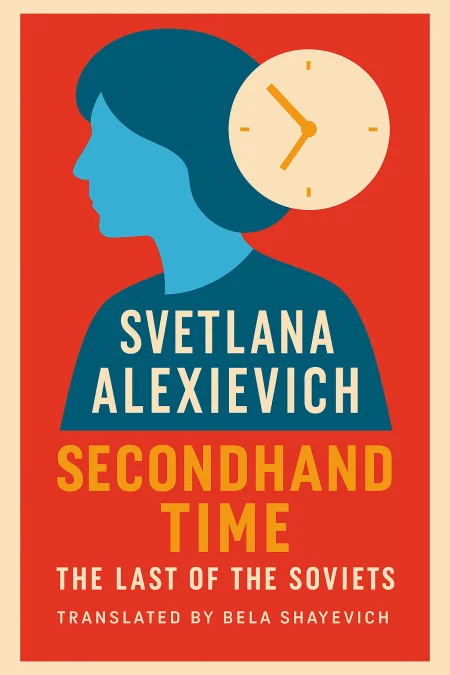
Secondhand Time
The Last of the Soviets
bySvetlana Alexievich, Bela Shayevich
Book Edition Details
Summary
Witness the echo of a nation’s soul in "Secondhand Time" by Nobel laureate Svetlana Alexievich. This gripping tapestry of voices unravels the poignant tales of individuals who endured the seismic shift from Soviet to post-Soviet life. Here, amidst the rubble of an empire, Alexievich weaves personal narratives into an evocative chronicle of cultural upheaval and rebirth. These vivid testimonies breathe life into the abstract, revealing the raw human experience behind historical transformation. As the past's iron curtain falls, hear the stories that official histories overlook—stories of resilience, loss, and identity. What does it mean to be Russian in an era of relentless change? Dive into this profound exploration and discover the enduring human spirit in the face of monumental societal shifts.
Introduction
In the final moments of the twentieth century, an extraordinary drama unfolded across the vast expanse of the former Soviet Union. An empire that had dominated one-sixth of the world's landmass for seven decades simply vanished overnight, leaving behind millions of people who found themselves citizens of countries that didn't exist when they went to sleep. These were individuals who had spent their entire lives believing in one reality, only to wake up in a completely different world where their values, memories, and very identities had become relics of a discredited past. Through intimate conversations with ordinary citizens—factory workers, teachers, former Party officials, and their children—we encounter the profound human cost of this seismic transformation. These voices reveal how deeply Soviet ideology had penetrated not just political structures, but the very fabric of daily life, personal relationships, and individual psychology. They illuminate three crucial questions that resonate far beyond Russia's borders: How does an entire civilization simply disappear, leaving barely a trace? What happens to people's sense of meaning and purpose when the world they knew ceases to exist? And perhaps most importantly, how do societies process the trauma of such radical transformation without losing their humanity? This exploration offers invaluable insights for anyone seeking to understand the mechanics of historical change, the psychology of political upheaval, and the enduring human struggle between idealism and reality. It speaks particularly to those interested in how ordinary people navigate extraordinary times, and how the grand narratives of history play out in kitchens, classrooms, and quiet moments of personal reckoning.
Empire's End: Collapse and the Chaos of Freedom (1991-1999)
The Soviet Union didn't collapse with the dramatic flourish that Hollywood might imagine. Instead, it simply stopped working, like a vast machine whose operators had quietly walked away from their posts. By 1991, the grand experiment that had promised to remake humanity itself was reduced to empty store shelves, worthless currency, and the bewildering spectacle of citizens who had spent their lives building socialism suddenly told they must become capitalists overnight. The human cost of this transition defied every economic prediction and political theory. Families who had lived modestly but securely under the old system found themselves choosing between heating their apartments and buying food. Distinguished engineers became street vendors, university professors cleaned office buildings at night, and decorated war veterans begged on subway platforms. The social contract that had governed Soviet life for generations—modest prosperity and social security in exchange for political compliance—vanished without replacement, leaving people with neither prosperity nor clear rules about what was expected of them. Yet perhaps the deepest trauma was psychological rather than material. People had to reconstruct not just their economic lives, but their entire understanding of right and wrong, success and failure, past and future. The grandmother who had survived Stalin's purges and Hitler's invasion now watched her grandson sell drugs to buy Western sneakers. The factory worker who had taken genuine pride in building socialism discovered that his life's work was considered worthless by the new market economy. The teacher who had instructed children about heroic sacrifice for the collective good found those same values mocked as naive relics of a discredited past. This period revealed a fundamental truth about human societies: when the stories people tell themselves about their lives suddenly become invalid, the result isn't just economic hardship but a kind of collective identity crisis. The chaos of the 1990s wasn't merely the growing pains of capitalism—it was the sound of an entire civilization trying to remember how to dream about the future.
Putin's Bargain: Stability for Silence (2000-2011)
Vladimir Putin's rise to power offered Russians something they desperately craved after a decade of humiliating chaos: the promise of stability, order, and restored national pride. His message was seductive in its elegant simplicity—Russia would be strong again, the oligarchs would be brought to heel, and ordinary people would finally be able to plan their lives without fearing that the rules would change overnight. For a population exhausted by uncertainty, this bargain seemed worth almost any price. The Putin era brought undeniable improvements to daily life that even critics couldn't dismiss. Salaries were paid on time, pensions increased substantially, and the humiliating spectacle of a former superpower reduced to begging for Western aid became a fading memory. Moscow transformed into a glittering European capital, complete with luxury boutiques, world-class restaurants, and a confident middle class that could afford to travel abroad. The new social contract was clear: material prosperity and national dignity in exchange for political passivity. Yet this stability came with strings attached that became increasingly visible over time. Political opposition was systematically crushed through a combination of legal harassment, media manipulation, and selective violence. Independent journalists found themselves labeled as foreign agents, civil society organizations were strangled by bureaucratic restrictions, and the space for genuine public discourse steadily contracted. What emerged was a peculiar form of modern authoritarianism—one that offered material comfort and cultural pride while demanding that citizens remain politically small. This period illuminated how authoritarian systems adapt to contemporary conditions. Putin's Russia wasn't a simple return to Soviet totalitarianism but something new and more sophisticated—a system that used the language of democracy while hollowing out its substance, that celebrated Russian culture while suppressing Russian voices, that promised greatness while ensuring that most citizens would never be asked to participate in achieving it. The tragedy was that many people, traumatized by the chaos of the previous decade, found this bargain not just acceptable but preferable to the uncertainties of genuine freedom.
Cracks in the System: Resistance and Repression (2012-Present)
By 2012, the Putin system's internal contradictions had become impossible for many Russians to ignore. A new generation, educated and connected to the wider world through the internet, began asking uncomfortable questions: Why did their country's vast natural wealth remain concentrated in so few hands? Why did elections seem predetermined? Why had speaking truth to power become so dangerous? The spark that ignited widespread protests came from the most mundane of sources—evidence of electoral fraud so blatant that even the politically apathetic could no longer pretend their voices mattered. The demonstrations that erupted in Moscow's squares represented something unprecedented in Russian history: a middle-class rebellion against authoritarian rule. These weren't desperate people with nothing to lose, but engineers, teachers, small business owners, and students who had tasted enough freedom to want more. Their demands were modest by Western standards—fair elections, rule of law, basic civil liberties—but revolutionary in the Russian context. For a brief moment, it seemed possible that the country might choose a different path. The government's response revealed both the system's strength and its fundamental weakness. While the protests were eventually suppressed through a combination of legal persecution, propaganda campaigns, and carefully calibrated violence, the very fact that they occurred demonstrated that Putin's social contract was beginning to fray. The promise of prosperity in exchange for political passivity worked only as long as the prosperity continued to grow and the alternatives seemed worse. When economic growth slowed and international isolation increased, the bargain became less attractive to those who had once accepted it. The voices of resistance, though ultimately unsuccessful in changing the system, preserved something essential for the future. They proved that the desire for dignity and self-determination hadn't been extinguished by decades of authoritarianism. Their courage in speaking out, despite knowing the personal costs involved, maintained the possibility that Russia might someday choose a different path. The tragedy was that so few of their fellow citizens were ready to join them in paying the price that freedom demands, preferring the familiar constraints of authoritarian stability to the uncertain promises of democratic change.
Summary
The story that emerges from these voices reveals a fundamental tension that extends far beyond Russia's borders—the eternal human struggle between the desire for security and the yearning for freedom. Through three decades of dramatic transformation, we witness how people navigate the collapse of old certainties and the painful birth of new possibilities, often choosing familiar forms of oppression over the uncertainties of genuine liberation. This pattern repeats throughout history and across cultures, making these testimonies relevant to anyone seeking to understand the dynamics of political change in the modern world. The lessons learned from this experience offer crucial insights for our contemporary global challenges. First, we discover that democracy cannot be imposed from above or imported like consumer goods—it must be cultivated through generations of civic engagement and defended by citizens willing to sacrifice immediate comfort for long-term principle. Second, we learn that authoritarian systems survive not just through force, but by offering compelling narratives about national greatness and personal security that can seduce even educated populations tired of uncertainty and change. Third, we understand that the institutions of freedom are far more fragile than we often assume, requiring constant vigilance and active participation to maintain. Perhaps most importantly, these voices remind us that the price of freedom is not paid once in some dramatic revolutionary moment, but continuously, by each generation that chooses dignity over ease, truth over comfort, and hope over cynicism. In our own era of rising authoritarianism and political polarization, the hard-won wisdom of those who lived through the Soviet century offers both warning and inspiration. The question each society must ultimately answer is not whether it will face the choice between freedom and security, but which values it will choose to nurture when that inevitable moment of decision arrives.
Related Books
Download PDF & EPUB
To save this Black List summary for later, download the free PDF and EPUB. You can print it out, or read offline at your convenience.
By Svetlana Alexievich
