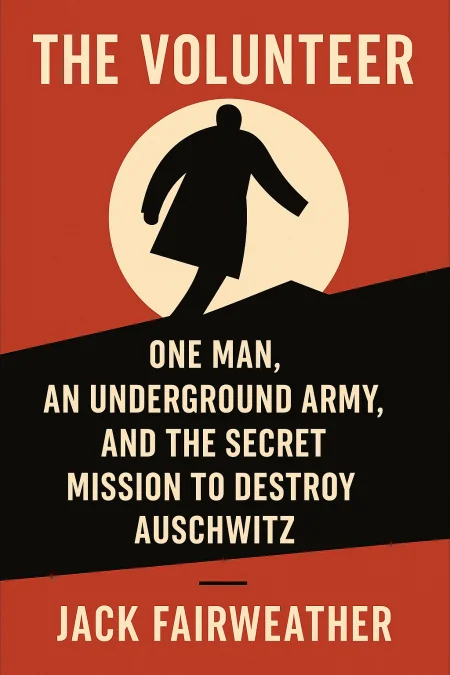
The Volunteer
One Man, an Underground Army, and the Secret Mission to Destroy Auschwitz
Book Edition Details
Summary
In the shadowy labyrinth of Auschwitz, one man defied destiny with audacious courage. Witold Pilecki, a Polish resistance hero, willingly stepped into the maw of horror, infiltrating the camp with a singular mission: unveil the unspeakable truth of Nazi atrocities and spark rebellion from within. For over two harrowing years, he orchestrated a clandestine network, sabotaging Nazi operations, gathering damning evidence, and risking all to smuggle the truth to the outside world. But as the dark tide of genocide rose, Pilecki faced an even graver challenge: a daring escape across hostile terrain to alert the Allies before hope was lost. Jack Fairweather's gripping narrative, enriched by newly unearthed documents and personal accounts, resurrects Pilecki's erased legacy, revealing a tale of unimaginable bravery and betrayal. This is not just history—it's a testament to the indomitable spirit of a man who dared to stand against darkness.
Introduction
In September 1940, as Nazi Germany tightened its grip on occupied Poland, a Polish cavalry officer made one of the most extraordinary decisions in human history. Witold Pilecki deliberately allowed himself to be captured and sent to Auschwitz concentration camp, volunteering for what seemed like certain death to gather intelligence from within the Nazi system. His mission would transform him into the first person to systematically document the Holocaust as it unfolded, providing the world with detailed reports about genocide that Allied leaders received but tragically failed to act upon. This remarkable story illuminates three crucial aspects of World War II that remain poorly understood today. First, it reveals how the Nazi extermination machine evolved from a brutal prison system into an industrial killing apparatus, showing the gradual escalation that made the Holocaust possible. Second, it exposes the tragic failure of Allied powers to respond effectively to early warnings about genocide, despite receiving detailed intelligence from multiple sources. Finally, it demonstrates the extraordinary moral courage required to bear witness to unprecedented evil and the profound cost of speaking truth to indifferent power. This account will captivate readers seeking to understand how ordinary people respond to extraordinary evil, how institutions fail during moral crises, and why individual acts of courage matter more than we imagine. It offers both a gripping wartime thriller and a meditation on resistance, sacrifice, and moral responsibility that speaks directly to contemporary struggles with injustice and institutional indifference.
Voluntary Imprisonment: Building Resistance Inside Auschwitz (1940-1941)
The German occupation of Poland in 1939 unleashed a systematic campaign to destroy Polish culture and eliminate its intellectual leadership. By 1940, reports began filtering out about a new concentration camp established in former Polish army barracks near the town of Oświęcim. When the Polish underground desperately needed intelligence about this facility, Witold Pilecki volunteered for an unprecedented mission: deliberately getting himself arrested and sent to what would become history's most notorious death camp. Pilecki's arrival at Auschwitz in September 1940 as prisoner number 4859 confronted him with a system designed to strip away human dignity through starvation, exhaustion, and random violence. The camp's kapo system, which forced prisoners to brutalize fellow inmates, created a hierarchy of suffering that seemed to make resistance impossible. Yet within this hellscape, Pilecki began the painstaking work of identifying trustworthy prisoners and slowly building a clandestine military organization. The formation of this underground network required extraordinary psychological resilience and tactical brilliance. Operating under constant surveillance and the threat of execution, Pilecki recruited carefully selected inmates into small cells of five men each, establishing communication networks and smuggling routes throughout the camp. His recruitment strategy focused on identifying prisoners who retained their moral compass through small acts of altruism, sharing bread with the starving or caring for the sick. By early 1941, Pilecki's organization had grown to include several hundred members across different work details and barracks. They provided mutual protection, shared scarce resources, and maintained morale through clandestine news from hidden radios. Most crucially, they began documenting the camp's systematic brutality and smuggling detailed reports to the outside world through released prisoners and sympathetic civilians. These communications represented the first systematic intelligence about the Nazi concentration camp system to reach Allied capitals, setting the stage for even more horrific revelations to come.
Witnessing Industrial Murder: The Final Solution Unfolds (1942)
The year 1942 marked a terrible transformation in Auschwitz's purpose and Pilecki's understanding of Nazi intentions. What had begun as a brutal prison for Polish political prisoners evolved into something far more sinister: the epicenter of the systematic extermination of European Jewry. The first experimental gassings of Soviet prisoners of war in late 1941 had provided a grim preview, but the scale of killing that began in 1942 revealed the true scope of Nazi genocidal ambitions. Pilecki watched in horror as trainloads of Jewish families began arriving from across occupied Europe, subjected to "selections" that immediately separated those deemed fit for labor from those marked for death. The elderly, sick, and mothers with young children were sent directly to newly constructed gas chambers at Birkenau, where they were murdered within hours of arrival. The efficiency and systematic nature of these killings revealed an unprecedented crime: the industrial-scale murder of an entire people. Through his underground network, Pilecki documented every aspect of this genocide with meticulous detail. His agents in the camp records office calculated mortality statistics, while contacts among the Sonderkommando provided horrific accounts of the killing process itself. The reports they smuggled out described not just individual atrocities but the systematic nature of the extermination program, estimating that hundreds of thousands were being murdered monthly in what prisoners called "the little red house" and its expanded facilities. The psychological toll of witnessing genocide while remaining powerless to stop it created profound strain within the resistance network. Many of Pilecki's closest collaborators were discovered and executed, while those who survived faced the daily trauma of watching mass murder unfold around them. Yet they continued their work of documentation and resistance, driven by the conviction that the world needed to know what was happening, even as their hopes for rescue or intervention began to fade in the face of institutional indifference.
Escape and Failed Appeals: Intelligence Without Action (1943-1945)
By April 1943, Pilecki had concluded that his mission inside Auschwitz was complete but his ultimate goal remained unfulfilled. His detailed reports about the Holocaust were reaching Allied capitals through Polish resistance channels, yet the hoped-for military intervention never materialized. The disconnect between accurate intelligence and meaningful action forced Pilecki to make an agonizing decision: escape from the camp to deliver his testimony directly to Allied leaders. His successful escape with two fellow prisoners represented both a tactical triumph and a strategic gamble. The intelligence Pilecki had gathered provided the most comprehensive contemporary account of the Holocaust's machinery, offering Allied decision-makers both detailed knowledge and moral imperative to act. Yet even this direct testimony struggled against institutional inertia, bureaucratic skepticism, and competing strategic priorities that had allowed genocide to proceed unchecked for years. The failure of Pilecki's appeals revealed a tragic pattern in Allied responses to Holocaust intelligence. British and American officials, while acknowledging the reports, concluded that winning the war as quickly as possible was the best way to help victims. Proposals to bomb Auschwitz or its railway lines were rejected as militarily unfeasible or strategically unwise. The very magnitude of the crimes being reported seemed to work against belief and action, as officials struggled to comprehend systematic extermination on such a scale. Pilecki's final wartime service during the Warsaw Uprising of 1944 demonstrated both the heroism and futility of Polish resistance against overwhelming odds. His subsequent efforts to organize opposition to Soviet-imposed Communist rule led to his arrest, torture, and execution in 1948. The man who had risked everything to expose Nazi genocide became a victim of Stalinist terror, his extraordinary story buried in state archives for decades. His intelligence had succeeded brilliantly in documenting the Holocaust but failed catastrophically in its ultimate purpose of prompting rescue efforts.
Summary
Witold Pilecki's mission reveals the central tragedy of the Holocaust: not merely the systematic murder of six million Jews, but the failure of individuals and institutions to respond adequately to clear warnings about genocide in progress. His extraordinary courage succeeded in providing detailed, accurate intelligence about Nazi atrocities, yet this knowledge failed to translate into the urgent international response that might have saved countless lives. This paradox illuminates the persistent gap between knowing about evil and acting to stop it. The deeper significance of Pilecki's sacrifice lies in his understanding that bearing witness to atrocity is itself a form of resistance, even when immediate intervention proves impossible. His meticulous documentation preserved the dignity of victims and created an historical record that would eventually demand accountability. This suggests that moral courage often operates on timescales longer than individual lives, creating ripple effects that may not be visible to those who exercise it but prove essential for future justice and understanding. For our contemporary world, Pilecki's example offers both inspiration and urgent warning. It reminds us that extraordinary evil often begins with ordinary bureaucratic decisions and gradual escalation, making early recognition and response crucial for prevention. It challenges us to examine our own responses to systematic injustice and to build institutional mechanisms that can rapidly translate knowledge about atrocities into effective action. Most importantly, it demonstrates that individual acts of conscience, however seemingly futile in the moment, preserve essential truths and moral clarity that can inspire future generations to create a more just and responsive world.
Related Books
Download PDF & EPUB
To save this Black List summary for later, download the free PDF and EPUB. You can print it out, or read offline at your convenience.
By Jack Fairweather
