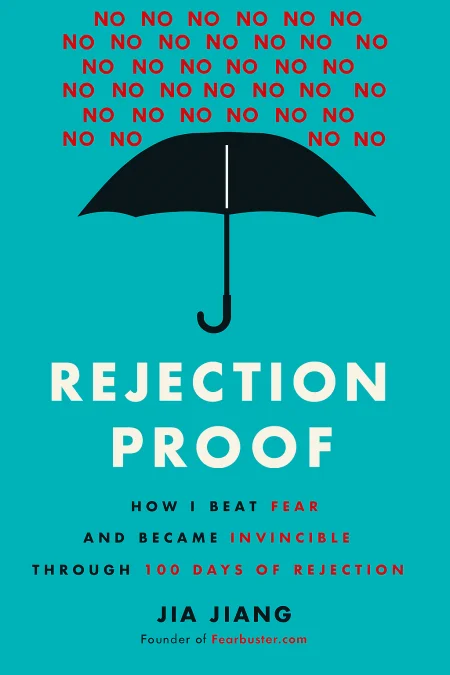
Rejection Proof
How I Beat Fear and Became Invincible Through 100 Days of Rejection
Book Edition Details
Summary
Jia Jiang's odyssey through the labyrinth of rejection is anything but typical. In "Rejection Proof," he chronicles a captivating experiment of self-discovery that transforms the dreaded "no" into an exhilarating gateway to unexpected opportunities. Armed with nothing but determination, Jia embarks on a quest to confront his greatest fear, diving headlong into a whirlwind of daily denials. His adventures range from outlandish requests for Olympic-ring-shaped doughnuts to bold inquiries for public announcements mid-flight, each step unveiling the art of turning the improbable into the possible. This vibrant narrative not only unveils the secrets of persuasive asking but also fortifies the reader with the resilience to face rejection with unshakable confidence. For anyone seeking to live audaciously and embrace life's uncertainties, this book serves as an empowering guide to finding strength in vulnerability.
Introduction
Standing at a stranger's door with a soccer ball in hand, asking to play in their backyard—this seemingly absurd request would become the turning point in one man's extraordinary journey from paralyzing fear to remarkable freedom. Jia Jiang, a Chinese immigrant and aspiring entrepreneur, had spent most of his adult life trapped by an invisible prison: the fear of rejection. When his startup dreams were shattered by an investor's rejection, he faced a crossroads that would define his future. Rather than retreat into the safety of conformity, Jiang embarked on an audacious experiment—seeking out rejection for 100 consecutive days, transforming what most people avoid at all costs into his greatest teacher. Born in Beijing with dreams of becoming the next Bill Gates, Jiang's story reflects the universal struggle between ambition and fear. His journey takes us through the corporate corridors of America, where brilliant ideas die in desk drawers, and into the raw territories of human psychology, where our deepest fears often become our most powerful allies. Through his remarkable transformation, readers will discover how to reframe rejection from a devastating verdict into valuable feedback, how to find extraordinary opportunities hidden within ordinary conversations, and how to unlock the courage that lies dormant within us all. This is not merely a story about overcoming fear—it is a blueprint for reclaiming the boldness that society teaches us to abandon.
From Immigrant Dreams to Corporate Conformity
Jia Jiang's entrepreneurial dreams began taking shape in 1980s Beijing, where a fourteen-year-old boy tore down sports posters from his bedroom walls and replaced them with a single, audacious goal: to become the next Bill Gates. When Microsoft's founder visited Beijing for the first time, young Jiang felt his destiny crystallize. He even wrote a letter to his family, promising that his future company would be so successful he would buy Microsoft by age twenty-five. This wasn't mere childhood fantasy—it was the birth of an obsession that would both drive and torment him for decades. The path from Beijing to American boardrooms proved more treacherous than any teenage dreamer could anticipate. Arriving in rural Louisiana as an exchange student, Jiang's introduction to America was a nightmare of broken trust and shattered expectations. His host family stole his money, and he found himself sleeping in a convicted murderer's bed. Yet these early rejections only strengthened his resolve. He taught himself English with thousands of flashcards, earned scholarships through sheer determination, and methodically climbed the academic ladder from community college to Duke University's prestigious MBA program. However, success in traditional terms began to feel like failure in personal ones. Each achievement—the six-figure corporate salary, the suburban house with pond views, the golden retriever named Jumbo—added another layer between Jiang and his entrepreneurial dreams. The boy who once promised to change the world had become a marketing manager, collecting steady paychecks while his blueprint for shoe-skates gathered dust in a drawer. When Heelys became a billion-dollar company based on virtually the same idea, the pain of what might have been became unbearable. The corporate world offered everything except the one thing Jiang truly craved: the freedom to fail on his own terms. Sitting at a July 4th fireworks display, eight months of marriage and weeks away from becoming a father, he could visualize his entire future stretching before him—a series of promotions, raises, and responsibilities leading to a respectable but unremarkable grave. It was his wife Tracy who issued the challenge that would change everything: quit his job, take six months to build a company, and leave no regrets behind. The choice was stark—remain safely imprisoned by fear or step into the terrifying freedom of uncertainty.
The 100 Days Journey of Facing Fears
When Jiang's startup faced its first major rejection—an investor's crushing "no" after months of preparation—the familiar demons of self-doubt returned with vengeance. But this time, instead of retreating to the safety of another corporate job, he made a decision that would seem crazy to most people: he would seek out rejection deliberately, systematically, and relentlessly. Inspired by a Canadian entrepreneur's "Rejection Therapy" game, Jiang committed to making one rejection attempt every day for 100 days, documenting each encounter on video. The early attempts were exercises in pure terror. Asking a security guard to borrow $100 left Jiang trembling and mumbling incoherently. But by his third attempt—requesting Olympic ring-shaped donuts from Krispy Kreme—something magical happened. Jackie, the shift manager, not only fulfilled his bizarre request but created custom donuts in Olympic colors, free of charge, transforming what should have been a rejection into an act of unexpected kindness. The video went viral, attracting millions of views and international media attention, proving that the world was far more generous and creative than fear had taught him to believe. Each subsequent attempt became a masterclass in human psychology and negotiation. When Scott, a Dallas Cowboys fan, agreed to let a stranger play soccer in his backyard, he explained his reasoning: "It was so off the wall, how could I say no?" When Jiang asked to deliver pizza for Domino's or give a lecture at the University of Texas, he learned that audacity itself could be compelling. The key wasn't in crafting perfect requests—it was in approaching each interaction with genuine curiosity rather than paralyzing fear. Perhaps most surprisingly, Jiang discovered that rejection and acceptance often had little to do with him personally. The same request could yield vastly different responses depending on the person's mood, background, circumstances, or simple personality differences. This revelation was profoundly liberating: if rejection was more about the rejector than the rejected, then it need not be taken as a judgment of personal worth. By the end of his 100 days, Jiang had accumulated not just an impressive collection of yeses to impossible requests, but something far more valuable—the knowledge that fear of rejection had been his greatest enemy, not rejection itself.
Mastering the Art of Human Connection
Through his systematic exploration of rejection, Jiang inadvertently became a student of human nature, discovering principles of connection and persuasion that most people never learn. The most powerful tool in his arsenal turned out to be a simple question: "Why?" When a homeowner rejected his request to plant a flower, asking for the reason revealed that the man didn't want flowers himself but enthusiastically referred Jiang to a neighbor who loved gardening. This single word—why—transformed rejections from conversation-enders into new beginnings, often unveiling paths to unexpected yeses. The art of positioning requests proved equally crucial. Jiang learned that explaining his reasoning up front dramatically increased his success rate, echoing Harvard psychologist Ellen Langer's famous copy machine experiment. People responded more favorably when they understood the "why" behind even the most unusual requests. Whether asking strangers to pose for photos in New York City or requesting to speak over Costco's intercom, providing context and acknowledging the strangeness of his requests actually enhanced his credibility rather than undermining it. Most importantly, Jiang discovered that collaboration consistently trumped confrontation. When he approached people as allies rather than adversaries—asking for their help in solving a mutual problem rather than demanding compliance—remarkable things happened. Restaurant managers who couldn't break company policy offered creative alternatives. Store employees who couldn't fulfill impossible requests went out of their way to suggest other solutions. The shift from "me versus you" to "us versus the problem" transformed the entire dynamic of human interaction. These lessons extended far beyond rejection attempts into the realm of genuine influence and leadership. By starting requests with "I" rather than pretending to know others' interests, by acknowledging obvious doubts before others could voice them, and by targeting receptive audiences rather than trying to convince everyone, Jiang developed a framework for authentic persuasion. The irony was profound: by becoming less attached to outcomes, he achieved far better results. By expecting nothing, he received everything.
Finding Purpose Through Vulnerability and Growth
The true transformation came not from conquering rejection but from discovering its hidden gifts. What began as a fear-fighting exercise evolved into something far more profound—a journey toward empathy, meaning, and authentic purpose. Standing on street corners asking for money taught Jiang not just about rejection but about the invisible struggles of those society often dismisses. Meeting Frank, the disabled veteran panhandling to fund his son's heart surgery, shattered assumptions and built bridges of understanding that pure sympathy could never achieve. Each rejection became a teacher, offering lessons in resilience, creativity, and self-worth. When Louis C.K.'s early comedy performances bombed spectacularly, he discovered something invaluable: "I didn't die, and I'm still interested." This became Jiang's revelation too—that surviving rejection often reveals how much we truly want something. The magnitude of our dreams can be measured by the amount of rejection we're willing to endure for them. Those who achieve greatness aren't those who never face rejection; they're those who face it and continue anyway. The journey culminated in Jiang's most meaningful challenge: helping his wife Tracy land a job at Google, one of the world's most selective employers. Applying every principle he'd learned—from detachment from results to persistence through multiple rejections—they transformed what could have been a devastating series of "nos" into ultimately triumphant "yes." Tracy's success proved that rejection-proof principles weren't just personal therapy but practical tools for achieving real-world goals. Perhaps most surprisingly, Jiang realized that his 100-day experiment had returned him to something he'd lost—the fearless curiosity of childhood, when asking for anything seemed natural and possible. The sophisticated adult who had learned to fear judgment and avoid vulnerability had rediscovered the bold simplicity of his son Brian, whose pointing finger served as a "magic wand" for requesting whatever captured his imagination. In facing his greatest fear, Jiang hadn't just conquered rejection—he had reclaimed the essential courage to dream, to ask, and to become fully alive in a world of infinite possibility.
Summary
Jia Jiang's extraordinary journey reveals that rejection is not the enemy we imagine but rather a teacher waiting to unlock our greatest potential. His transformation from a fear-paralyzed corporate employee to a confident entrepreneur demonstrates that our relationship with rejection shapes not just our professional success but our entire life experience. The principles he discovered—asking "why" after hearing "no," positioning requests with authenticity, collaborating rather than contending, and maintaining detachment from outcomes—offer a practical blueprint for anyone trapped by the fear of judgment or disapproval. The deepest lesson of Jiang's story lies not in techniques for avoiding rejection but in the liberating recognition that rejection reveals more about the rejector than the rejected. When we stop taking "no" personally, we free ourselves to ask boldly, dream audaciously, and pursue our authentic paths regardless of others' opinions. This freedom becomes the foundation for genuine achievement, meaningful relationships, and the kind of life that honors both our ambitions and our humanity. For anyone who has ever avoided asking for what they truly want, Jiang's journey offers both inspiration and instruction—proof that on the other side of our greatest fears lie our most extraordinary possibilities.
Related Books
Download PDF & EPUB
To save this Black List summary for later, download the free PDF and EPUB. You can print it out, or read offline at your convenience.
By Jia Jiang
