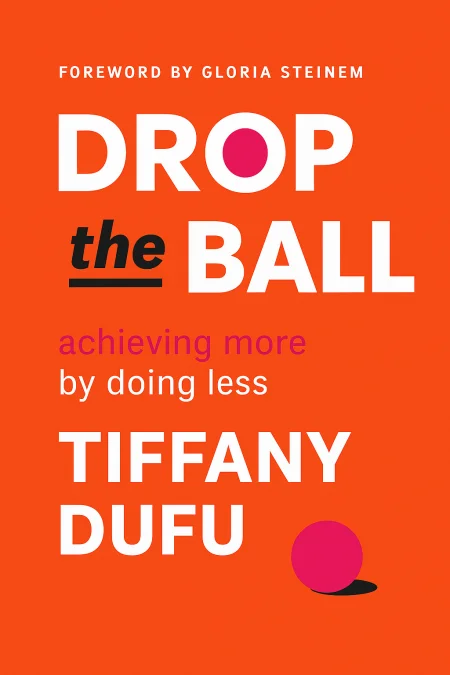
Drop the Ball
Achieving More by Doing Less
byTiffany Dufu, Gloria Steinem
Book Edition Details
Summary
When the pursuit of perfection becomes an anchor, Tiffany Dufu presents an audacious manifesto that promises liberation through the art of relinquishing control. In "Drop the Ball," Dufu sheds her overachiever skin, sharing her transformative journey from the brink of burnout to a life brimming with purpose and connection. With a deft blend of memoir and wisdom, she challenges the myth that women must juggle every role to claim success. As Dufu navigates the tangled web of professional ambitions and personal responsibilities, she discovers a radical truth: by lowering the bar and welcoming collaboration, women can unearth a life of genuine fulfillment. This insightful guide ignites a revolution for women everywhere—championing the courage to prioritize what truly matters and crafting a blueprint for a balanced, empowered existence.
Introduction
Picture this: It's 11:30 PM, and Maria sits on her bathroom floor, laptop balanced on her knees, responding to work emails while her family sleeps. The laundry basket overflows beside her, tomorrow's lunches remain unpacked, and she still needs to review her daughter's science project. Sound familiar? This scene unfolds in countless homes where women have become the invisible orchestrators of everything—managing careers while simultaneously running households, coordinating schedules, and ensuring nothing falls through the cracks. We've been promised we can have it all, but somewhere along the way, that dream transformed into an expectation that we must do it all. The result is a generation of women spinning plates, carrying mental loads that would challenge any CEO, and wondering why they feel perpetually exhausted despite their impressive capabilities. This isn't about personal failure or poor time management—it's about recognizing that the current system is fundamentally unsustainable. The path forward requires a radical shift in thinking. True partnership isn't about finding more efficient ways to juggle everything alone; it's about learning to share the load authentically. When we courageously release control and trust others to contribute in their own unique ways, we don't just lighten our burden—we create space for deeper relationships, more meaningful work, and the kind of life we actually want to live. This journey toward genuine partnership offers hope for anyone ready to transform overwhelm into empowerment.
The Breaking Point: When Perfect Performance Becomes Prison
The moment of reckoning arrived in a corporate bathroom stall, where she found herself pumping breast milk while balancing a conference call and reviewing quarterly reports. This wasn't an isolated incident—it had become her daily reality. She had mastered the art of invisible labor, seamlessly managing her demanding career while orchestrating every detail of her family's life. From coordinating carpools to remembering which child needed what supplies for which project, she carried the mental load of their entire household. Her husband was loving and capable, but somehow she had become the default manager of all things domestic. He could execute tasks beautifully when asked, but the responsibility for remembering, planning, and coordinating fell entirely on her shoulders. She told herself this was normal—even admirable proof of her dedication as both professional and mother. Yet beneath the surface, resentment was building like pressure in a kettle. The breaking point came when she realized she was spending more mental energy managing grocery lists and school schedules than advancing the career she'd worked so hard to build. She was drowning in details while her partner seemed blissfully unaware of the complex choreography required to keep their lives running smoothly. Every forgotten permission slip felt like a personal failure, every missed appointment a reflection of her inadequacy. This scenario reveals the invisible prison that perfectionism creates. When we believe we must manage every detail flawlessly, we trap ourselves in a cycle of endless responsibility. The myth that women are naturally better suited for domestic management isn't just outdated—it actively prevents us from creating the authentic partnerships we desperately need. Breaking free requires recognizing that our worth isn't measured by how much we can handle alone.
The Funeral Exercise: Discovering What Truly Matters Most
Sitting quietly in her bedroom one evening, she embarked on an unusual but transformative exercise: imagining her own funeral. She visualized three people standing at the podium, sharing memories of the woman she had been. A family member spoke of her as a champion for women and girls. A community member described how she inspired others to believe in themselves. A colleague celebrated her understanding of how stories could empower others. Most powerfully, she imagined her son saying, "She was a good mom because she didn't confuse her journey with mine." The visualization left her in tears, but it also provided the clarity she'd been desperately seeking. For months, she'd been drowning in an endless sea of tasks—organizing closets, planning elaborate meals, managing social calendars. Every item on her to-do list felt equally urgent and important, creating a paralyzing sense that she could never do enough. But this exercise forced her to confront a difficult question: what would truly matter when her life was over? She followed up with another powerful exercise, asking friends and family to share stories of when they'd experienced her at her best. The responses revealed patterns she hadn't recognized in herself. Words like "passionate," "authentic," "determined," and "powerful voice" appeared repeatedly. Her mother recalled a childhood moment when she'd stood up to a boy who had inappropriately touched her, refusing to apologize when confronted by his mother about her fierce response. Through these exercises, she discovered that what mattered most could be distilled into three clear priorities: loving her husband, raising conscious global citizens, and advancing women and girls. Everything else, no matter how urgent it seemed in the moment, was negotiable. This revelation didn't just provide focus—it offered permission to let go of the countless tasks that consumed her energy but didn't align with her deepest values.
The Excel Revolution: Building Partnership Through Shared Ownership
The transformation began with a simple Excel spreadsheet that would revolutionize their marriage. Sitting cross-legged on their bed one evening, she opened her laptop and began listing every task required to manage their household—from vacuuming floors to coordinating babysitters to tracking medical appointments. It was the first time she'd extracted the endless mental load from her head and put it on paper. She created columns for herself, her husband, and surprisingly, a third column labeled "No one" for tasks they would simply stop doing. When she presented the idea to her husband, his response surprised her. Rather than defensively accepting her assessment of their division of labor, he began adding items she'd overlooked. Who replaced the water filter? Who booked their family travel? Who handled their son's middle-of-the-night wake-ups that she somehow slept through? As they worked together to populate what they called their Management Excel List, she realized her husband had been contributing far more than she'd recognized. The most revolutionary aspect wasn't the redistribution of tasks, but the explicit acknowledgment that some things simply wouldn't get done. The "No one" column represented their mutual agreement to stop feeling guilty about imperfection. For months, the car would be dirty, the living room would be dusty, and their clothes would come from laundry baskets rather than organized drawers. This wasn't failure—it was strategic prioritization. The beauty of their new system extended beyond task management to fundamental relationship dynamics. When her husband took complete ownership of fixing a leaky faucet, arranging for a repair that resulted in an aesthetically questionable but perfectly functional replacement, she learned to appreciate innovation over perfection. The ugly faucet became a daily reminder that done by someone else's standards was often better than perfect by her own impossible criteria. True partnership emerges not from equal division of tasks, but from shared commitment to supporting each other's highest aspirations.
Summary
The journey from overwhelmed perfectionist to empowered partner reveals a profound truth about modern life: we cannot have it all if we insist on doing it all. The path to fulfillment requires the courage to release control, the wisdom to distinguish between what matters and what merely seems urgent, and the trust to believe that others can contribute meaningfully to our shared goals, even when their methods differ from our own. True partnership emerges not from the equal division of tasks, but from the mutual commitment to support each other's deepest values and aspirations. When we clearly articulate what matters most and focus our energy on activities that align with those priorities, we create space for others to step into their own areas of strength and contribution. The magic happens when we stop trying to be indispensable and start building systems that allow everyone to thrive. This transformation requires both practical tools and emotional evolution. We must learn to delegate with joy rather than resentment, to express gratitude for contributions that may not meet our exact specifications, and to build communities of support that extend beyond our immediate households. Most importantly, we must release the myth that our worth depends on our ability to manage every detail perfectly. The freedom that comes from dropping some balls allows us to catch the ones that truly matter, creating lives of greater purpose, deeper relationships, and more sustainable success.
Related Books
Download PDF & EPUB
To save this Black List summary for later, download the free PDF and EPUB. You can print it out, or read offline at your convenience.
By Tiffany Dufu
