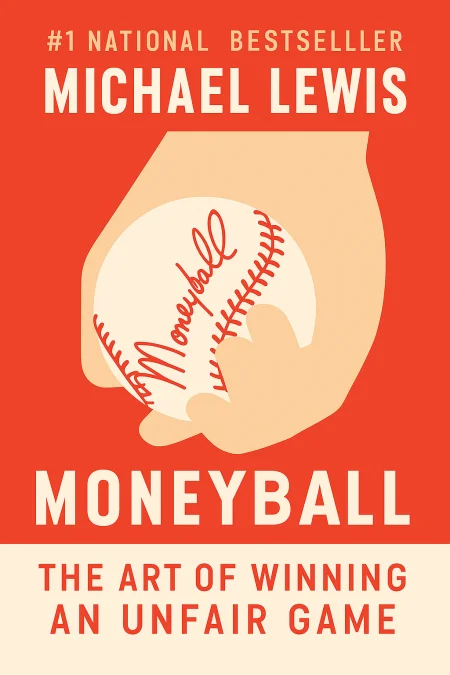
Moneyball
The Art of Winning an Unfair Game
Book Edition Details
Summary
In the high-stakes arena of Major League Baseball, where money talks and the deep-pocketed rule, one underdog team turns the game on its head. Enter the Oakland A's, helmed by their audacious general manager, Billy Beane. Armed not with cash but with keen insight and a band of unorthodox theorists, Beane challenges the sacred doctrines of the diamond. "Moneyball" weaves a captivating tale of innovation, where statistics become the secret weapon and tradition is thrown a curveball. Dive into Michael Lewis's riveting account of how determination and data can rewrite the playbook, giving the Davids of the world a fighting chance against the Goliaths.
Introduction
In the early 2000s, a quiet revolution was brewing in the Oakland Coliseum, where a cash-strapped baseball team was about to challenge everything the sport thought it knew about winning. While wealthy franchises like the New York Yankees threw around hundred-million-dollar payrolls, the Oakland Athletics were forced to find another way—one that would ultimately expose the profound inefficiencies lurking beneath America's pastime. This transformation reveals how entrenched traditions can blind entire industries to better methods, how statistical analysis can uncover hidden truths that conventional wisdom misses, and why the courage to think differently often matters more than abundant resources. The story demonstrates that in any competitive arena, whether sports or business, those willing to question fundamental assumptions and embrace uncomfortable truths can achieve remarkable success against seemingly impossible odds. Perfect for anyone fascinated by underdog stories, the power of analytical thinking, or the intersection of tradition and innovation, this tale shows how a small group of outsiders used data and logic to revolutionize not just baseball, but our understanding of how markets really work.
The Traditional Era: Century-Old Scouting Methods and Market Blindness
For over a century, baseball scouts had operated like medieval guilds, passing down their craft through generations of former players who trusted their eyes above all else. They spoke in a coded language of "tools" and "projectability," evaluating young men based on how they looked in uniform rather than what they actually accomplished on the field. A scout's reputation rested on his ability to spot the next superstar in a high school game, to see something invisible to others in a teenager's swing or stride. This system had created its own mythology, where scouts would drive thousands of miles and sleep in countless motels, all for that magical moment when they'd witness raw talent that others had missed. They measured sixty-yard dash times with stopwatches, noted the "good face" that suggested character, and dismissed players who didn't fit their mental image of what a ballplayer should look like. Height, speed, and arm strength became the holy trinity, while less visible qualities like patience, discipline, and baseball intelligence were relegated to afterthoughts. The financial stakes of these subjective judgments had grown astronomical. What once cost thousands now demanded millions, yet the evaluation methods remained frozen in amber. Teams continued to draft based on physical projection rather than actual performance, paying premium prices for teenagers who looked the part while overlooking college players who had already proven they could hit. This created a massive market inefficiency that most organizations couldn't see because they were too invested in their traditional ways of thinking. The old guard's resistance to change wasn't merely stubborn tradition—it was an entire worldview that elevated intuition over evidence, experience over analysis. They believed that baseball was too complex and human for numbers to capture, that the game's essence could only be understood by those who had played it at the highest level. This philosophical stance would soon collide with a new generation of thinkers who saw opportunity in every outdated assumption.
The Analytical Awakening: Bill James and the Sabermetric Revolution (1970s-1990s)
In the late 1970s, a night watchman at a pork and beans factory in Kansas began asking questions that would eventually transform how we think about baseball. Bill James possessed neither playing experience nor insider credentials, but he had something more powerful: an insatiable curiosity about whether the game's conventional wisdom actually made sense. Working alone with basic statistics and a mimeograph machine, he started publishing annual abstracts that challenged nearly every sacred assumption in baseball. James discovered that many of the sport's most cherished beliefs were demonstrably false. Batting average, the statistic that had defined hitting excellence for over a century, told only part of the story. The ability to avoid making outs—measured by on-base percentage—was far more valuable than anyone realized. Stolen bases, sacrifice bunts, and other "small ball" tactics that managers loved actually hurt teams more than they helped. Even fielding statistics, which seemed objective, were revealed as moral judgments disguised as facts. His work attracted a growing community of mathematicians, economists, and scientists who found in baseball a perfect laboratory for testing theories about performance and value. They called their field "sabermetrics," and they approached the game with the same rigor that Wall Street analysts brought to financial markets. These outsiders could see patterns that insiders missed because they weren't blinded by tradition or invested in maintaining the status quo. The revolution remained largely academic for decades, as major league teams showed little interest in insights that contradicted their established methods. Baseball executives dismissed the statistical analysts as computer nerds who had never played the game, failing to recognize that this very distance from the sport's culture gave them clearer vision. The stage was set for someone with the authority and desperation to bridge these two worlds—someone who could translate analytical insights into competitive advantage.
Oakland's Breakthrough: Proving Intelligence Over Money (Early 2000s)
By the late 1990s, the Oakland Athletics faced an existential crisis that would force them to innovate or perish. With one of baseball's smallest payrolls, they watched helplessly as richer teams poached their best players year after year. Traditional approaches to team building were financial suicide for a franchise that couldn't compete in the free agent market. This desperation became the catalyst for the most radical experiment in modern baseball history. General Manager Billy Beane, himself a former prospect whose career had been derailed by the very scouting system he now ran, embraced the analytical revolution with the fervor of a convert. Working with Harvard-educated assistant Paul DePodesta, Beane began systematically identifying market inefficiencies that other teams ignored. They discovered that certain types of players—those who drew walks, worked deep counts, and got on base at high rates—were dramatically undervalued because they didn't fit baseball's traditional image of what a star looked like. The Athletics started acquiring players that other teams didn't want: aging veterans past their prime, defensive liabilities who could hit, college players dismissed as too small or too slow. They turned their draft strategy upside down, selecting overweight catchers and undersized infielders based purely on their statistical production. Each move seemed crazy in isolation, but together they formed a coherent philosophy: maximize the team's ability to score runs while minimizing the cost of doing so. The results spoke louder than any theory. Despite losing star players to free agency every year, the Athletics consistently won more games than teams with payrolls three times larger. They reached the playoffs repeatedly, coming within a few outs of eliminating the mighty New York Yankees. Their success proved that intelligence and innovation could triumph over raw financial power, that markets could remain inefficient even under intense scrutiny, and that the courage to think differently was perhaps the most valuable resource of all.
Industry Transformation: The Spread of Data-Driven Baseball
The Oakland Athletics' sustained success could not be ignored indefinitely. Other organizations began to take notice, particularly those facing similar financial constraints or seeking competitive advantages. The Boston Red Sox, despite their substantial resources, hired Bill James as a consultant and attempted to recruit Billy Beane as their general manager. Teams across the league started hiring statisticians and analysts, investing in technology and data collection systems that would have been unthinkable just a few years earlier. This gradual adoption of analytical methods created a ripple effect throughout baseball. The market for certain types of players began to shift as organizations recognized the value in previously overlooked skills and attributes. Players with high on-base percentages began commanding higher salaries, forcing teams like Oakland to constantly evolve their approach and find new inefficiencies to exploit. The revolution had entered its second phase, where early advantages began to erode as competitors caught up. However, the transformation was far from uniform or immediate. Many teams remained committed to traditional methods, creating ongoing opportunities for analytically-minded organizations. The resistance often came from entrenched interests—scouts, coaches, and executives whose expertise and job security depended on maintaining the status quo. This created a fascinating dynamic where innovation and tradition coexisted uneasily within the same sport. The spread of analytical thinking in baseball represented more than just a change in player evaluation methods. It demonstrated how data-driven approaches could challenge and ultimately transform traditional industries. The principles pioneered in baseball—identifying market inefficiencies, questioning conventional wisdom, and using objective measurement to guide decision-making—began finding applications in other sports and business contexts, suggesting that this revolution extended far beyond the diamond.
Summary
The transformation of baseball through statistical analysis reveals a timeless truth about human nature and institutional change: we often cling to familiar methods long after better alternatives have emerged, especially when those methods are wrapped in tradition and defended by established interests. The conflict between old-school scouts and statistical analysts wasn't really about baseball—it was about whether intuition or evidence should guide important decisions, whether experience or analysis better reveals truth. This revolution offers profound lessons for anyone navigating competitive environments today. First, the greatest opportunities often hide in plain sight, disguised as conventional wisdom that no one questions. Second, being an outsider can be an advantage rather than a handicap, providing the distance necessary to see what insiders cannot. Third, sustainable success comes not from having more resources than competitors, but from using available resources more intelligently. The story ultimately demonstrates that in any field where performance can be measured, there are likely hidden inefficiencies waiting to be discovered by those brave enough to challenge assumptions and smart enough to act on what they find. The question isn't whether such opportunities exist, but whether we have the courage and discipline to pursue them when they contradict everything we thought we knew.
Related Books
Download PDF & EPUB
To save this Black List summary for later, download the free PDF and EPUB. You can print it out, or read offline at your convenience.
By Michael Lewis
