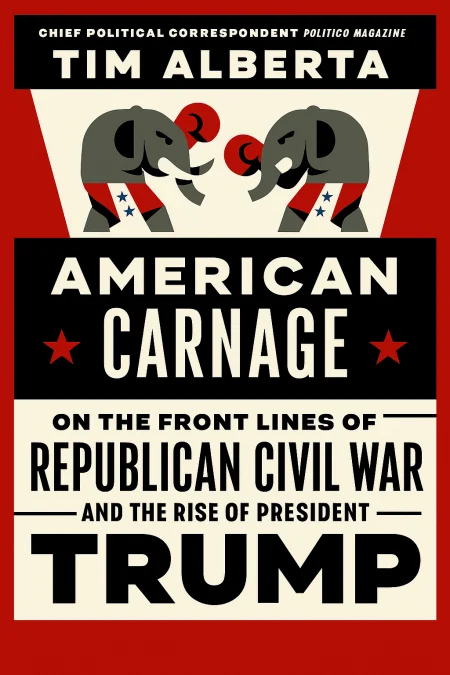
American Carnage
On the Front Lines of the Republican Civil War and the Rise of President Trump
Book Edition Details
Summary
In the crucible of American politics, where ideologies clash and party lines blur, Tim Alberta's "American Carnage" exposes the seismic shifts that have reshaped the Republican Party into an unlikely vessel for Donald Trump's ascension. This narrative is not of a single election, but a decade-long saga of turmoil, revealing Trump as the inevitable product of internal Republican strife and nationwide upheaval. Alberta's keen insight and groundbreaking reporting illuminate the party's existential battles—from the embers of Bush's compassionate conservatism to the conflagration of Tea Party fervor. Witness the GOP's metamorphosis, as it grapples with identity crises and power struggles, setting the stage for an unprecedented political takeover. This is a tale of evolution, collapse, and rebirth—a vivid chronicle of how a grand old party became the backdrop for a modern insurgency.
Introduction
Between 2008 and 2016, the Republican Party experienced one of the most dramatic transformations in American political history. What began as a traditional conservative movement built around fiscal responsibility, strong defense, and free markets evolved into something entirely different—a populist insurgency that would fundamentally reshape American politics. This remarkable metamorphosis wasn't the work of a single leader or a carefully orchestrated strategy, but rather the result of a series of internal battles, strategic miscalculations, and cultural shifts that exposed deep fractures within the conservative coalition. The story reveals how established political institutions, despite appearing strong and stable, can be overwhelmed by insurgent forces when they lose touch with their base constituencies. Time and again, Republican leaders found themselves outmaneuvered by movements they had initially dismissed as fringe elements. From grassroots Tea Party rallies to congressional showdowns, each chapter of this internal struggle weakened traditional party structures while strengthening anti-establishment sentiment that would eventually find its perfect champion. This transformation offers crucial insights for anyone seeking to understand modern American democracy, the nature of political movements, and how populist forces can capture and remake established institutions. The lessons extend far beyond partisan politics, illuminating broader questions about leadership, institutional resilience, and the relationship between political elites and their constituents in democratic societies. For political observers, engaged citizens, and those wondering how American politics became so polarized, this account provides essential context for understanding our current moment.
Tea Party Rebellion and Obama's Challenge (2008-2012)
Barack Obama's historic victory in 2008 created an existential crisis for Republicans that would reshape their party forever. After eight years of George W. Bush's presidency, marked by unpopular wars and economic collapse, the GOP found itself not just defeated but seemingly irrelevant. Obama's soaring approval ratings and Democratic control of both chambers of Congress suggested a potential generational shift that could leave Republicans wandering in the political wilderness for decades. The party's initial response revealed deep strategic confusion among its leadership. Figures like John Boehner and Eric Cantor understood they needed to oppose Obama's agenda, but they also recognized the political dangers of appearing obstructionist against such a popular president. Their careful calculations, however, were soon overwhelmed by an organic uprising that caught everyone by surprise. Rick Santelli's famous rant on CNBC about government bailouts sparked something far more powerful than traditional Republican opposition—it ignited a genuine grassroots movement. The Tea Party emerged as a perfect storm of economic anxiety, cultural resentment, and political frustration. While establishment Republicans focused on policy details and electoral mathematics, Tea Party activists tapped into something deeper: a sense that ordinary Americans were being left behind by an increasingly distant political class. These weren't the country club Republicans of old, but working-class and middle-class Americans who felt abandoned by both parties and viewed the bank bailouts as crony capitalism. This grassroots energy initially seemed like a blessing for Republican leaders, providing passion and volunteers that the party desperately needed after its crushing defeat. The 2010 midterm elections became a referendum on Obama's agenda, with Tea Party-backed candidates defeating establishment Republicans in primaries before going on to flip control of the House. But the movement's anti-establishment DNA would soon prove impossible to control, introducing a new political vocabulary centered on constitutional purity and resistance to compromise that would fundamentally alter the party's approach to governance.
Congressional Insurgency and Establishment Resistance (2013-2015)
The Tea Party's electoral success brought Republicans back to power in the House, but victory came with an unexpected price: a freshman class of members who viewed compromise as betrayal and governing as warfare. Speaker John Boehner quickly discovered that his new majority was unlike any in modern congressional history. These weren't traditional Republicans seeking to climb the institutional ladder—they were revolutionaries determined to tear down the system from within. The debt ceiling crisis of 2011 exposed the fundamental tension between governing and revolution. While Boehner sought to extract concessions from Obama through traditional negotiation, conservative hardliners demanded total victory or total war. The Speaker found himself caught between an immovable president and an unstoppable force within his own ranks. The government shutdown of 2013 marked a turning point in this internal struggle, as Ted Cruz's twenty-one-hour speech demonstrated how individual senators could now command national attention independent of party leadership. The formation of the House Freedom Caucus in 2015 formalized what had been an ongoing insurgency, creating an organized bloc of conservatives willing to use procedural tactics to force confrontations with both Democratic opponents and their own leadership. Organizations like Heritage Action and the Club for Growth provided funding and intellectual cover for primary challenges against establishment Republicans, while right-wing media amplified the insurgents' message and punished those who sought compromise. The insurgency's success in toppling House Majority Leader Eric Cantor in a 2014 primary sent shockwaves through the Republican establishment. Cantor's stunning defeat wasn't just about immigration policy or any single issue—it represented a complete rejection of the political class by voters who felt abandoned and betrayed. The loss demonstrated that no Republican was safe from conservative challengers, fundamentally altering the incentive structure within the party and setting the stage for even more dramatic upheavals to come.
Trump's Hostile Takeover and Electoral Victory (2016)
Donald Trump's entry into the 2016 presidential race initially appeared to be another publicity stunt from a reality television star with a history of political flirtations. His announcement speech, with its inflammatory comments about Mexican immigrants, seemed to confirm that this was merely another attention-seeking exercise. Republican leaders like Reince Priebus initially viewed Trump as a useful vehicle for generating media attention that would ultimately benefit more serious candidates. What establishment Republicans failed to recognize was how Trump's message resonated with the same voters who had been driving the party's internal rebellions for years. His attacks on political correctness, his promises to fight for forgotten Americans, and his contempt for Washington expertise appealed to constituencies that had been mobilized by the Tea Party but never fully satisfied by traditional conservative politicians. Trump had identified something the political class had missed entirely: years of economic stagnation and cultural change had created a reservoir of anger that conventional politicians couldn't tap. The primary campaign became the ultimate test of the Republican establishment's power. Despite massive financial advantages and institutional support, traditional candidates like Jeb Bush found themselves overwhelmed by Trump's populist appeal and media dominance. Trump's success was built on his ability to synthesize various strands of conservative discontent into a coherent populist message, combining the Tea Party's anti-establishment anger with older traditions of economic nationalism and cultural conservatism. The establishment's attempts to stop Trump only strengthened his appeal among voters who had lost faith in traditional Republican institutions. Every criticism from party leaders, every negative editorial from conservative publications, every warning from foreign policy experts served as validation that Trump was indeed the outsider he claimed to be. His narrow electoral victory, achieved by threading the needle in three Rust Belt states, validated his unconventional approach while devastating the establishment's confidence in their understanding of their own party.
Complete Transformation and Institutional Capture (2017-2019)
Trump's unexpected victory created an immediate crisis of legitimacy within the Republican Party. Leaders who had spent months denouncing him as unfit for office suddenly found themselves forced to work with him as president-elect. Paul Ryan's decision to embrace Trump despite their previous conflicts exemplified the broader capitulation of the Republican establishment, as the promise of unified government and conservative policy victories overcame moral reservations about Trump's character and temperament. The early months of Trump's presidency were defined by chaos that would have been career-ending for any traditional politician, yet his approval ratings among Republican voters remained remarkably stable. Congressional Republicans found themselves in an impossible position, having finally achieved unified control of government but with a president who knew little about policy and cared even less about the details of governing. The failure to repeal Obamacare exposed fundamental tensions within the coalition, while the passage of tax reform came at the cost of abandoning decades of rhetoric about fiscal responsibility. Perhaps more importantly, Trump transformed the party's political culture and standards of behavior. His use of Twitter to attack opponents, spread conspiracy theories, and undermine democratic norms became the new normal for Republican politics. Party members who criticized Trump found themselves facing primary challenges and social ostracism, while those who defended him were rewarded with access and influence. The same lawmakers who had spent the Obama years warning about executive overreach now worked overtime to protect Trump from oversight and accountability. By 2019, the Republican Party bore little resemblance to the institution that had nominated Mitt Romney just seven years earlier. It had become a vehicle for Trump's personality cult, where ideological consistency mattered less than personal loyalty, and where the traditional conservative movement had been replaced by a populist nationalism that drew its energy from grievance rather than governance. The transformation was complete, creating a new reality where authenticity mattered more than experience and where entertainment value superseded governing competence.
Summary
The Republican Party's transformation from a traditional conservative institution into a populist movement represents one of the most significant political realignments in modern American history. The central tension throughout this period was between a party establishment that prioritized electability and governance and a grassroots base that demanded ideological purity and confrontational tactics. This fundamental disconnect created space for insurgent forces to gradually weaken traditional Republican institutions while building alternative power structures that would ultimately elevate an outsider to the presidency. The story offers several crucial lessons for understanding contemporary politics and democratic governance. First, established political institutions are far more fragile than they appear, especially when they lose touch with their core constituencies and fail to adapt to changing circumstances. Second, in the age of social media and partisan news, individual politicians can build national followings independent of party structures, fundamentally altering traditional power dynamics and creating opportunities for outsiders to bypass established gatekeepers entirely. Most importantly, this transformation demonstrates how the desire to be seen fighting for one's principles can become more important than actually achieving policy victories, creating incentives for performative politics over substantive governance. For citizens concerned about democratic health, the Republican experience suggests that political parties must continuously earn the loyalty of their supporters rather than taking it for granted, while also maintaining institutional norms that preserve the possibility of compromise and effective governance across partisan divides.
Related Books
Download PDF & EPUB
To save this Black List summary for later, download the free PDF and EPUB. You can print it out, or read offline at your convenience.
By Tim Alberta
