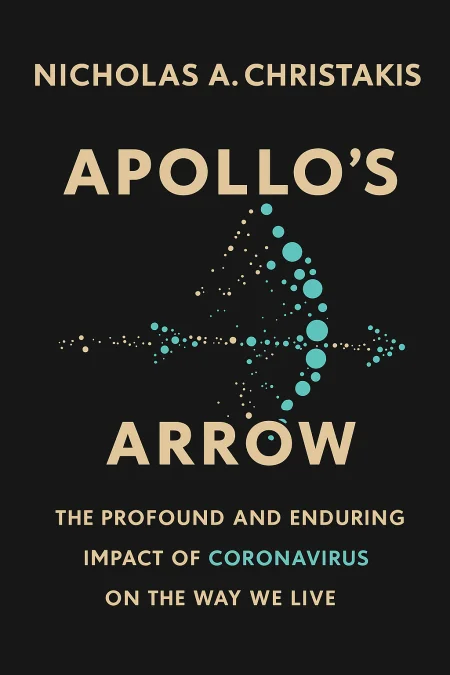
Apollo’s Arrow
The Profound and Enduring Impact of Coronavirus on the Way We Live
Book Edition Details
Summary
In a world gripped by an unseen adversary, "Apollo's Arrow" emerges as an illuminating chronicle of our shared ordeal during the COVID-19 pandemic. Nicholas A. Christakis, a celebrated sociologist and physician, guides us through the tumultuous year of 2020, unraveling the intricate dance between a virulent microbe and human society. This book traverses time and science, drawing parallels with historical epidemics and offering a future glimpse shaped by today's challenges. As new social fissures are exposed and unexpected alliances formed, Christakis provides not only a map of our recent past but a compass for the years to come. With vivid storytelling and a keen eye for detail, "Apollo's Arrow" is a clarion call to understand the enduring resilience and vulnerability of our collective human experience.
Introduction
When a mysterious respiratory illness began spreading through Wuhan in late 2019, few could have predicted that within months, the entire world would be transformed by lockdowns, mask mandates, and social distancing measures that seemed to belong to a bygone era. Yet as history reveals, our response to COVID-19 followed patterns established centuries ago during the Black Death, the 1918 Spanish flu, and countless other pandemics that have shaped human civilization. This exploration demonstrates how pandemics serve as both destroyers and creators of social order, exposing the fault lines in our societies while simultaneously revealing our capacity for resilience, innovation, and collective action. Throughout history, infectious diseases have repeatedly forced humanity to choose between individual liberty and collective survival, between economic prosperity and public health, between transparency and social stability. These recurring tensions illuminate fundamental truths about human nature and social organization that transcend any single historical moment. This examination offers invaluable insights for policymakers, healthcare professionals, and curious citizens seeking to understand not just what happened during COVID-19, but why it happened the way it did. The lessons contained within extend far beyond epidemiology, offering profound insights into human nature, social cohesion, and the delicate balance between freedom and responsibility that defines modern civilization. By understanding these timeless patterns, we can better prepare for the challenges that lie ahead.
Early Spread and Recognition (2019-2020)
In the final weeks of 2019, an invisible enemy made its leap from the animal kingdom into human society. The SARS-CoV-2 virus, likely originating in bats and possibly passing through pangolins, found its first human host in Wuhan, China. This moment represented a classic zoonotic spillover event, the kind that has plagued humanity throughout history, yet it occurred in a world more interconnected than ever before. The initial response in Wuhan followed a depressingly familiar pattern of denial and suppression. Dr. Li Wenliang, the ophthalmologist who first sounded the alarm about the emerging outbreak, was silenced by authorities and forced to retract his warnings as rumor-mongering. This suppression of early warning signals would prove catastrophic, as precious weeks were lost while the virus established itself in the human population. The timing could not have been worse, coinciding with the Lunar New Year migration that would carry infected individuals across China and around the globe. When Chinese authorities finally acknowledged the severity of the situation, their response was unprecedented in scale. The lockdown of Wuhan and eventually much of China represented the largest public health intervention in human history, affecting nearly a billion people. Yet by then, the virus had already begun its global journey, with genetic analysis later revealing multiple introduction points into countries worldwide, as travelers unknowingly carried different viral variants to seed new outbreaks. The emergence phase of COVID-19 demonstrated both the vulnerability of our interconnected world and the power of modern scientific tools. Within weeks, researchers had sequenced the viral genome, developed diagnostic tests, and begun tracking the pathogen's spread using everything from mobile phone data to phylogenetic analysis. Yet for all our technological advancement, the basic challenge remained unchanged from medieval times: how to stop an invisible enemy that spreads through the most fundamental human activities of breathing, speaking, and gathering together.
Social Disruption and Response Measures
By March 2020, the pandemic had triggered social disruptions on a scale not seen since World War II. Governments worldwide implemented lockdowns, school closures, and travel restrictions that would have been unimaginable just months earlier. These measures, while necessary to slow viral transmission, created secondary crises that rippled through every aspect of human society, revealing the interconnected fragility of modern life. The economic devastation was swift and severe. Within weeks, unemployment soared to levels not seen since the Great Depression, while small businesses shuttered permanently and entire industries ground to a halt. The unequal distribution of these economic costs fell most heavily on service workers and small business owners, highlighting existing inequalities and creating new sources of social tension. Essential workers, often among the lowest paid in society, faced the highest exposure risks while the privileged classes retreated to home offices and country estates. Educational systems faced unprecedented challenges as schools closed and millions of students shifted to remote learning. This transition exposed the digital divide that separated advantaged from disadvantaged communities, creating new forms of educational inequality. Children from low-income families, lacking reliable internet or quiet study spaces, fell further behind their peers, potentially creating lasting impacts on an entire generation's development and opportunities. Healthcare systems, despite decades of preparation for pandemic scenarios, quickly became overwhelmed. Hospitals ran short of basic protective equipment, forcing medical professionals to make impossible choices about resource allocation. The crisis revealed how decades of efficiency-focused healthcare management had eliminated the surge capacity needed for emergency response, while healthcare workers risked their lives to care for patients under overwhelming conditions with inadequate protection.
Community Resilience and Collective Action
Despite the devastation wrought by COVID-19, the pandemic also revealed remarkable examples of human resilience, innovation, and solidarity. Healthcare workers risked their lives to care for patients, often with inadequate protective equipment and under overwhelming conditions. Communities organized mutual aid networks to support vulnerable neighbors, while scientists around the world collaborated at unprecedented speed to develop vaccines and treatments. The rapid development of effective vaccines represented one of the greatest scientific achievements in human history. What normally takes decades was accomplished in less than a year, thanks to new technologies, massive public investment, and the removal of bureaucratic barriers. This success demonstrated what becomes possible when societies mobilize their full resources toward a common goal, offering a model for addressing other existential challenges like climate change through coordinated global action. The pandemic also accelerated social and technological changes that may prove beneficial in the long term. Remote work became normalized, potentially reducing commuting and its environmental impact. Digital technologies enabled new forms of education, healthcare delivery, and social connection. The crisis forced innovations in everything from urban planning to supply chain management that could make societies more resilient to future shocks. Most importantly, the pandemic reminded us of our fundamental interconnectedness and shared vulnerability. The virus recognized no borders, respected no social hierarchies, and threatened all of humanity equally. This shared experience of vulnerability created opportunities for empathy and solidarity that transcended traditional divisions. Simple acts like mask-wearing became symbols of social solidarity, visible demonstrations that individual behavior could serve collective welfare and protect the most vulnerable members of society.
Long-term Changes and Historical Perspective
As the acute phase of the pandemic waned, its long-term impacts began to crystallize into permanent changes in how societies function. Remote work, once considered an experimental perk, became standard practice for millions of professionals. Healthcare delivery shifted toward telemedicine and distributed care models. Educational institutions embraced hybrid learning approaches that combined in-person and digital instruction, fundamentally altering how knowledge is transmitted across generations. These changes accelerated existing technological and social trends while creating entirely new patterns of human organization. Cities, long the engines of economic growth, faced questions about their continued relevance as work became location-independent. Rural areas experienced population influxes as people sought more space and lower costs. These demographic shifts promised to reshape political and economic landscapes for decades to come, potentially redistributing power and resources in unexpected ways. The pandemic also catalyzed broader social and political movements. The disproportionate impact on communities of color sparked renewed attention to systemic inequalities that had long been ignored or minimized. The essential role of previously undervalued workers led to new discussions about fair wages and working conditions. The successful mobilization of resources for vaccine development demonstrated government capacity for large-scale intervention, potentially changing expectations about what public institutions could and should accomplish. Looking through the lens of history, COVID-19 appears likely to join the ranks of transformative pandemics that fundamentally altered human civilization. Like the Black Death's role in ending feudalism or the 1918 flu's contribution to modern public health systems, this pandemic has created conditions for systemic change. The question remains whether societies will seize these opportunities for positive transformation or allow the crisis to deepen existing divisions and inequalities that threaten social cohesion.
Summary
The COVID-19 pandemic, viewed through historical perspective, reveals itself as part of a recurring pattern in human experience where biological crises serve as catalysts for profound social transformation. The central tension throughout this crisis has been between our individual desires for normalcy and freedom versus our collective need for coordinated action and mutual protection. This fundamental conflict between personal liberty and community responsibility has shaped every aspect of the pandemic response, from mask mandates to vaccine distribution, echoing similar struggles throughout human history. History suggests that pandemics ultimately strengthen human societies by forcing adaptation and innovation while revealing both our vulnerabilities and our capabilities. The communities and nations that have fared best during COVID-19 are those that successfully balanced individual rights with collective responsibility, invested in robust public institutions, and maintained social trust even under extreme stress. These lessons point toward crucial insights for navigating future crises, whether biological, environmental, or technological in nature. Moving forward, we must invest not only in vaccines and treatments but in the social infrastructure that enables effective collective action. This means strengthening public health systems, improving scientific literacy, building more equitable societies, and fostering the social cohesion necessary to respond to future crises. The next pandemic is not a matter of if but when, and our survival will depend not on our individual preparations but on our collective wisdom, solidarity, and willingness to prioritize shared welfare over narrow self-interest.
Related Books
Download PDF & EPUB
To save this Black List summary for later, download the free PDF and EPUB. You can print it out, or read offline at your convenience.
By Nicholas A. Christakis
