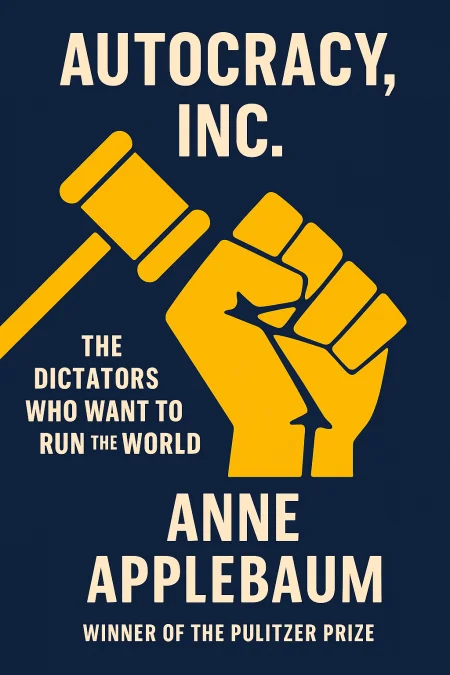
Autocracy, Inc.
The Dictators Who Want to Run the World
Book Edition Details
Summary
A chilling alliance of power and impunity casts its shadow over the democratic world. In "Autocracy, Inc.," Pulitzer Prize-winning author Anne Applebaum exposes the covert networks bolstering today's authoritarian regimes. Forget the single dictator of old; modern autocracies thrive on a web of kleptocratic finance, advanced surveillance, and relentless propaganda. These regimes, from Beijing to Moscow, operate with a chilling synchronicity, united not by ideology but by an insatiable lust for control and wealth. Applebaum's urgent narrative challenges democracies to rethink their strategies, drawing parallels to past struggles against tyranny, and calls for a renewed resistance against a sophisticated global threat.
Introduction
In the flickering shadows of a rambling hotel outside Vilnius, something remarkable happened in the autumn of 2022. Politicians and activists from Russia, Zimbabwe, Iran, North Korea, Nicaragua, Rwanda, Cuba, and China gathered in rooms with bad lighting and long tables. They came from Venezuela, Syria, Cambodia, Belarus, and Uganda. What united them was not ideology or geography, but a shared understanding of how modern dictatorships operate and collaborate across borders. This convergence reveals a startling truth about our contemporary world. While democratic nations often view global politics as separate regional issues, autocracies see an interconnected battlefield where victories and defeats in one theater affect outcomes everywhere else. From Putin's manipulation of European energy markets to China's surveillance technology exports, from Iranian proxy networks to Venezuelan money laundering schemes, today's dictators have created something unprecedented in human history: a sophisticated global network of mutual support that transcends traditional ideological boundaries. This is not your grandfather's Cold War with neat ideological camps and clear geographical divisions. Instead, we face something more insidious and adaptable. Modern autocrats have learned to weaponize the very systems that democracies created for prosperity and freedom. They exploit international finance, social media platforms, legal frameworks, and even democratic institutions themselves to maintain power and spread their influence. Understanding this new reality is essential for anyone concerned about the future of human freedom, the rule of law, and the survival of democratic societies in an increasingly interconnected world.
The Foundation of Kleptocratic Networks (1990s-2000s)
The foundations of today's autocratic alliance were laid not in Moscow's war rooms or Beijing's party headquarters, but in the seemingly mundane world of international finance during the optimistic 1990s. As the Cold War ended and globalization promised universal prosperity, Western leaders embraced a seductive theory: trade would automatically transform dictatorships into democracies. This belief, encapsulated in the German phrase "Wandel durch Handel" or change through trade, would prove to be one of history's most costly miscalculations. Vladimir Putin's early career perfectly illustrates how autocrats exploited this naïve optimism. As deputy mayor of St. Petersburg in the early 1990s, Putin appeared on camera advocating for small businesses and Western investment, convincing observers he was a reformer. Behind the scenes, however, he was pioneering techniques that would become the blueprint for modern kleptocracy. His schemes to steal money from St. Petersburg's food programs required Western banks to accept mysterious cash flows, Western companies to sign questionable contracts, and Western regulators to look the other way. This wasn't Russian corruption operating in isolation but a collaborative effort between Eastern autocrats and Western enablers. The same pattern emerged globally during this period. Hugo Chávez in Venezuela initially presented himself as an anti-corruption reformer, yet quickly established a system where loyalty to the regime was rewarded with opportunities for theft. Chinese officials absorbed Western technology and investment while carefully studying how to maintain political control in an economically open society. What appeared to Western observers as awkward transitions toward democracy were actually sophisticated experiments in combining authoritarian control with global economic integration. These early kleptocratic networks created the financial architecture that modern autocrats still use today. They learned to exploit offshore banking systems, shell companies, and regulatory gaps that democracies had created for legitimate purposes. More importantly, they discovered that Western financial institutions, real estate markets, and legal systems could be weaponized to store stolen wealth and protect corrupt officials from accountability. This foundation would prove crucial as autocracies began sharing not just money-laundering techniques, but political strategies for survival.
Digital Control and Information Warfare (2010s)
While Western leaders confidently predicted that the internet would spread democracy worldwide, autocratic regimes were quietly constructing the most sophisticated propaganda and surveillance systems in human history. China led this transformation, moving far beyond simple censorship to create what researchers call "engineered consent" through technological manipulation. The Great Firewall became not just a barrier to information, but an active system for shaping how people think about politics, democracy, and their own governments. The Chinese approach differed fundamentally from Soviet-era propaganda. Instead of promoting utopian visions that citizens could compare unfavorably to reality, modern autocrats focused on breeding cynicism and hopelessness. Their message was simple but effective: all governments are corrupt, all politicians lie, democracy brings chaos, and resistance is futile. This nihilistic approach proved far more durable than inspiring slogans about workers' paradise or national glory, because it lowered expectations rather than raising them. By the mid-2010s, these techniques were spreading globally through what intelligence analysts call "information laundering." Russian operatives would create false stories, Chinese media would amplify them, Iranian outlets would translate them into different languages, and Venezuelan channels would adapt them for Latin American audiences. The same conspiracy theories and anti-democratic narratives appeared simultaneously in multiple countries, each seemingly from local sources but actually coordinated from autocratic capitals. The 2016 U.S. election marked a turning point when Americans discovered that foreign autocrats were actively manipulating their domestic politics. Russian trolls posed as American activists on both sides of divisive issues, Chinese accounts spread conspiracy theories about biological weapons, and a complex network of shell websites made foreign propaganda appear to be local journalism. Social media platforms, designed to connect people and spread information freely, became perfect vectors for coordinated disinformation campaigns. The technology that was supposed to democratize information had been reverse-engineered to undermine democracy itself.
Coordinated Global Assault on Democracy (2020s)
The Russian invasion of Ukraine in February 2022 revealed the full scope of autocratic cooperation, transforming what many still viewed as separate regional challenges into an unmistakably coordinated global assault on democratic principles. Putin's war was designed not merely to conquer territory, but to demonstrate that international law, human rights, and democratic solidarity were powerless concepts that could be ignored with impunity. The support network that emerged around Russia's aggression exposed the true nature of Autocracy, Inc. China provided economic lifelines through discounted oil purchases and sanctions evasion. Iran supplied thousands of lethal drones and military advisers. North Korea shipped ammunition and missiles. Belarus allowed its territory to be used as a launching pad for attacks. Turkey, Georgia, and other hybrid regimes helped Russian companies evade sanctions by providing transshipment routes for banned technology. This wasn't coincidental cooperation but systematic collaboration designed to demonstrate that democracies lacked the will to enforce their own rules. The autocratic alliance's coordination extended far beyond Ukraine. As Western attention focused on the war, Azerbaijan ethnically cleansed 100,000 Armenians from Nagorno-Karabakh, Iranian-backed Hamas launched devastating attacks on Israel, and Chinese hackers penetrated British parliamentary computer systems. Venezuelan migration to the U.S. border increased dramatically, fueling domestic political divisions that weakened American support for Ukraine. These simultaneous crises were not orchestrated by a single mastermind, but they demonstrated how autocracies had learned to time their actions for maximum impact on democratic decision-making. Perhaps most revealing was the evolution of proxy warfare into a profitable business model. The Wagner Group in Africa, Iranian militias across the Middle East, and similar organizations elsewhere began offering "regime survival packages" to threatened dictators. These included personal protection, propaganda campaigns promoting "multipolarity" and anti-Western themes, money-laundering services, and violent suppression of opposition movements. What had once been ideological solidarity between communist or fascist states became a commercial enterprise where autocrats could purchase the tools of repression from other autocrats, creating self-reinforcing networks of mutual dependence and shared guilt.
The Democratic Response and Future Strategies
The fight for freedom in the 21st century will not be won by individual nations acting alone, but by building interconnected networks that can match the scope and sophistication of autocratic cooperation. Democracy activists from Hong Kong to Venezuela to Belarus have learned that they face not just their local dictators, but a global system designed to crush democratic movements wherever they emerge. Their response must be equally global and equally strategic. The most promising developments involve what activists call "reverse information laundering," where democratic voices amplify each other's messages across borders and languages. Russian independent journalists translate their investigations into English, Chinese democracy activists coordinate with Iranian women's rights campaigners, and Venezuelan opposition leaders share tactical knowledge with Belarusian protesters. These connections are organic rather than government-directed, but they represent the kind of horizontal solidarity that autocrats fear most because it cannot be easily co-opted or controlled. Democratic governments are finally beginning to understand that the struggle against autocracy requires new institutions and approaches. Efforts to expose information warfare before it spreads, coordinate sanctions enforcement across multiple jurisdictions, and create joint investigations into transnational kleptocracy represent important first steps. However, these official responses often lag behind both autocratic innovation and the insights of democracy activists who understand the nature of modern repression from lived experience. The ultimate challenge lies not just in defeating current autocratic regimes, but in rebuilding international systems that favor transparency over secrecy, accountability over impunity, and human dignity over raw power. This requires confronting uncomfortable truths about how democratic institutions have been corrupted by foreign money, how social media platforms have been weaponized against democracy, and how international financial systems have become vehicles for autocratic influence. The war for democracy will be won or lost not on traditional battlefields, but in the complex networks of money, information, and influence that shape modern global politics.
Summary
The rise of global autocracy represents perhaps the most significant threat to human freedom since the totalitarian movements of the 20th century, yet it operates through mechanisms that are often invisible to citizens of democratic societies. Unlike previous ideological conflicts between communism and capitalism or fascism and democracy, today's struggle pits those who believe in transparency, accountability, and human dignity against those who profit from secrecy, corruption, and repression, regardless of their stated political beliefs. The autocratic advantage lies not in superior ideas or more effective governance, but in their willingness to collaborate across traditional boundaries while democracies often remain trapped in bureaucratic silos and national perspectives. When Russian oligarchs, Chinese tech companies, Iranian proxies, and Venezuelan money launderers work together to undermine democratic institutions, they exploit the very openness and rule-following that make democratic societies successful. The solution cannot be to abandon democratic principles, but to defend them more strategically and collectively. Three urgent actions emerge from this historical analysis. First, democratic nations must end the financial secrecy that allows autocratic wealth to corrupt our institutions by requiring full transparency in real estate, banking, and corporate ownership. Second, we must treat information warfare as seriously as physical warfare by exposing propaganda networks before they spread and holding social media platforms accountable for the algorithms that amplify divisive content. Finally, we must build lasting coalitions between democratic governments and the brave individuals fighting for freedom under authoritarian rule, recognizing that their insights and networks are often more valuable than traditional intelligence sources. The choice before us is stark: build effective networks to defend democracy, or watch freedom disappear one country, one institution, and one compromise at a time.
Related Books
Download PDF & EPUB
To save this Black List summary for later, download the free PDF and EPUB. You can print it out, or read offline at your convenience.
By Anne Applebaum
