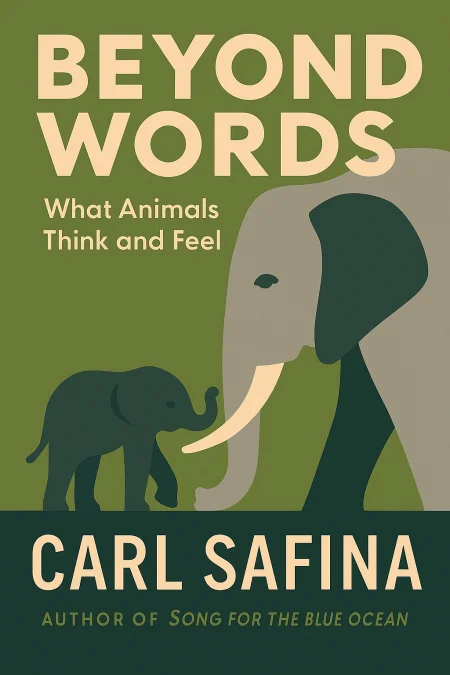
Beyond Words
What Animals Think and Feel
Book Edition Details
Summary
Witness the soulful heartbeat of the animal kingdom in "Beyond Words." In the shimmering heat of Kenya's Amboseli National Park, elephant families navigate the perils of poaching and drought with remarkable resilience. Meanwhile, the haunting valleys of Yellowstone echo with the cries of wolves confronting the void left by their lost kin. In the tranquil depths of the Pacific Northwest, killer whales reveal a society built on peace and intricate social bonds. This book invites you to contemplate the depth of thought and emotion that animates these creatures, unveiling a tapestry of life as rich and complex as our own. Here, the barriers between human and animal blur, illuminating a shared capacity for emotion and learning that binds all sentient beings.
Introduction
Have you ever watched your dog tilt their head when you speak to them, as if they're trying to decode not just your words but your emotions? Or wondered what thoughts pass through an elephant's mind as it gently touches the bones of a deceased family member with its trunk? For centuries, humans have maintained a comfortable belief that we alone possess the gifts of complex thought, deep emotion, and true consciousness. We've drawn a clear line between ourselves and the rest of the animal kingdom, convinced that while other creatures might display interesting behaviors, they lack the rich inner lives that define our humanity. Yet groundbreaking research from around the world is shattering these assumptions, revealing that the mental and emotional lives of animals are far more sophisticated than we ever dared imagine. From dolphins who call each other by individual names and whales who pass down cultural traditions through generations, to crows that fashion tools with the skill of craftsmen and elephants that appear to hold funeral ceremonies for their dead, the evidence is mounting that consciousness exists on a vast and varied spectrum throughout the natural world. This exploration will take you deep into the hidden emotional worlds and remarkable cognitive abilities of some of Earth's most fascinating creatures, challenging everything you thought you knew about what makes a mind truly intelligent and what it means to experience life with depth, meaning, and awareness.
The Universal Foundation: Shared Biology of Animal Consciousness
At the most fundamental level, all animals share what scientists call the basic biological toolkit for consciousness and emotion. This isn't merely philosophical speculation but hard neuroscience backed by decades of research. The brain circuits that generate fear, joy, curiosity, and social bonding in humans are remarkably similar to those found in other mammals, and variations of these systems extend even to creatures as different from us as birds and fish. When a laboratory rat experiences anxiety, the same stress hormones and neurotransmitters flood its nervous system as when you feel nervous before an important exam. When an elephant displays what appears to be grief over a fallen family member, the neurochemical processes occurring in its massive brain mirror those of a mourning human in striking detail. This shared foundation makes perfect evolutionary sense when we consider that emotions aren't luxuries or cultural inventions, but essential survival tools that evolved to help animals navigate the complex challenges of staying alive and reproducing successfully. Fear keeps creatures alive by triggering rapid fight-or-flight responses to danger. Joy and pleasure motivate behaviors that promote survival and successful reproduction. Social emotions like empathy, loyalty, and cooperation enable group living, which provides protection from predators, shared resources, and collaborative care for offspring. These emotional systems proved so crucial for survival that they appeared early in evolutionary history and have been preserved across millions of years and countless species, forming the biological bedrock upon which all animal consciousness is built. What makes this shared emotional heritage particularly fascinating is how it manifests differently across species, shaped by each animal's unique ecological niche and social structure. A wolf's profound capacity for loyalty and pack bonding serves the cooperative hunting strategies and shared child-rearing that define pack life. An elephant's extraordinary memory and complex grief responses help maintain the intricate social bonds that are crucial for finding water sources and navigating seasonal migrations across vast African landscapes. A dolphin's playfulness and insatiable curiosity drive the extensive learning necessary for mastering sophisticated echolocation techniques and navigating the complex social alliances that characterize dolphin society. The implications of this discovery are profound and humbling. When we observe animals displaying what looks remarkably like human emotion, we're not simply projecting our own feelings onto them or engaging in wishful anthropomorphism. Instead, we're recognizing the deep evolutionary kinship that connects all conscious beings, seeing authentic expressions of awareness and feeling that arise from the same ancient biological roots we all share. The joy in a dog's enthusiastic greeting, the apparent grief of a mother whale carrying her dead calf for days, the obvious curiosity of a crow methodically solving a complex puzzle, these aren't pale imitations of human experience but genuine manifestations of consciousness emerging from our common evolutionary heritage.
Beyond Words: Complex Communication Systems Across Species
While humans often pride themselves on possessing the only true language, the animal kingdom is alive with sophisticated communication systems that rival and sometimes exceed our own in complexity, range, and effectiveness. Elephants provide perhaps the most remarkable example, communicating across vast distances using infrasonic rumbles that occur at frequencies so low they're barely detectable to human ears. These subsonic calls can travel for dozens of miles through the ground and air, allowing separated family members to coordinate movements across enormous territories. Far from being simple signals, these communications contain layered information about individual identity, current emotional state, precise location, and specific intentions, forming what researchers increasingly recognize as a true language with its own vocabulary and grammar. Dolphins take interspecies communication to even more extraordinary levels through their sophisticated use of signature whistles and collaborative vocalizations. Each dolphin develops its own unique signature whistle early in life, essentially creating a personal name that it uses consistently throughout its lifetime. When dolphins encounter each other, they exchange these vocal calling cards in what can only be described as formal introductions, and mothers carefully teach their calves not only their own names but the signature whistles of other family members and close associates. Even more remarkably, dolphins demonstrate the ability to learn and appropriately use human-created symbols and gestures, showing comprehension not just of individual words but of basic grammar and syntax, following complex instructions that require understanding word order and abstract concepts. Many species possess what can only be called cultural dialects and traditions that are passed down through generations via social learning rather than genetic inheritance. Killer whale families each maintain their own unique set of calls and vocalizations that serve as acoustic signatures, immediately identifying which clan and family lineage they belong to. Young whales learn these distinctive family dialects from their mothers and maintain them faithfully throughout their lives, even when they encounter and interact with other whale populations that speak different acoustic dialects. Different populations of the same species living in separate geographic regions develop distinct calling patterns, vocal accents, and communication styles, much like the regional dialects and languages that characterize different human cultures. The sophistication of animal communication extends far beyond vocalizations to include intricate systems of gestures, body language, scent marking, and even tool-mediated signals. Chimpanzees employ dozens of distinct hand gestures and body movements, each with specific meanings ranging from requests for grooming or play to complex negotiations over food sharing and social status. Many bird species engage in elaborate dances, displays, and construction projects that convey detailed information about their physical fitness, reproductive readiness, territorial claims, and emotional states. These diverse communication systems fundamentally challenge our human-centered understanding of language and meaning, revealing that the drive to share information, coordinate complex behaviors, and maintain social relationships through symbolic communication represents a widespread and sophisticated aspect of animal consciousness that connects species across the entire tree of life.
Intelligence Redefined: Diverse Cognitive Abilities in Nature
For decades, scientists attempted to measure animal intelligence using human cognitive abilities as the gold standard, often concluding that other species fell short of our mental capabilities. This approach was fundamentally flawed, rather like judging a fish's intelligence by its ability to climb trees or evaluating a bird's worth based on its swimming skills. Modern research has revolutionized our understanding by recognizing that intelligence isn't a single, linear scale but rather a diverse collection of cognitive abilities, each shaped by millions of years of evolutionary pressure and finely tuned to meet the specific survival challenges of different ecological niches. When we examine animals within the context of their own evolutionary adaptations and environmental demands, we discover forms of intelligence that are not only remarkably sophisticated but sometimes far superior to human cognitive abilities. The corvid family, including crows, ravens, and jays, showcases problem-solving abilities that consistently astonish researchers and challenge our assumptions about avian intelligence. These birds routinely solve multi-step puzzles that stump young children, demonstrate the ability to fashion sophisticated tools from unfamiliar materials, and show clear evidence of planning for future events and needs. Betty, a famous New Caledonian crow, spontaneously bent a straight piece of wire into a functional hook to retrieve food from a narrow tube, a feat requiring insight, advance planning, and sophisticated understanding of cause-and-effect relationships. Ravens have been observed engaging in complex bartering behaviors with humans, saving tokens to trade later for preferred treats, demonstrating both remarkable self-control and an understanding of delayed gratification that rivals the cognitive abilities of preschool children. Elephants showcase an entirely different but equally impressive form of intelligence rooted in their extraordinarily complex social lives and challenging environmental demands. Elderly matriarchs function as living libraries for their families, storing decades of accumulated knowledge about seasonal weather patterns, the locations of distant water sources, safe migration routes, and the intricate social relationships that exist within and between different elephant communities. During severe droughts that occur perhaps once in a generation, the survival of entire extended families often depends entirely on the eldest female's precise memory of remote water holes that she visited decades earlier as a young elephant. This represents not mere rote memorization but flexible, contextual knowledge that elephants can creatively apply to novel situations, such as leading their families to entirely new areas when traditional migration routes become blocked or dangerous. Marine mammals demonstrate yet another remarkable dimension of intelligence through their masterful navigation of complex three-dimensional aquatic environments and their sophisticated social coordination abilities. Dolphins engage in cooperative hunting strategies that require real-time communication, role assignment, and tactical flexibility as conditions change during the hunt. They've been extensively documented using tools, systematically teaching essential skills to their offspring, and engaging in what can only be described as cultural innovation, where new behaviors and techniques spread through populations like technological advances or fashion trends. Whales navigate vast ocean basins using mental maps that somehow integrate magnetic field variations, celestial navigation, underwater topographical features, and seasonal current patterns in ways that continue to mystify even the most advanced human navigation experts, suggesting cognitive abilities adapted to challenges we can barely comprehend.
Empathy Across Species: Cooperation and Compassion in Animals
Perhaps the most profound and transformative discovery in modern animal behavior research is the widespread presence of empathy, sophisticated cooperation, and genuine altruism throughout the animal kingdom. These prosocial behaviors, which we once confidently assumed were uniquely human moral achievements arising from culture, religion, and philosophical reflection, appear instead to be fundamental features of social life that evolved independently across many different evolutionary lineages. The mounting evidence suggests that the capacity for genuinely caring about others' welfare, feeling distress at their suffering, and taking action to help them isn't a recent cultural invention but rather an ancient biological inheritance that connects us to countless other species across the tree of life. Empathy manifests in remarkable and deeply moving ways throughout the natural world, often in contexts that clearly demonstrate genuine understanding of others' emotional states rather than mere instinctive responses. Elephants have been extensively documented engaging in sophisticated comforting behaviors toward distressed family members, gently touching them with their trunks, positioning their massive bodies to provide physical support and protection, and producing specific vocalizations that appear designed to calm and reassure. When elephant mothers lose calves, other females in the family group often engage in what can only be described as communal mourning, standing vigil over the deceased youngster, touching the body with obvious gentleness and care, and producing low-frequency calls that seem to express shared grief and solidarity with the bereaved mother. Cooperation reaches truly extraordinary levels of sophistication in many social species, requiring not just coordination but genuine understanding of others' intentions, capabilities, and mental states. Wolf packs demonstrate remarkably complex teamwork during hunts, with different individuals seamlessly taking on specialized roles that change dynamically as the hunt progresses. Some wolves serve as high-speed chasers who separate prey from protective herds, others position themselves at strategic ambush points along likely escape routes, while still others coordinate the final attack phase, all requiring split-second communication, absolute trust in packmates' abilities, and sophisticated understanding of both prey behavior and fellow wolves' hunting strategies and limitations. Most surprisingly and profoundly, empathy and altruistic behavior frequently extend across species boundaries in ways that cannot possibly be explained by genetic relatedness, reciprocal benefit, or any other traditional evolutionary mechanism. Dolphins have been repeatedly documented rescuing drowning humans, often at considerable risk to themselves and with no possibility of reward or recognition. Whales have guided lost boats safely back to shore through treacherous waters, and elephants have been observed helping other species in distress, from lifting fallen animals out of mud holes to protecting vulnerable creatures from predators. These behaviors represent genuine altruistic responses to perceived suffering or need, suggesting that the capacity for moral behavior extends far beyond the boundaries of our own species and challenges our most basic assumptions about the nature of ethics, compassion, and what it truly means to be a conscious, caring being in a complex and interconnected world.
Summary
The most revolutionary insight emerging from decades of cutting-edge animal behavior research is that consciousness, complex emotion, and sophisticated intelligence aren't uniquely human achievements that separate us from the rest of the natural world, but rather shared evolutionary inheritances that connect us to a vast community of thinking, feeling beings who experience life with remarkable depth and meaning. From elephants who engage in elaborate mourning rituals and pass down crucial survival knowledge through generations of careful teaching, to dolphins who call each other by individually chosen names and cooperate in hunting strategies that require real-time tactical coordination, to crows who fashion precision tools and demonstrate planning abilities that rival those of young children, animals throughout the natural world possess cognitive and emotional lives far richer, more complex, and more sophisticated than we ever dared imagine possible. This profound recognition fundamentally challenges us to reconsider our relationship with other species and raises transformative questions about the very nature of consciousness itself: If intelligence, emotion, and awareness can evolve in so many radically different forms across such diverse species, what other kinds of minds and forms of consciousness might exist in the natural world that we haven't yet learned to recognize, understand, or appreciate? How should this new understanding of animal consciousness reshape our ethical responsibilities toward the countless creatures we share this planet with, and what might we learn from species who have mastered the arts of cooperation, environmental harmony, and sustainable living that could help us address the challenges facing our own species and our shared world?
Related Books
Download PDF & EPUB
To save this Black List summary for later, download the free PDF and EPUB. You can print it out, or read offline at your convenience.
By Carl Safina
