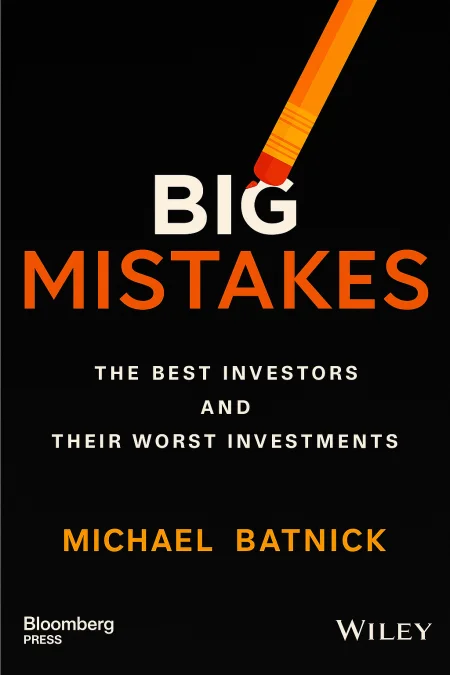
Big Mistakes
The Best Investors and Their Worst Investments
Book Edition Details
Summary
In the high-stakes arena of investment, even titans stumble. "Big Mistakes: The Best Investors and Their Worst Investments" unveils the fascinating tapestry of errors from the financial world's luminaries, including Warren Buffet and Bill Ackman. With each misstep, these legends illuminate the path to resilience, turning costly blunders into invaluable wisdom. This book isn't just a litany of failures—it's a strategic manual for navigating the turbulent markets with foresight and savvy. As you delve into these riveting tales, you'll uncover the hidden art of learning from others' misadventures, arming yourself with insights that textbooks simply can't offer. Here lies a treasure trove of strategies that transform pitfalls into stepping stones, crafted for every investor eager to refine their craft and soar.
Introduction
In the world of finance, legends are born from spectacular successes, but wisdom is often forged through spectacular failures. The greatest investors of our time—from Benjamin Graham to Warren Buffett, from Jesse Livermore to Charlie Munger—have one thing in common: they all made costly mistakes that would have destroyed lesser minds. Yet these very mistakes became the foundation stones of their eventual mastery. What separates the truly great investors from the merely lucky is not their ability to avoid errors, but their capacity to learn from them. Each mistake carries within it a lesson so powerful that it transforms not just their approach to investing, but their understanding of human nature itself. These titans of finance discovered that the market's greatest teacher is not success, but failure—and the tuition is paid in dollars lost and pride wounded. Through examining the most painful and expensive mistakes of history's most successful investors, we uncover three essential truths about building wealth: the critical importance of understanding market psychology and human behavior, the necessity of developing unshakeable discipline in the face of both fear and greed, and the profound wisdom that comes only from experiencing loss and learning to transform it into future strength. Their stumbles illuminate the path forward for anyone seeking to build lasting wealth in the unforgiving arena of financial markets.
The Pioneers: Early Lessons in Value and Risk
The early pioneers of modern investing laid the groundwork for everything we understand about markets today, but their path was littered with expensive learning experiences. Benjamin Graham, the father of value investing, lost 70% of his capital during the Great Depression despite being one of the most analytical minds of his generation. His early confidence in his ability to time markets and predict short-term movements proved disastrously misplaced. Graham's partnership suffered devastating losses from 1929 to 1932, teaching him that even the most thorough security analysis could not protect against the violent mood swings of Mr. Market. Jesse Livermore, perhaps the most famous speculator of all time, made and lost several fortunes throughout his career. His greatest mistake was believing that past success guaranteed future results. Despite earning legendary status for his prescient bets during market crashes, Livermore repeatedly fell victim to overconfidence and excessive leverage. His inability to maintain discipline during winning streaks led to four separate bankruptcies, proving that even genius-level market intuition means nothing without proper risk management. Mark Twain's investing disasters illustrate how even brilliant minds can be seduced by get-rich-quick schemes. His obsession with the Paige typesetting machine, into which he poured nearly $200,000 over many years, demonstrated the danger of falling in love with an investment. Twain's refusal to cut his losses and his tendency to throw good money after bad eventually bankrupted his publishing company and nearly destroyed his personal fortune. These pioneers learned that successful investing requires more than intelligence or market knowledge—it demands the emotional discipline to admit mistakes quickly, the wisdom to distinguish between temporary setbacks and permanent capital loss, and the humility to accept that markets will always be more powerful than any individual participant, no matter how brilliant or well-informed.
The Legends: Overconfidence and Market Hubris
The most celebrated investors of the modern era achieved their legendary status through a combination of skill, discipline, and remarkable insight. Yet their greatest mistakes often stemmed from the very confidence that made them successful. Warren Buffett's acquisition of Dexter Shoe Company for $433 million in Berkshire Hathaway stock represents one of the costliest errors in investment history. Buffett's overconfidence in his ability to assess management quality and his belief that he could predict the durability of the company's competitive advantages led him to use precious Berkshire shares for a business that would eventually become worthless. Charlie Munger's early hedge fund experienced devastating losses of over 30% in both 1973 and 1974, primarily due to his concentrated position in Blue Chip Stamps. While this concentrated approach eventually proved successful over the long term, Munger learned that even the best investments can temporarily lose favor with the market for extended periods. His experience taught him that successful investing requires not just identifying great businesses, but having the emotional fortitude to withstand severe paper losses without panicking. Michael Steinhardt's venture outside his circle of competence into European bond markets in 1994 cost his fund $800 million in just four days. After building a remarkable track record over nearly three decades by focusing on U.S. equities, Steinhardt's confidence led him to believe he could apply his skills to unfamiliar markets. The complexity of foreign exchange relationships and his lack of established relationships with European brokers left him vulnerable when markets turned against his positions. These legends discovered that overconfidence is perhaps the most expensive emotion in investing. Success breeds hubris, and hubris breeds carelessness. The very traits that enabled their rise—boldness, conviction, and willingness to act decisively—became liabilities when not tempered by humility and respect for the markets' capacity to humble even the greatest minds. Their mistakes remind us that in investing, yesterday's genius can become tomorrow's cautionary tale if pride overwhelms prudence.
The Innovators: Modern Failures and Hard Truths
Modern investment innovators have pushed the boundaries of financial theory and practice, but their cutting-edge approaches have also led to spectacular failures. John Meriwether's Long-Term Capital Management assembled some of the brightest mathematical minds in finance, including Nobel Prize winners, yet lost $4.6 billion in a matter of months. Their sophisticated models failed to account for the irrational behavior of panicked investors during the 1998 Russian crisis, proving that mathematical precision cannot capture the full complexity of human emotion under extreme stress. Stanley Druckenmiller's foray into technology stocks during the dot-com bubble represents a classic case of abandoning a proven strategy for the allure of easy profits. After building a legendary career through disciplined macro investing, Druckenmiller's fear of missing out led him to invest billions in overvalued technology companies he didn't understand. His $6 billion loss in just six weeks demonstrated that even the most successful investors can fall victim to the psychological pressure of watching others get rich in areas outside their expertise. Bill Ackman's public crusade against Herbalife illustrates the dangers of letting ego override investment discipline. By publicly committing to his short position and declaring it would go to zero, Ackman painted himself into a corner that made it nearly impossible to exit gracefully. His public statements attracted other investors who bet against him simply because they knew he couldn't easily change course, turning his investment thesis into a target for opportunistic traders. The Sequoia Fund's concentration in Valeant Pharmaceuticals shows how even time-tested strategies can lead to disaster when taken to extremes. Despite decades of successful concentrated investing, the fund's 32% position in Valeant became a catastrophic bet on a business model built on unsustainable price increases for essential medications. Their mistake wasn't in concentrating their holdings, but in failing to recognize when concentration had crossed the line into reckless speculation. These modern failures reveal that innovation in finance often comes with hidden risks that only become apparent in hindsight.
Summary
The greatest investors in history share a common thread: they transformed their most painful mistakes into their most valuable lessons. Their failures teach us that successful investing is not about avoiding errors—it's about making mistakes quickly, learning from them completely, and never repeating the same error twice. Each catastrophic loss, every moment of devastating overconfidence, and all the times they ventured outside their circle of competence became stepping stones to greater wisdom and more durable success. The path to investment mastery requires us to develop what Charlie Munger calls "temperament"—the ability to remain rational when others are losing their minds, to act decisively when others are paralyzed by fear, and to maintain humility when others are intoxicated by success. We must learn to view our mistakes not as failures but as expensive education, understanding that the tuition paid in lost capital often yields wisdom that no textbook or guru can provide. The investors profiled here ultimately succeeded not because they were infallible, but because they were brave enough to confront their failures honestly and wise enough to let those failures reshape their approach to building wealth.
Related Books
Download PDF & EPUB
To save this Black List summary for later, download the free PDF and EPUB. You can print it out, or read offline at your convenience.
By Michael Batnick
