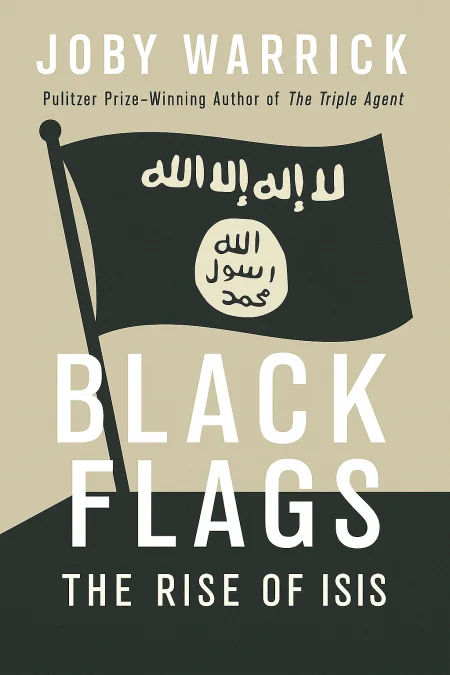
Black Flags
The Rise of ISIS
Book Edition Details
Summary
In the shadowy corridors of power, where decisions ripple across nations, one overlooked release from a Jordanian prison unwittingly ignites a wildfire of extremism. Pulitzer Prize laureate Joby Warrick delves into the chilling rise of Abu Musab al-Zarqawi, a terror architect whose ambitions outstripped even al-Qaeda. As the American invasion of Iraq brews chaos, Zarqawi seizes the moment, transforming into a symbol of resistance and spawning an insurgency that defies borders and ideologies. "Black Flags" unravels the spine-tingling saga of how a single man's dark vision birthed the monstrous entity known as ISIS. Through the eyes of intelligence operatives and the sweeping tides of history, Warrick crafts an unforgettable narrative that charts the sinister evolution of a threat that continues to haunt the modern world.
Introduction
In the scorching heat of a Jordanian prison in 1998, a muscular man with cold, reptilian eyes commanded absolute obedience from dozens of hardened criminals without uttering a single word. This was Ahmad Fadil al-Khalayleh, a petty thug from the industrial town of Zarqa who would transform himself into Abu Musab al-Zarqawi, one of history's most brutal terrorists. His journey from street criminal to the architect of modern jihadist terror reveals how a single individual's pathological ambitions can reshape entire regions and redefine the nature of warfare itself. The rise of ISIS represents more than just another terrorist organization. It embodies the convergence of ancient sectarian hatreds, modern technological capabilities, and the unintended consequences of Western intervention in the Middle East. Through Zarqawi's story, we witness how prison became a university for extremism, how American mistakes in Iraq created the perfect breeding ground for terror, and how a barely literate criminal masterminded a campaign of violence that would eventually threaten the stability of nations from Syria to France. This account illuminates three critical questions that continue to haunt our world: How do failed states become laboratories for extremism? What happens when traditional counterterrorism approaches meet an enemy that thrives on chaos? And how can democracies respond to threats that exploit their very openness and humanity? These insights prove essential for anyone seeking to understand the forces that continue to shape global security, from policymakers and military leaders to citizens trying to comprehend the world their children will inherit.
Prison University: Zarqawi's Ideological Transformation (1994-2003)
The transformation of Ahmad Fadil al-Khalayleh from a drunken street thug into the future leader of ISIS began not in the mountains of Afghanistan, but in the suffocating confines of Jordan's al-Jafr prison. Arrested in 1994 for plotting attacks against Israeli targets, Zarqawi entered a correctional system that would inadvertently become a finishing school for jihadist ideology. The Jordanian authorities, seeking to isolate dangerous Islamist prisoners, concentrated them in a single facility where they could reinforce each other's extremist beliefs and forge the bonds that would later terrorize the world. Within the prison's walls, Zarqawi encountered Abu Muhammad al-Maqdisi, a charismatic Islamic scholar whose radical interpretations of religious law provided intellectual justification for violence against Muslim rulers deemed insufficiently pious. Under Maqdisi's tutelage, Zarqawi's unfocused rage found direction and purpose. He memorized the Koran, developed a rigid worldview that divided humanity into believers and enemies, and demonstrated the leadership qualities that would later attract thousands of followers. The prison environment revealed Zarqawi's capacity for both cruelty and calculated manipulation. He brutalized inmates who crossed him while simultaneously displaying tender care for the wounded and disabled among his followers. This duality would become a hallmark of his later leadership style, inspiring fierce loyalty through a mixture of fear and paternalistic protection. More significantly, the years of confinement allowed him to study his captors, learning the weaknesses of the Jordanian security apparatus that he would later exploit with devastating effect. When King Abdullah II's 1999 amnesty unexpectedly freed Zarqawi and his fellow extremists, the Jordanian intelligence services had created their own worst nightmare. The man who entered prison as a local criminal emerged as a hardened ideologue with an international network of contacts and an unshakeable belief in his divine mission. The stage was set for a reign of terror that would eventually span continents and redefine the nature of modern warfare.
Iraq's Chaos: From Invasion to Sectarian Warfare (2003-2011)
The American invasion of Iraq in March 2003 provided Zarqawi with the opportunity he had been seeking since his release from prison. Having established a small training camp in northern Iraq's lawless mountains, he watched as Coalition forces dismantled Saddam Hussein's regime and inadvertently created the perfect conditions for insurgency. The disbanding of the Iraqi army and the wholesale purging of Baath Party members left hundreds of thousands of armed, experienced men without jobs or hope, many of whom would eventually join Zarqawi's growing movement. Zarqawi's early attacks demonstrated a strategic brilliance that belied his lack of formal education. Rather than simply targeting American forces, he methodically struck at the foundations of Iraq's reconstruction effort. His bombing of the Jordanian Embassy eliminated potential Arab support for the occupation. The devastating attack on UN headquarters drove away international humanitarian organizations and legitimized the American presence. Most crucially, his assault on Shiite religious sites during the holy day of Ashura began the sectarian war that would tear Iraq apart and create the chaos in which his organization could thrive. The kidnapping and brutal execution of American businessman Nicholas Berg in May 2004 marked Zarqawi's emergence as a global terrorist celebrity. The gruesome video of Berg's beheading, personally carried out by Zarqawi, introduced a new level of theatrical cruelty to international terrorism. Unlike previous terrorist leaders who operated from the shadows, Zarqawi embraced publicity and used the internet's growing reach to broadcast his message of uncompromising violence. By 2005, Zarqawi commanded a network of thousands of fighters and had forced even Osama bin Laden to take notice. When al-Qaeda's leadership finally offered him a formal alliance, it was clear that the student had become the master. Zarqawi's Iraq-based organization was conducting more spectacular attacks and attracting more recruits than al-Qaeda's scattered remnants. His death in a 2006 American airstrike might have ended his organization's story, but instead it marked the beginning of its transformation into something far more dangerous.
Syrian Crucible: The Birth of the Caliphate (2011-2014)
The outbreak of civil war in Syria in 2011 offered Zarqawi's heirs the chance they had been waiting for. Operating under the name Islamic State of Iraq, they established a Syrian affiliate called Jabhat al-Nusra and began carving out territory in the chaos of the collapsing state. Unlike previous terrorist organizations that operated as underground networks, the group that would become ISIS sought to control and govern territory, implementing their extreme interpretation of Islamic law and building the infrastructure of a functioning state. Under the leadership of Abu Bakr al-Baghdadi, a former American detainee who had absorbed Zarqawi's lessons about the power of extreme violence, the organization formally declared itself the Islamic State in 2014. This proclamation represented more than a change of name; it was a direct challenge to the existing international order and a claim to religious authority over all Muslims worldwide. The group's sophisticated use of social media, professional production values, and carefully choreographed brutality attracted tens of thousands of foreign fighters and inspired copycat attacks across the globe. The conquest of large swaths of Iraq and Syria, including major cities like Mosul and Raqqa, demonstrated that Zarqawi's vision of using terrorism to create a functioning Islamic state was not merely a fantasy. For the first time since the Mongol invasions of the thirteenth century, a non-state actor had successfully erased international borders and established effective control over territory the size of Great Britain. The period witnessed a fundamental shift in jihadist strategy. Where previous terrorist groups had operated as underground networks, the Islamic State began functioning as an actual government, complete with bureaucracies, taxation systems, and social services. They recruited not just fighters but engineers, doctors, and administrators. By early 2014, they controlled oil fields generating millions of dollars in revenue and possessed the military capability to challenge conventional armies. The black flags that Zarqawi had dreamed of planting across the Middle East now flew over a self-proclaimed caliphate that governed millions of people.
Black Flags Rising: ISIS's Global Terror Campaign (2014-2019)
The summer of 2014 witnessed one of the most stunning military campaigns in modern Middle Eastern history. In a matter of weeks, ISIS forces swept across northern Iraq, capturing Mosul, the country's second-largest city, and routing four Iraqi army divisions. The images of black-clad fighters parading through conquered territories in captured American military vehicles announced the arrival of a new kind of threat, one that combined medieval brutality with modern military tactics and social media savvy. Baghdadi's declaration of the caliphate from Mosul's Great Mosque in July 2014 represented the culmination of Zarqawi's original vision. For the first time since the collapse of the Ottoman Empire, a group claiming to represent all Muslims controlled significant territory and governed millions of people. The psychological impact was enormous, inspiring lone-wolf attacks across Europe and North America while drawing thousands of foreign fighters to Syria and Iraq. The group's governance model revealed the practical implications of their extremist ideology. In cities like Raqqa, ISIS implemented a totalitarian system that regulated every aspect of daily life, from mandatory prayer attendance to restrictions on women's movement. Public executions, crucifixions, and beheadings became routine spectacles designed to terrorize the population into submission. Yet the organization also provided basic services, maintained infrastructure, and created a functioning economy based on oil sales and taxation. The international response evolved slowly from dismissive contempt to genuine alarm. The burning alive of Jordanian pilot Muath al-Kasasbeh in early 2015 marked a turning point, galvanizing Arab opinion against the group and demonstrating that their brutality had finally exceeded even their supporters' tolerance for violence. This period established ISIS as the dominant brand in global jihadism, eclipsing al-Qaeda and inspiring affiliate groups across Africa, Asia, and beyond. The ultimate defeat of ISIS's territorial caliphate in 2019 marked the end of one chapter, but their influence on global terrorism continues to shape threats worldwide.
Summary
The story of Abu Musab al-Zarqawi and the rise of ISIS illuminates the central paradox of modern counterterrorism: the very actions taken to defeat terrorist organizations often create the conditions for their evolution and spread. Zarqawi's transformation from petty criminal to global terrorist leader was facilitated by well-intentioned but misguided policies, from the concentration of extremist prisoners in Jordan to the wholesale dismantling of Iraqi state institutions. Each attempt to contain the threat only provided new opportunities for it to metastasize and adapt. The enduring legacy of Zarqawi's innovations demands a fundamental rethinking of how democratic societies respond to extremist threats. First, policymakers must recognize that military solutions alone cannot address problems rooted in political grievances, social marginalization, and ideological conviction. Second, the international community must develop more sophisticated approaches to post-conflict reconstruction that avoid creating the power vacuums in which extremist movements flourish. Finally, societies must strengthen their resilience against terrorist propaganda while preserving the open, pluralistic values that make them worth defending. The battle against the ideas that Zarqawi unleashed will likely continue for generations, requiring sustained commitment to both security measures and the patient work of building more just and inclusive societies that offer alternatives to the apocalyptic visions of extremist movements.
Related Books
Download PDF & EPUB
To save this Black List summary for later, download the free PDF and EPUB. You can print it out, or read offline at your convenience.
By Joby Warrick
