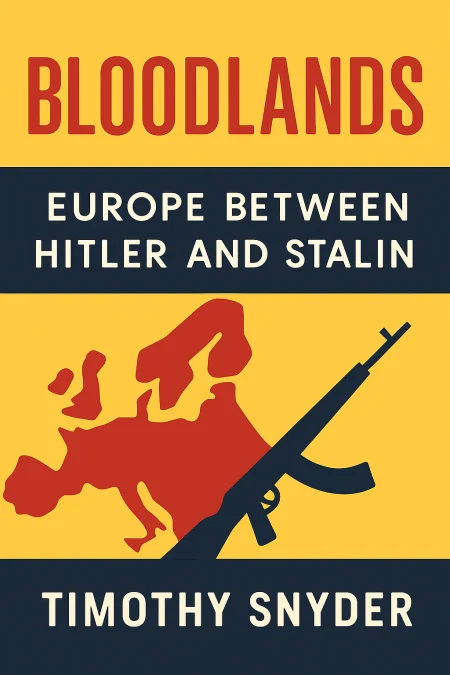
Bloodlands
Europe Between Hitler and Stalin
Book Edition Details
Summary
In the shadowy expanse between Nazi Germany and Stalin's Soviet Union lies a haunting territory soaked in untold suffering. Timothy Snyder's "Bloodlands" illuminates this dark epoch where, under the iron grips of two ruthless dictators, millions met their tragic end. Snyder's narrative masterfully intertwines the stories of those caught between Stalin's collectivization and Hitler's genocidal ambitions, painting a vivid tableau of humanity amidst the chaos. With meticulous research and poignant storytelling, this book challenges the simplistic dichotomy of "good" and "evil" in wartime rhetoric. It beckons readers to confront the raw truths of history, offering a profound exploration of the atrocities that unfolded in these lands, and remains an essential read for anyone seeking to grasp the true horror of mid-20th century Europe.
Introduction
Between 1933 and 1945, fourteen million civilians perished in a zone of systematic killing that stretched from central Poland to western Russia. This was not the random violence of warfare, but the calculated implementation of policies designed to eliminate entire populations through starvation, shooting, and gassing. The victims were teachers, farmers, children, and families—ordinary people caught between two totalitarian machines that viewed human life as expendable in pursuit of their revolutionary visions. This extraordinary history reveals how Nazi Germany and the Soviet Union, despite their ideological hatred for each other, developed remarkably similar approaches to mass murder and social engineering. Their competition for the same territories created a deadly dynamic where each regime's violence enabled and escalated the other's crimes. The bloodlands became a laboratory for testing how modern states could mobilize bureaucracy, technology, and ideology to commit genocide on an unprecedented scale. Understanding these events offers crucial insights for anyone seeking to comprehend the mechanics of mass atrocity, the vulnerability of democratic institutions, and the warning signs that precede societal collapse. The lessons drawn from this dark chapter remain painfully relevant as contemporary authoritarian movements employ similar tactics of dehumanization, scapegoating, and systematic violence against targeted populations.
Soviet Terror and Ukrainian Famine (1932-1938)
The bloodlands story begins with Stalin's war against his own people, particularly the deliberate starvation of Soviet Ukraine between 1932 and 1933. Stalin's collectivization campaign had encountered fierce peasant resistance, and his response was to weaponize hunger itself as a tool of political control. Soviet authorities confiscated grain, blocked food deliveries, and sealed Ukraine's borders to prevent starving peasants from seeking help elsewhere. The resulting famine killed approximately 3.3 million Ukrainians in what became known as the Holodomor. Entire villages disappeared as families consumed everything edible, then turned to bark, grass, and finally cannibalism. Children's bodies swelled with hunger before they died in their mothers' arms. This was not natural disaster but calculated murder, designed to break peasant resistance and eliminate Ukrainian national consciousness. The Great Terror of 1937-1938 expanded this logic of elimination beyond class enemies to include entire ethnic groups. Stalin's security apparatus systematically murdered nearly 750,000 Soviet citizens, targeting not only political opponents but also national minorities deemed potentially disloyal. The Polish operation alone killed over 100,000 people, making Soviet Poles statistically more likely to die than any other group in the USSR. These early Soviet policies established the fundamental template that would govern the bloodlands: that entire categories of people could be declared enemies of progress and eliminated without moral consequence. Stalin had demonstrated that modern states possessed unprecedented power to kill their own citizens, and that ideological conviction could override basic human sympathy. The techniques developed in Ukraine would soon inspire even greater crimes as Hitler rose to power in Germany.
Nazi-Soviet Collaboration and Polish Destruction (1939-1941)
The signing of the Molotov-Ribbentrop Pact in August 1939 created history's most deadly partnership. Two ideological enemies discovered they could cooperate in destroying the states and peoples that lay between them. Poland, caught between these totalitarian giants, became the first victim of their coordinated assault and a testing ground for techniques of mass murder and population control. When German and Soviet forces jointly invaded Poland in September 1939, they initiated synchronized campaigns to eliminate Polish independence permanently. Both occupiers understood that destroying Poland required more than military conquest—it demanded the systematic elimination of Polish leadership and cultural institutions. The Germans launched operations targeting intellectuals, clergy, and political leaders, while the Soviets deported hundreds of thousands of Polish citizens to remote regions of the USSR. The Katyn massacre of 1940 exemplified this collaborative destruction. Soviet forces murdered approximately 22,000 Polish prisoners of war, including military officers and intellectuals, in a calculated effort to decapitate Polish society. This mass execution, carried out with bureaucratic precision, demonstrated how the Soviet system had perfected industrial-scale killing that paralleled Nazi methods while serving different ideological goals. During this period of cooperation, both regimes refined their approaches to ethnic cleansing and social engineering. The destruction of Poland eliminated a buffer state that had long frustrated both powers while providing valuable lessons in the logistics of genocide. The alliance revealed how totalitarian systems could cooperate when their interests converged, setting dangerous precedents for the even greater horrors that would follow when the partners inevitably turned against each other.
The Holocaust and Eastern Front War (1941-1944)
Hitler's invasion of the Soviet Union in June 1941 transformed the bloodlands into the primary theater of Nazi genocide. Operation Barbarossa was conceived not merely as military conquest but as a war of racial extermination designed to eliminate Jewish and Slavic populations to make room for German colonization. The scale and systematic nature of the killing that followed represented the culmination of Nazi ideological goals and the perfection of industrial murder. The Holocaust in the bloodlands differed fundamentally from the concentration camp system that dominates popular memory. Here, most Jewish victims were murdered by shooting rather than gassing, killed in their home communities rather than distant camps. Einsatzgruppen death squads, supported by local collaborators and German police battalions, systematically murdered entire Jewish communities across occupied Soviet territory. At Babi Yar alone, over 33,000 Jews were shot in two days, their bodies thrown into a ravine that became a symbol of the Holocaust's eastern character. Simultaneously, the German hunger plan sought to starve thirty million Slavs to death to redirect food supplies westward. German forces deliberately starved Soviet prisoners of war, allowed civilian populations to perish from hunger, and destroyed agricultural infrastructure to create artificial famines. This systematic starvation campaign killed approximately 3.3 million Soviet prisoners of war and countless civilians, demonstrating how modern warfare could be weaponized for genocidal purposes. As the war turned against Germany, the pace of killing intensified rather than diminished. The construction of death camps like Treblinka and Sobibor represented the industrialization of murder, capable of killing thousands daily with assembly-line efficiency. These facilities processed primarily Polish Jews but also victims from across Nazi-occupied Europe, making the bloodlands the epicenter of the Final Solution's most deadly phase and revealing how quickly systematic murder could be scaled to continental proportions.
Ethnic Cleansing and Stalinist Antisemitism (1944-1953)
The Soviet reconquest of the bloodlands initiated a new phase of population engineering that would reshape the region's ethnic composition permanently. As the Red Army pushed westward, Stalin implemented massive deportation programs targeting entire ethnic groups deemed potentially disloyal. Germans, Poles, Ukrainians, and other minorities found themselves uprooted from ancestral lands and scattered across the Soviet Union's vast territories in cattle cars reminiscent of Nazi deportations. The postwar settlement involved unprecedented population transfers that affected millions of people across Eastern Europe. The expulsion of Germans from Poland and Czechoslovakia, the deportation of Ukrainians from Poland to Soviet Ukraine, and the forced resettlement of various ethnic groups represented a continent-wide experiment in ethnic homogenization. These transfers, often conducted in brutal conditions with massive mortality rates, demonstrated how the war's end brought not peace but new forms of organized violence against civilian populations. Stalin's growing antisemitism in his final years created a new category of victims within the bloodlands. The murder of Jewish intellectuals, the suppression of Jewish culture, and the planned deportation of Soviet Jews revealed how even victory over Nazi Germany did not end the targeting of Jewish populations. The Doctors' Plot of 1953, which falsely accused Jewish physicians of plotting to murder Soviet leaders, suggested that Stalin was preparing another massive purge before his death intervened. The establishment of communist regimes across Eastern Europe extended Stalinist methods of control throughout the former bloodlands. Show trials, forced confessions, and the systematic elimination of potential opposition created new waves of political terror that continued well into the 1950s. Countries like Poland and Czechoslovakia experienced their own versions of Stalinist purges, often targeting Jewish communists and intellectuals in campaigns that demonstrated how the techniques of mass murder had become standard tools of totalitarian governance.
Summary
The history of the bloodlands reveals how two totalitarian systems, despite their ideological differences, developed remarkably similar approaches to mass murder and population control. Both Nazi Germany and the Soviet Union treated human beings as raw material for social engineering projects, whether racial purification or socialist transformation. Their competition for the same territories intensified the violence, creating a deadly dynamic where each regime's actions enabled and encouraged the other's crimes, ultimately consuming fourteen million civilian lives. The systematic nature of these killings, carried out by modern bureaucratic states using advanced organizational methods, demonstrates how quickly civilized societies can descend into barbarism when citizens abandon their responsibility to protect human dignity. The perpetrators were not monsters but ordinary people who became complicit in extraordinary evil through ideological conviction, bureaucratic routine, and social pressure. Understanding this transformation is essential for recognizing similar patterns in contemporary authoritarian movements. Today's world faces renewed challenges from regimes that echo the bloodlands' darkest lessons through the manipulation of ethnic tensions, the systematic dehumanization of targeted groups, and the use of artificial scarcity as political weapons. The memory of these fourteen million victims demands not only remembrance but active commitment to defending democratic institutions before they are weakened beyond repair, resisting the dehumanization of any group regardless of political convenience, and remembering that the choice between civilization and barbarism is made daily through countless individual decisions to uphold or abandon our common humanity.
Related Books
Download PDF & EPUB
To save this Black List summary for later, download the free PDF and EPUB. You can print it out, or read offline at your convenience.
By Timothy Snyder
