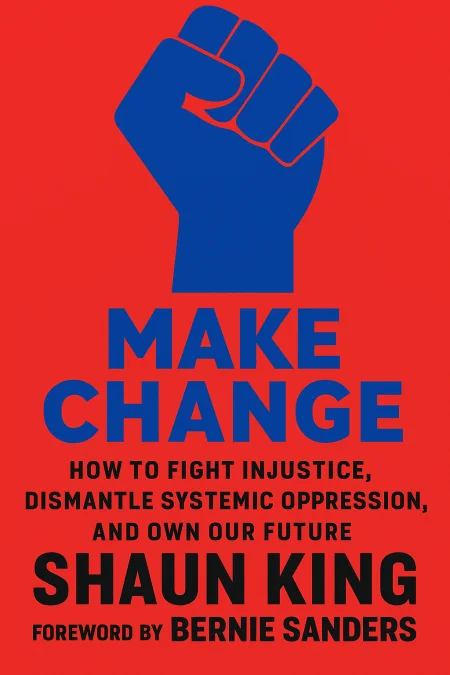
Make Change
How to Fight Injustice, Dismantle Systemic Oppression, and Own Our Future
Book Edition Details
Summary
In a world teetering on the edge of social upheaval, Shaun King emerges not just as a voice, but as a clarion call for justice. "Make Change" is his riveting manifesto, a testament to the power of activism grounded in both unyielding passion and meticulous research. King chronicles his journey through the turbulent waters of modern civil rights, sharing the hard-won victories and gut-wrenching setbacks that have defined his path. From leading campaigns like Raise the Age to confronting police brutality head-on, this book isn't just a recounting—it's a blueprint for action. King skillfully weaves personal narratives with practical strategies, offering readers a lifeline in the chaotic storm of political and social turmoil. For anyone yearning to effect real change, this is your roadmap to resilience and revolution.
Introduction
The gap between moral outrage and meaningful change has never been wider. While millions express righteous anger at injustice through social media posts and protests, systemic problems persist with stubborn resilience. This disconnect reveals a fundamental misunderstanding about how transformative change actually occurs in practice. The assumption that being morally right automatically translates to political victory has led countless well-intentioned movements to exhaust their energy without achieving their goals. The challenge lies not in identifying what needs fixing, but in understanding why good intentions consistently fail to dismantle entrenched systems of oppression. Through examining successful and failed organizing efforts across different contexts, a clearer picture emerges of the specific elements required to interrupt the status quo. The path from individual awakening to collective action to structural transformation follows identifiable patterns that can be studied, replicated, and refined. This exploration draws from frontline organizing experiences to reveal how energy without strategy becomes mere performance, how passion without structure dissipates into frustration, and how moral clarity without tactical sophistication enables the very systems it seeks to challenge. The journey ahead traces the evolution from reactive responses to proactive campaigns, ultimately revealing why sustainable change demands far more than righteousness alone.
The Historical Pattern: Why Energy Alone Cannot Break Oppressive Systems
History moves not in steady upward progression but in dramatic peaks and valleys, with periods of remarkable human progress inevitably followed by steep descents into cruelty and regression. This cyclical pattern challenges the comfortable assumption that civilization naturally evolves toward greater justice and equality over time. Instead, human societies oscillate between their highest and lowest impulses, with technological advancement masking the persistence of ancient forms of oppression. The aftermath of major social breakthroughs consistently triggers powerful backlash from entrenched interests. The end of slavery precipitated the lynching epidemic of the Jim Crow era. The civil rights victories of the 1960s enabled the mass incarceration explosion that began under Nixon. The election of the first Black president activated dormant white nationalist movements that eventually captured mainstream political power. These patterns reveal how progress threatens established hierarchies, provoking systematic efforts to restore previous arrangements of power. Understanding these historical cycles explains why energized movements often encounter seemingly impenetrable resistance from institutions that appear unmovable despite overwhelming public pressure. The systems designed to maintain inequality possess built-in mechanisms for weathering social storms while preserving their fundamental operations. Protest energy, however intense, eventually dissipates without structural changes to the underlying arrangements that generate injustice. The lesson emerges clearly: moral energy represents the necessary spark for social change, but sparks alone cannot sustain the prolonged effort required to dismantle and rebuild entrenched systems. Energy must evolve into something more durable, more strategic, and more structurally sophisticated to achieve lasting transformation rather than temporary disruption.
The Three Pillars: Energized People, Strategic Organization, and Sophisticated Plans
Sustainable social change rests on three interdependent foundations that must function simultaneously to break through the barriers protecting unjust systems. Energized people provide the essential force that interrupts business as usual, creating openings for transformation that would otherwise remain sealed. This energy emerges from collective outrage, hope, and determination, but requires careful cultivation to avoid burning out before achieving concrete victories. Strategic organization transforms scattered individual energy into coordinated collective power capable of sustained pressure on multiple fronts simultaneously. Effective organization moves beyond simple mobilization to create deep relationships among participants, develop their diverse skills and resources, and establish clear roles that maximize each person's contribution to shared goals. The invisible infrastructure of successful movements includes countless behind-the-scenes conversations, planning meetings, and relationship-building efforts that rarely receive public attention but determine ultimate success or failure. Sophisticated plans provide the roadmap for translating energy and organization into specific policy changes, electoral victories, or institutional reforms. These plans must match the complexity of the systems they seek to change, incorporating detailed analysis of decision-making processes, key stakeholders, potential obstacles, and multiple contingency scenarios. Plans serve as living documents that evolve through experience while maintaining clear focus on measurable outcomes rather than symbolic gestures. When all three pillars operate together, they create the conditions for breakthrough moments when seemingly impossible changes become inevitable. The absence of any single pillar typically results in well-intentioned efforts that generate temporary attention but leave underlying structures intact. The interplay between energy, organization, and planning enables movements to sustain momentum through inevitable setbacks while building toward transformative victories.
Beyond Good Intentions: Why Moral Righteousness Must Meet Political Strategy
The seductive belief that moral superiority alone guarantees political victory has undermined countless social justice efforts throughout history. Being right about the diagnosis of social problems provides necessary clarity about what needs changing, but offers little guidance about how to overcome the specific obstacles protecting unjust arrangements. The gap between moral clarity and strategic effectiveness explains why passionate movements often find themselves repeatedly defeated by less righteous but better organized opponents. Political strategy requires honest assessment of existing power relationships, identification of persuadable constituencies, and development of messaging that speaks to people's immediate interests rather than abstract principles. This tactical orientation sometimes conflicts with moral purity, demanding compromises that feel uncomfortable to ideologically committed activists. However, strategic thinking enables movements to build the broad coalitions necessary to overcome entrenched opposition rather than remaining isolated within ideological echo chambers. The most effective campaigns combine moral conviction with tactical flexibility, maintaining clear ethical boundaries while adapting their approaches based on changing circumstances and new information about what works in practice. This balance requires distinguishing between core principles that cannot be compromised and tactical decisions that should be evaluated solely on their contribution to achieving stated goals. Strategic sophistication includes learning from failures, incorporating diverse perspectives, and remaining focused on concrete outcomes rather than symbolic victories. Understanding the difference between being right and being effective liberates movements from the paralysis of perfectionism while maintaining accountability to the communities most affected by injustice. The goal becomes not just expressing correct positions but building sufficient power to implement solutions that materially improve people's lives and prevent future harm.
Sustaining the Movement: Personal Resilience and Collective Responsibility
The work of challenging entrenched systems extracts enormous personal costs from those who commit themselves fully to social change. Constant exposure to injustice, trauma, and institutional resistance creates cumulative psychological burdens that can overwhelm even the most dedicated activists. The intensity required for breakthrough moments cannot be sustained indefinitely without explicit attention to individual and collective well-being throughout extended campaigns. Personal resilience emerges from practices that maintain psychological balance, physical health, and emotional connections despite the draining nature of justice work. This includes establishing boundaries around availability and emotional labor, cultivating relationships outside movement spaces, and engaging in activities that restore rather than deplete personal energy reserves. The false choice between self-care and movement commitment undermines long-term effectiveness by burning out potential leaders before they can develop the experience necessary for strategic thinking. Collective responsibility involves creating movement cultures that support sustained engagement rather than glorifying exhaustion and burnout as signs of dedication. Organizations must develop structures for sharing leadership responsibilities, providing mutual support during difficult periods, and celebrating incremental progress alongside major victories. The most resilient movements create environments where people can contribute meaningfully over decades rather than months. The ultimate sustainability challenge involves building institutional capacity that outlasts individual involvement, ensuring that hard-won progress continues even when specific leaders step back or move on to other priorities. This requires training new leaders, documenting successful strategies, and establishing organizational systems that function independently of any particular personality or charismatic figure. Sustainable change demands both individual resilience and collective structures designed for long-term effectiveness.
Summary
The fundamental insight driving effective social change lies in recognizing that moral outrage, while necessary, remains insufficient for dismantling systems specifically designed to resist transformation. Historical analysis reveals that energy without strategic organization and sophisticated planning consistently fails to achieve lasting structural change, regardless of the righteousness of the cause or intensity of public sentiment. The three pillars of sustainable transformation must operate simultaneously, creating the conditions for breakthrough moments when seemingly impossible changes become politically inevitable through coordinated pressure applied strategically over time. This framework challenges movements to evolve beyond reactive responses toward proactive campaigns that build the institutional capacity necessary for long-term victory rather than temporary disruption. The path forward requires balancing moral conviction with tactical flexibility, maintaining focus on concrete outcomes while sustaining the personal and collective resilience needed for extended struggle against entrenched opposition.
Related Books
Download PDF & EPUB
To save this Black List summary for later, download the free PDF and EPUB. You can print it out, or read offline at your convenience.

By Bernie Sanders
