
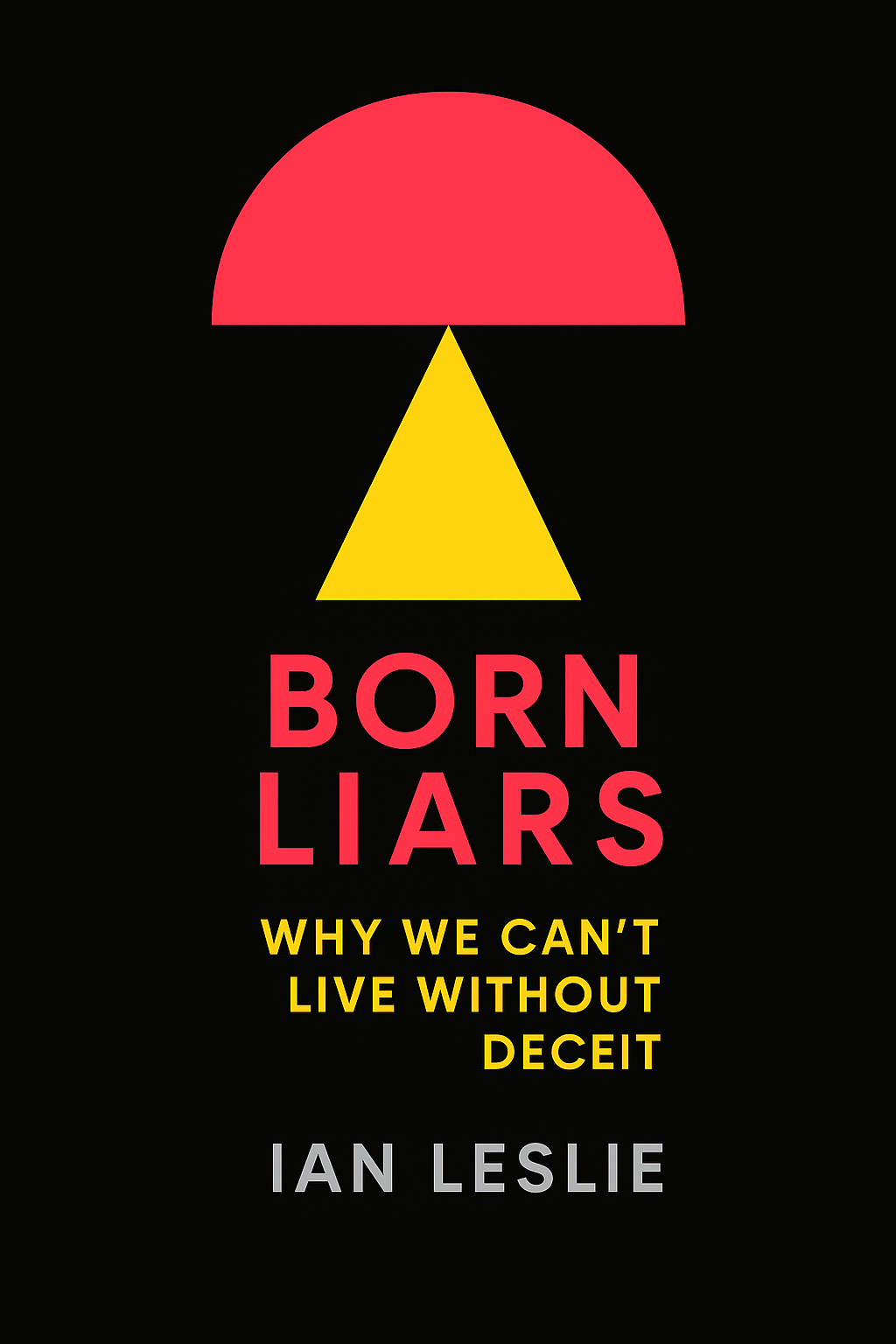
Born Liars
Why We Can’t Live Without Deceit
Book Edition Details
Summary
Liars aren't just born—they're crafted through the intricate dance of human nature. Ian Leslie's "Born Liars" shatters the illusion of honesty as a purely virtuous ideal, proposing instead that deception is woven into the very fabric of our being. This isn't a lamentation of morality but an exploration of how fibs and fabrications fuel creativity, survival, and societal advancement. Leslie's narrative sweeps through history and psychology, unearthing the surprising utility of lies in art, politics, and personal identity. From clandestine operations to the deceit within our own minds, each tale challenges the reader to reconsider the thin line between truth and fabrication. With a mix of historical anecdotes and modern insights, "Born Liars" compels us to question not only our own truths but the very nature of truth itself.
Introduction
The capacity for deception fundamentally shapes human experience in ways most people rarely consider. From the moment children develop language, they begin crafting untruths with remarkable sophistication, yet society consistently condemns lying while simultaneously depending on it for social cohesion. This paradox reveals something profound about human nature: deception is not merely a moral failing but an essential component of consciousness, creativity, and civilization itself. The exploration that follows challenges the conventional wisdom that truthfulness represents humanity's highest virtue while lies constitute corruption of our better angels. Instead, evidence from evolutionary biology, neuroscience, and social psychology suggests that the ability to deceive—both others and ourselves—enabled our species to develop complex societies, artistic expression, and even medical healing. The analysis proceeds through examining how deception evolved as a survival mechanism, how it operates within individual psychology, and how various forms of beneficial dishonesty sustain human relationships and institutions. Understanding deception requires moving beyond simple moral categories to examine the intricate ways truth and falsehood interweave throughout human experience. The investigation ahead reveals that effective living demands not the elimination of deception, but rather the cultivation of wisdom about when and how different forms of dishonesty serve essential functions in maintaining both individual well-being and social stability.
The Evolutionary Origins and Cognitive Development of Human Deception
Human beings possess an unparalleled capacity for deception that distinguishes us from all other species, including our closest evolutionary relatives. While other animals engage in various forms of camouflage and misdirection, only humans can create elaborate fictional narratives and convince themselves of their veracity. This sophisticated ability to lie emerged through millions of years of evolutionary pressure, developing alongside our exceptional intelligence and complex social structures. The "social brain hypothesis" provides compelling evidence that deception drove human cognitive evolution. As early human groups became larger and more complex, survival increasingly depended on the ability to navigate intricate social relationships involving cooperation, competition, and manipulation. Those individuals who could most effectively deceive others while detecting deception in return gained significant advantages in securing resources, attracting mates, and avoiding threats. This created an evolutionary arms race where increasingly sophisticated deceptive abilities were matched by increasingly refined detection mechanisms. Research on primate behavior reveals that deceptive ability correlates directly with brain size, particularly the neocortex region responsible for higher-order thinking. Great apes demonstrate tactical deception through elaborate schemes involving misdirection, concealment, and even recruitment of allies to achieve deceptive goals. However, human deception transcends these primitive forms through our unique capacity for language, which detached communication from immediate physical reality and enabled infinitely more complex and abstract forms of falsehood. Children's developmental progression from simple defensive lies around age three to sophisticated strategic deception by age four demonstrates that lying requires advanced cognitive abilities including theory of mind, executive function, and creative imagination. The capacity to understand that others hold different beliefs, to manage multiple mental processes simultaneously, and to envision alternative versions of reality represents one of humanity's most remarkable intellectual achievements. Rather than viewing early childhood lying as moral corruption, recognizing it as cognitive sophistication offers insight into the fundamental role deception plays in human mental development.
Self-Deception as a Fundamental Feature of Human Psychology
The human brain constructs reality through active interpretation rather than passive reception, creating what neuroscientists describe as "controlled fantasy" that guides perception, memory, and decision-making. From the basic level of visual processing, where the brain fills gaps and smooths inconsistencies to create coherent images, to complex emotional responses shaped by expectations and beliefs, human consciousness operates through sophisticated self-deceptive mechanisms that prioritize psychological utility over objective accuracy. Scientific investigation reveals that people systematically maintain unrealistically positive views of themselves, their capabilities, and their futures. These "positive illusions" manifest in three primary domains: inflated self-regard, unrealistic optimism, and exaggerated sense of personal control. Rather than representing cognitive errors, these self-deceptive tendencies appear essential for psychological health, motivation, and social functioning. Individuals who lack such positive biases—those who see themselves and their prospects more accurately—demonstrate higher rates of depression and anxiety. The phenomenon extends beyond individual psychology into the realm of memory and decision-making. Research demonstrates that people routinely construct post-hoc explanations for their actions and emotions, creating coherent narratives that may bear little resemblance to the actual causes of their behavior. The brain's "interpreter module" continuously generates plausible stories to explain experiences, even when those explanations are demonstrably false. This ongoing process of confabulation helps maintain psychological coherence and enables effective action despite uncertainty and complexity. Self-deception proves particularly valuable in contexts requiring confidence and persistence despite objective challenges. Studies of athletes, students, and entrepreneurs reveal that those with greater capacity for positive self-deception achieve superior performance outcomes. The ability to maintain optimistic beliefs in the face of setbacks enables individuals to persevere through difficulties that would otherwise prove overwhelming. However, this adaptive capacity becomes maladaptive when positive illusions become completely disconnected from reality, transforming from beneficial self-enhancement into dangerous delusion.
The Beneficial Functions of Lies in Medicine, Society and Relationships
Medical practice provides perhaps the clearest illustration of deception's therapeutic potential through the well-documented placebo effect. Patients who believe they are receiving effective treatment often experience genuine physiological improvements, even when receiving inert substances or sham procedures. This phenomenon demonstrates that the act of being treated can be as important as the specific medical intervention, challenging the traditional biomedical model that views only active pharmaceutical ingredients as legitimate healing agents. The placebo effect operates through complex interactions between belief, expectation, and biochemical processes. When patients trust their physicians and believe in their treatments, their bodies activate natural healing mechanisms including immune responses, pain management systems, and mood regulation pathways. The therapeutic encounter itself—with its cultural symbols of authority, scientific equipment, and healing rituals—creates meaning that translates into measurable biological changes. This suggests that effective medicine requires attention to psychological and social factors alongside purely technical interventions. Social relationships similarly depend on various forms of beneficial deception to maintain harmony and function. "White lies" enable people to navigate complex interpersonal situations without causing unnecessary pain or offense while preserving important relationships. These socially sanctioned deceptions include polite expressions of interest, diplomatic responses to difficult questions, and tactful omissions of hurtful truths. Such practices reflect sophisticated social intelligence that prioritizes collective well-being over rigid adherence to literal truth-telling. Different cultures maintain varying standards for acceptable deception, suggesting that lying serves essential functions in social organization. Societies that emphasize individual achievement tend to condemn self-promotional deception while accepting competitive misdirection, whereas cultures prioritizing group harmony approve deception that preserves collective face while condemning lies that threaten social cohesion. These variations indicate that appropriate deception reflects deeper cultural values about the relationship between individual expression and communal responsibility.
Toward an Honest Understanding of Necessary Dishonesty
Recognizing deception as fundamental to human nature does not eliminate moral considerations but rather requires more nuanced ethical frameworks that acknowledge the complexity of truthfulness in lived experience. The traditional binary opposition between truth and falsehood proves inadequate for navigating situations where competing obligations create irreconcilable conflicts between honesty and other moral values such as compassion, loyalty, or justice. Effective lie detection depends less on identifying universal behavioral signals than on understanding context, relationships, and motivations. Professional investigators achieve better results by increasing cognitive demands on suspected liars rather than searching for stereotypical signs of deception. Similarly, creating social environments that reward honesty while acknowledging legitimate needs for privacy and face-saving proves more effective than punitive approaches that drive deception underground. The implications extend to democratic governance, where citizens must balance their desire for transparent leadership with recognition that political effectiveness sometimes requires strategic ambiguity or diplomatic misdirection. Demanding perfect honesty from public figures may paradoxically result in less trustworthy leadership by selecting for individuals skilled at concealing their deceptions rather than those who acknowledge the occasional necessity of strategic communication. Perhaps most importantly, accepting the universality of deception enables more authentic self-awareness and more compassionate interpersonal relationships. Rather than maintaining the fiction that some people are inherently honest while others are liars, recognizing that everyone engages in various forms of deception under different circumstances allows for more realistic expectations and more forgiving responses to human fallibility. This perspective suggests that true honesty lies not in eliminating deception but in developing wisdom about when truth serves genuine human needs and when other values take precedence.
Summary
The exploration of deception reveals that lying represents not a corruption of human nature but rather one of its most essential and sophisticated expressions, enabling everything from individual psychological health to complex social cooperation and even medical healing. The capacity for self-deception allows people to maintain optimism and motivation in the face of uncertainty, while social deception facilitates the delicate negotiations required for community life, and even therapeutic deception can mobilize powerful healing responses through the placebo effect. Rather than viewing honesty and deception as moral opposites, wisdom lies in understanding that human flourishing requires both truth-telling and strategic dishonesty, deployed with discernment and compassion in service of deeper values including kindness, loyalty, and the preservation of hope.
Related Books
Download PDF & EPUB
To save this Black List summary for later, download the free PDF and EPUB. You can print it out, or read offline at your convenience.
By Ian Leslie
