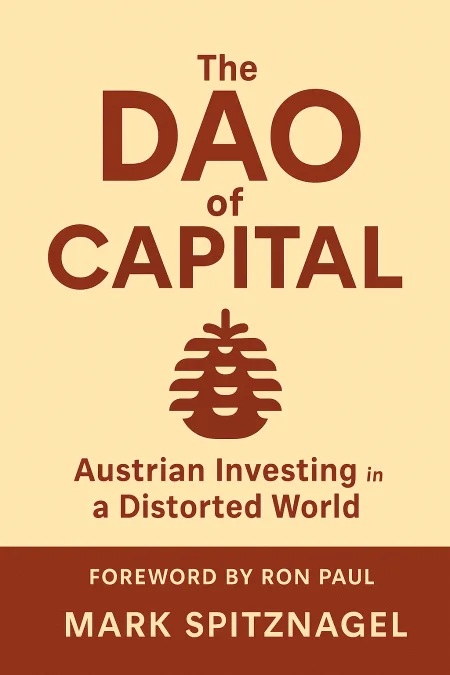
The Dao of Capital
Austrian Investing in a Distorted World
Book Edition Details
Summary
A financial maverick’s odyssey unfolds as Mark Spitznagel, a visionary of modern investing, transforms ancient wisdom into strategic genius. In "The Dao of Capital," Spitznagel navigates an intricate tapestry woven from the bustling Chicago pits, the enigmatic forests of China, and the philosophical corridors of 19th-century Austria. This is not merely a tale of economic conquest but a philosophical expedition where Spitznagel, armed with the principles of the Austrian School, teaches us the art of the 'roundabout'—a radical dance where retreat is a step toward triumph. He challenges the frenetic pulse of the markets with the calm precision of a Daoist sage, inviting readers to rethink time and value. Witness how the subtlety of losing to gain becomes a masterpiece of financial strategy, offering an uncharted path to wealth that resonates with timeless harmony.
Introduction
Contemporary financial markets operate under a fundamental delusion that direct approaches to wealth creation represent the pinnacle of efficiency and sophistication. This mechanistic worldview, reinforced by mathematical models and quantitative analysis, systematically ignores the profound strategic principle that has guided successful endeavors across millennia: the roundabout path often proves superior to the direct route. The convergence of ancient Eastern strategic wisdom with Austrian economic theory reveals why this counterintuitive approach consistently outperforms conventional methods in complex, dynamic systems. The Austrian school's revolutionary insights about capital structure, time preference, and market processes provide the theoretical foundation for understanding why indirect methods of production and investment generate superior long-term results. When combined with strategic principles derived from military theory and natural systems, these economic concepts illuminate the temporal dimension of wealth creation that mainstream finance theory completely overlooks. The synthesis challenges the prevailing obsession with immediate returns and quarterly performance metrics that dominate modern investment thinking. The exploration ahead demonstrates how this integrated framework transforms investment from speculation about future prices into strategic positioning based on understanding underlying economic forces. Through rigorous analysis of market homeostasis, monetary distortion, and the cyclical nature of economic development, the discussion reveals practical applications that enable investors to work with natural market processes rather than against them. The journey requires abandoning comfortable assumptions about efficiency and embracing the disciplined patience that genuine strategic advantage demands.
Ancient Wisdom Meets Austrian Theory: The Roundabout Production Principle
The philosophical foundations of strategic indirection emerge from humanity's oldest wisdom traditions, where apparent weakness becomes the source of ultimate strength through superior positioning and timing. Ancient Chinese military strategists understood that direct confrontation often represents the least effective path to victory, while circuitous approaches that appear inefficient create decisive advantages through careful preparation and resource allocation. This principle transcends its military origins to illuminate universal patterns governing all complex systems where time and positioning determine outcomes. Austrian economic theory revolutionizes this ancient wisdom through the concept of roundabout production, demonstrating that the most productive methods invariably require longer completion times and more complex arrangements of capital goods. Böhm-Bawerk's analysis reveals why Robinson Crusoe achieves greater fishing success by first building nets and boats rather than catching fish directly with his hands. The temporary sacrifice of immediate fish consumption while constructing tools enables dramatically increased future productivity that direct methods could never achieve. The Austrian understanding of capital as fundamentally temporal rather than merely physical provides the theoretical framework for comprehending why roundabout approaches succeed. Capital represents not just tools and machinery, but the entire hierarchical structure of production stages that transform raw materials into consumer goods over extended periods. Each stage serves the next in temporal sequence, creating a complex coordination problem that requires entrepreneurial judgment rather than mathematical optimization to solve effectively. This temporal dimension reveals why purely quantitative approaches to investment consistently fail to capture the essence of productive activity. Mathematical models treat capital as homogeneous and ignore the time structure that gives capital its productive power. Understanding investment as positioning within this temporal hierarchy of production stages provides insight into which opportunities represent genuine wealth creation versus those that merely redistribute existing resources without adding productive value to the economic system.
Market Homeostasis vs Monetary Intervention: The Distortion Critique
Natural market processes exhibit sophisticated homeostatic characteristics that automatically correct imbalances through negative feedback mechanisms, much like biological systems that maintain stable internal conditions despite external disturbances. The price system functions as the nervous system of this economic organism, transmitting information about relative scarcities and consumer preferences throughout the network while coordinating the actions of millions of individuals who possess only fragmentary knowledge of overall conditions. Entrepreneurial profit and loss serve as the primary feedback mechanisms that guide this self-regulating system toward equilibrium. Successful entrepreneurs who accurately anticipate consumer preferences and efficiently allocate resources earn profits that signal the value of their contributions, while those who misallocate resources suffer losses that redirect capital toward more productive uses. This continuous process of selection and adaptation enables markets to discover optimal resource allocation patterns without central planning or conscious design. Government intervention systematically disrupts these natural feedback mechanisms by preventing prices from adjusting to market conditions and insulating decision-makers from the consequences of their actions. Central bank manipulation of interest rates breaks the crucial link between genuine time preferences and investment decisions, sending false signals throughout the economy about resource availability and consumer preferences. When governments bail out failing enterprises, they eliminate the selection pressure that weeds out inefficient practices and prevents the system from learning from its mistakes. The Austrian theory of the business cycle explains how credit expansion creates systematic distortions throughout the capital structure that must eventually be corrected through economic recession. Artificially low interest rates encourage entrepreneurs to undertake longer-term projects while simultaneously encouraging consumers to increase current consumption rather than saving for the future. This fundamental contradiction between production plans and consumption patterns creates unsustainable boom conditions that collapse when reality reasserts itself, requiring painful but necessary resource reallocation to restore genuine equilibrium.
Time Preference and Implementation Challenges: From Theory to Practice
Human psychology presents the greatest obstacle to implementing roundabout strategies, as behavioral research confirms the universal tendency to overvalue immediate rewards relative to future benefits even when future benefits far exceed present costs. This time preference bias makes strategic patience extraordinarily difficult to maintain in practice, particularly in financial markets where career pressures and performance measurement cycles systematically reinforce short-term thinking at the expense of long-term value creation. The challenge becomes particularly acute for professional investors who face constant pressure to demonstrate immediate results, making it nearly impossible to pursue strategies that sacrifice near-term performance for superior long-term positioning. The institutional structure of modern finance systematically selects against the very patience that superior investment strategies require, creating a paradox where the most effective approaches become practically impossible to implement within existing organizational frameworks. Böhm-Bawerk's analysis revealed that time preference varies significantly across individuals and circumstances, with those facing immediate survival pressures naturally focusing on present needs while those with secure resources can afford longer time horizons. However, even secure individuals struggle with time inconsistency, planning to be patient in the future while remaining impatient in the present. This psychological reality explains why theoretical understanding of roundabout principles rarely translates into consistent practical application. Overcoming these barriers requires both individual self-awareness and structural changes to investment institutions. Successful implementation demands recognition of personal temporal biases and creation of systems that enforce longer-term thinking despite psychological pressures for immediate gratification. More fundamentally, the investment industry needs institutional arrangements that reward strategic patience rather than punishing it, aligning incentive structures with the temporal requirements that genuine value creation demands.
Austrian Investment Strategy: Practical Applications and Long-term Positioning
Austrian investment methodology translates theoretical insights into practical strategies by focusing on the temporal structure of capital rather than short-term price movements or statistical correlations. This approach seeks to identify and exploit the systematic distortions created by monetary intervention while positioning capital where it can benefit from long-term economic realities regardless of temporary market sentiment or artificial boom conditions. The strategy emphasizes patient capital deployment in undervalued productive assets while avoiding overvalued financial instruments that depend on continued artificial stimulus for their apparent profitability. Rather than attempting to predict short-term market movements through technical analysis or momentum strategies, Austrian investing positions capital to benefit from the inevitable correction of unsustainable distortions that build up over time through systematic policy errors. Practical application involves identifying when market prices diverge significantly from underlying productive values, indicating system disequilibrium that creates profit opportunities for investors willing to take positions contrary to prevailing sentiment. The Misesian Stationarity index serves as a crucial tool for recognizing when asset prices have been distorted by credit expansion beyond levels that genuine savings and time preferences would support, signaling both danger and opportunity for strategic positioning. The approach also emphasizes real productive capacity over financial engineering, seeking companies that create genuine value through efficient production processes, technological innovation, or superior service delivery rather than those dependent on financial manipulation or artificial market conditions. This focus on substance over appearance aligns investment strategy with fundamental economic realities rather than temporary market fashions, requiring both analytical skill to distinguish genuine value creation from accounting illusions and psychological fortitude to maintain contrarian positions until market forces validate the underlying analysis.
Summary
The integration of ancient strategic wisdom with Austrian economic principles reveals that sustainable wealth creation emerges through indirect approaches that prioritize long-term positioning over immediate gratification, challenging the modern obsession with quarterly results and mathematical optimization. The Austrian emphasis on time preference, capital heterogeneity, and market processes provides the theoretical foundation for understanding why roundabout methods consistently outperform direct approaches in complex systems, while ancient strategic thought offers the psychological framework necessary to implement these counterintuitive principles in practice. This synthesis demonstrates that investment success requires not merely analytical skill in selecting assets, but deep understanding of the temporal structure of production and the cyclical nature of market corrections that inevitably follow periods of artificial distortion. The approach demands extraordinary patience and contrarian thinking, as the greatest opportunities often emerge precisely when conventional wisdom suggests abandoning long-term perspective in favor of immediate action.
Related Books
Download PDF & EPUB
To save this Black List summary for later, download the free PDF and EPUB. You can print it out, or read offline at your convenience.
By Mark Spitznagel
