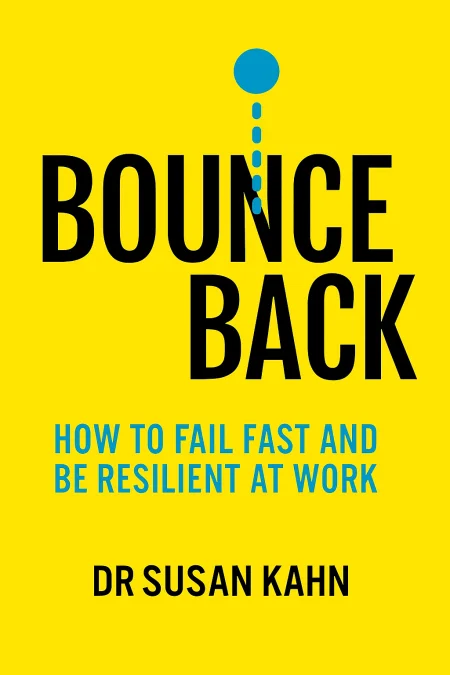
Bounce Back
How to Fail Fast and Be Resilient at Work
Book Edition Details
Summary
In the fast-paced world of business, the ability to rise from setbacks is not just an asset—it's a necessity. Enter "Bounce Back," a transformative guide penned by renowned Business Psychologist Dr. Susan Kahn. With the sharp insight of a seasoned mentor, Kahn dismantles the crippling fear of failure and reveals it as a stepping stone to success. This book is a treasure trove of practical exercises and enlightening case studies, all designed to build your resilience muscle. It challenges you to reframe failure, to see it not as a dead-end, but as a detour toward innovation and personal growth. Journey through the pages to discover how ancient wisdom, modern psychology, and global perspectives converge to empower you with the courage to take risks and the wisdom to learn from them. "Bounce Back" is your invitation to redefine failure and transform it into a powerful catalyst for your career and life.
Introduction
We live in an era of relentless change where traditional career paths have dissolved into uncertainty. Technology reshapes our roles overnight, organizational structures flatten and transform, and the very nature of work continues to evolve at breakneck speed. In this landscape of constant disruption, those who thrive aren't necessarily the smartest or most talented, but rather those who can bounce back from setbacks, adapt to change, and maintain their strength in the face of adversity. The ability to fail fast, learn quickly, and recover with greater wisdom has become the defining characteristic of successful professionals. This isn't about avoiding failure or pretending everything is perfect, but about developing the mental agility and emotional fortitude to navigate whatever challenges come your way. True resilience means transforming obstacles into opportunities and emerging stronger from every setback.
Embrace Failure as Your Greatest Teacher
At its core, resilience begins with reframing our relationship with failure. Rather than viewing setbacks as permanent reflections of our capabilities, we can learn to see them as temporary events that provide valuable data for improvement. The concept of failing fast emerges from the technology sector, where rapid prototyping and quick iterations lead to breakthrough innovations. Consider the story of Dame Inga Beale, who became the first female CEO of Lloyd's of London. She describes a devastating night when the Swiss reinsurance company she was running faced a hostile takeover. The business she had poured her heart into rebuilding was being torn away from her. That evening, she allowed herself to be completely absorbed by the shock, crying through the night as she processed the loss of what felt like her professional child. Yet by morning, she had made a crucial choice about her response. Rather than remaining paralyzed by the setback, Beale demonstrated the power of controlled emotional processing followed by decisive action. She put her face on, walked into the office, and declared to her team that they would fight the takeover. This wasn't denial or suppression of her feelings, but rather a conscious decision to move from grief to action within a compressed timeframe. The key to failing fast lies in creating permission structures that allow for experimentation without permanent consequences. Start by identifying low-risk opportunities to test new approaches in your work. When setbacks occur, implement a rapid review process within 24 hours, asking three questions: What specific factors contributed to this outcome? What assumptions proved incorrect? What will you do differently in the next iteration? This systematic approach transforms failure from a source of shame into a data collection exercise that accelerates learning and builds confidence in your ability to recover from future challenges.
Strengthen Your Mind and Body Foundation
True resilience rests on the understanding that our minds and bodies function as an integrated system. Neuroscience reveals that our brains remain remarkably plastic throughout our lives, capable of forming new neural pathways that support more resilient thinking patterns. This biological foundation gives us tremendous power to reshape our responses to stress and adversity. The key lies in recognizing how our nervous system responds to workplace challenges. Dr. Matthew Walker's research demonstrates that sleep functions as our most powerful reset mechanism, literally clearing toxins from our brain while consolidating memories and emotional experiences. Yet many professionals sacrifice sleep precisely when they need resilience most, creating a destructive cycle where their capacity to handle stress diminishes just as demands increase. Building physical resilience requires surprisingly modest interventions with profound impacts. Regular movement, even brief walks during lunch breaks, stimulates the production of endorphins and neurotransmitters that enhance our emotional regulation. Proper hydration and nutrition provide the biochemical foundation for clear thinking under pressure. Deep breathing exercises activate our parasympathetic nervous system, shifting us from fight-or-flight reactivity to calm, strategic thinking. The practical application involves creating daily resilience rituals that become as automatic as brushing your teeth. Begin each morning with five minutes of deep breathing or light stretching. Protect your sleep schedule as fiercely as you would an important client meeting. Take walking meetings when possible, and notice how movement changes the quality of your thinking. When you feel overwhelmed, place your hand on your heart and take three slow, deep breaths, allowing your exhale to be longer than your inhale. These simple practices create a physiological foundation that supports mental resilience when challenges inevitably arise.
Navigate Change with Stoic Wisdom
Change and loss permeate modern working life, from organizational restructuring to technological disruption to evolving industry standards. The ancient Stoics understood that our suffering comes not from events themselves, but from our resistance to accepting reality as it unfolds. This wisdom provides a practical framework for building resilience in our rapidly changing world. Stoic philosophy teaches us to distinguish between what we can control and what lies beyond our influence. When faced with unwanted change, we can control our preparation, our response, and our attitude, but not the external circumstances themselves. This clarity liberates enormous mental energy that would otherwise be wasted in futile resistance. Consider the practice of negative visualization, where Stoics regularly imagined losing the things they valued most. Rather than creating pessimism, this exercise built appreciation for current circumstances while mentally preparing for potential challenges. A modern professional might imagine their role being eliminated, their key project being cancelled, or their primary client leaving. This isn't catastrophic thinking, but strategic preparation that reduces the shock of actual setbacks. Maya Shankar exemplifies this principle in action. A child prodigy violinist with a clear trajectory toward musical greatness, she devoted everything to her craft under the mentorship of Itzhak Perlman at Juilliard. When an unexpected injury ended her musical career, she faced a complete reimagining of her identity and purpose. Rather than remaining trapped in grief for her lost future, she channeled her analytical abilities toward social science, eventually becoming a White House advisor and the first Behavioral Science Advisor to the United Nations. When facing significant change, implement the CRAB position: acknowledge the Change or disruption, choose your Resilient response, examine your Attitude toward the situation, and decide how you will Behave moving forward. Remember that resilience doesn't mean returning to your previous state unchanged, but emerging with greater wisdom, capability, and self-knowledge. Every change contains the seeds of unexpected opportunities if we approach it with curious openness rather than rigid resistance.
Lead with Purpose and Self-Compassion
Leadership demands exceptional resilience because others look to leaders for stability and direction during turbulent times. Yet leadership also creates unique vulnerabilities, as the transition from peer to authority figure often brings isolation, increased scrutiny, and the weight of decisions that affect multiple lives. Resilient leadership requires both external effectiveness and internal self-compassion. The concept of containment proves crucial here. Effective leaders create psychological safety for their teams by demonstrating that challenges can be faced and overcome without catastrophic consequences. This doesn't mean pretending everything is fine, but rather modeling how to acknowledge difficulties while maintaining forward momentum. Self-compassion emerges as a critical but often overlooked leadership skill. Psychologist Kristin Neff's research reveals that self-compassion provides a more stable foundation for resilience than self-esteem, because it doesn't depend on external validation or comparative performance. When leaders treat themselves with the same kindness they would offer a struggling colleague, they model healthy coping strategies while preserving their own emotional reserves. The practice begins with catching your internal critical voice and consciously choosing a more supportive narrative. Instead of "I should have known better," try "I'm learning from this experience." Rather than "Everyone else would handle this better," consider "This is challenging for anyone in this situation." This isn't positive thinking, but realistic self-talk that acknowledges difficulty without self-attack. Practical self-compassion involves creating boundaries that allow for recovery and growth. Schedule regular one-on-one time with yourself to process challenges and celebrate progress. Seek feedback actively, but distinguish between constructive input and harsh criticism. Build a support network of trusted advisors who can provide perspective during difficult decisions. Remember that perfectionist standards often mask fear of failure, while good-enough standards allow for learning and iteration. By modeling self-compassion, leaders give their teams permission to be human while striving for excellence, creating cultures where resilience flourishes naturally.
Summary
True resilience isn't about avoiding failure or maintaining constant optimism in the face of adversity. It's about developing the capacity to face reality clearly, process setbacks quickly, and emerge from challenges with greater wisdom and strength. As this exploration reveals, "We are more capable than we imagine ourselves to be," possessing inner reserves of strength that can be developed and refined through conscious practice. The path forward requires embracing failure as a teacher, strengthening our physical and mental foundations, accepting change as a constant, and leading ourselves and others with both purpose and compassion. Begin today by identifying one area where you've been avoiding risk due to fear of failure, and take a small, calculated step forward. Your resilience grows not through avoiding challenges, but through engaging with them thoughtfully and learning from whatever outcomes emerge.
Related Books
Download PDF & EPUB
To save this Black List summary for later, download the free PDF and EPUB. You can print it out, or read offline at your convenience.
By Dr Susan Kahn
